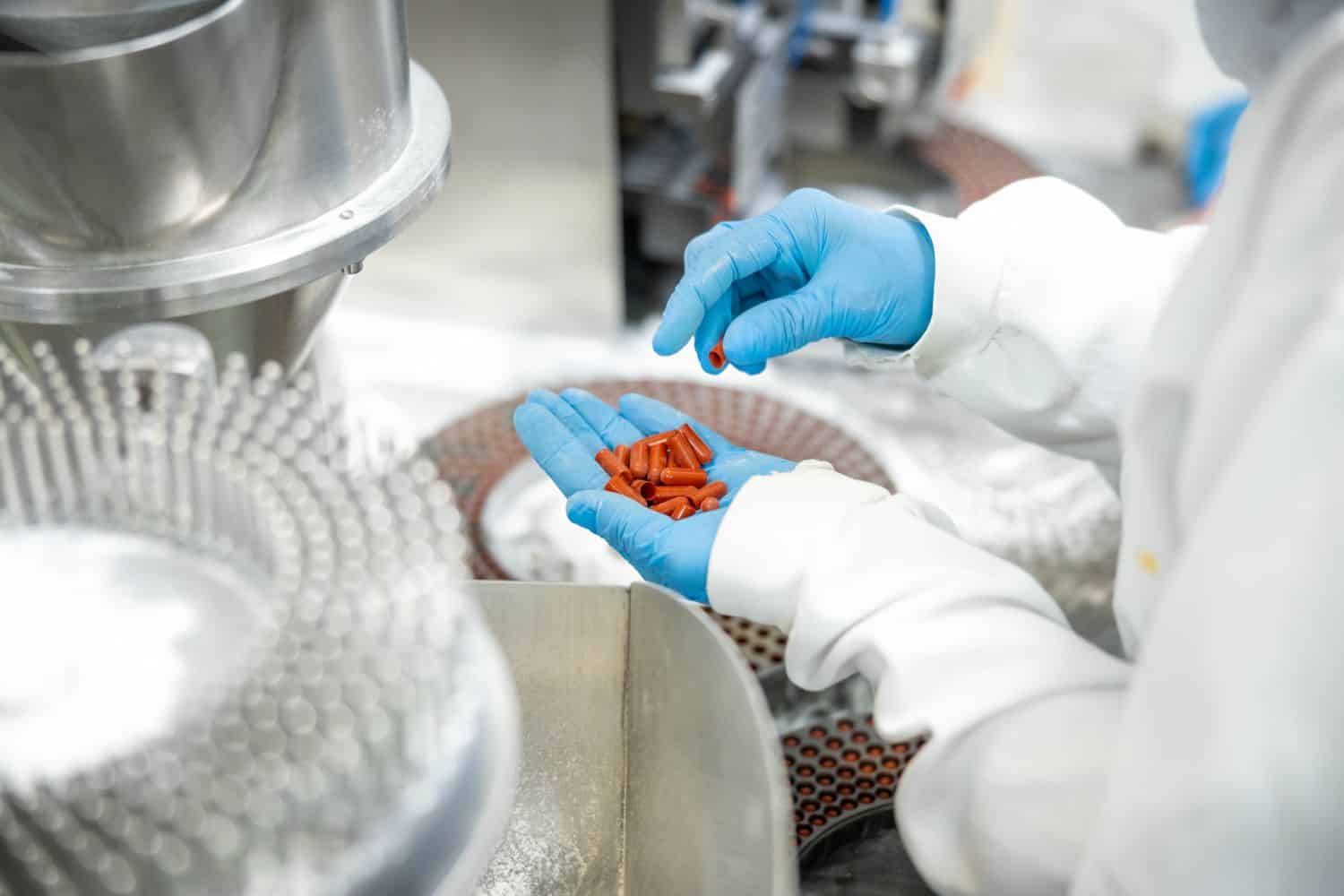
A close view of red capsules held for inspection before production, focusing on the emphasis of health safety in pharmaceuticals.
South Africa runs the world’s largest antiretroviral (ARV) treatment programme, with about eight million people on ARVs and a R15.5 billion tender to keep them medicated.
A cornerstone of that tender is a requirement that at least 70% of ARVs be procured from local manufacturers, a threshold the Department of Health has repeatedly cited as evidence of its commitment to domestic industry and supply security.
However, a parliamentary briefing on Wednesday exposed a troubling gap between that claim and reality.
Chief director for health products procurement, Khadija Jamaloodien, acknowledged that the department would now begin requesting batch manufacturing certificates to confirm local production claims.
What ‘local’ actually means, and what it doesn’t
Jamaloodien drew a distinction between local manufacturing and local ownership, explaining that the department’s definition aligned with the Public Procurement Act.
She added that it focuses on where formulation, tabletting, and labelling physically occur.
“Local manufacturing is about local content and production and is unrelated to ownership,” she told the committee.
She used Cipla as an example: an Indian-owned company with a South African manufacturing site that employs approximately 500 people.
Under the department’s framework, Cipla counts as a local manufacturer.
But the chairperson of the committee, Azwihangwisi Faith Muthambi, pressed her on whether that definition was being applied rigorously or conveniently.
Import records for several companies listed as local, including Innovata, Barrs, Aurobindo and Viatris, suggested products were entering South Africa from Indian manufacturing facilities rather than being produced domestically.
In the case of Barrs, Muthambi noted, the company had not yet completed its technology transfer to manufacture TLD locally at all. “How can they then be producing in South Africa?” she asked.
ALSO READ: Is Barrs’ medication safe? Company faced regulatory scrutiny before ARV tender
Jamaloodien responded that most manufacturers hold dual registration certificates listing sites in both South Africa and India, and that the department relies on supplier declarations in bid response documents.
“They tell us in their bid response documents that they will be manufacturing locally,” she said.
The committee was not convinced that declarations alone were sufficient, especially given the scale of the procurement involved.
Nobody checked, and the department knew it
Deputy director general for the National Health Insurance (NHI) Professor Nicholas Crisp confirmed that not a single South African company, including those classified as local manufacturers, produces active pharmaceutical ingredients, the core chemical compounds from which all medicines are made.
“APIs are not made in South Africa. So even the companies [that] say they are local manufacturers, they are importing the APIs,” he said. “But what they are doing is they are manufacturing the tablets, the capsules, the injections, and whatever, using that API.”
This means that, at best, what the department defines as local manufacturing is, in many cases, final-stage formulation and packaging using imported raw materials.
At worst, some companies may be importing completed or near-completed products and performing only minimal local processing or none at all while still qualifying for the preference points and contract allocations reserved for local producers.
“It is not a straightforward matter of just manufacturing the medicines,” Crisp said.
He added that an interdepartmental committee involving Health, Treasury, the Department of Trade, Industry and Competition, and the Department of Science and Technology has been working to map the local manufacturing landscape and identify where genuine domestic capacity exists.
The problem, as the committee made clear, is that this work is happening after the R15.5 billion tender has already been awarded.
Covid lesson that wasn’t learned
Jamaloodien highlighted that during Covid-19, local manufacturers were left unable to supply because they could not source APIs.
She noted that it was Indian manufacturers, manufacturing entirely offshore, who kept South Africa’s ARV supply stable during that period.
“If we had relied solely on local manufacturers during Covid-19, we would have been in very deep waters because they were not able to supply for a long period of time,” she said.
The argument, while reasonable, also undermines the department’s own 70% local procurement headline figure.
The committee heard that if local manufacturers are dependent on Indian API supply chains and can be knocked out by the same global disruptions that would affect offshore suppliers, the risk diversification benefit of procuring locally is considerably narrower than presented.
Health Minister Dr Aaron Motsoaledi acknowledged the bind directly, explaining that the pricing gap between local and imported ARVs has always been the central constraint.
He noted that in 2010, when government launched what he described as the world’s biggest HIV counselling, testing and treatment campaign, buying ARVs exclusively from local suppliers would have required an additional R15 billion over five years, money the then finance minister Pravin Gordhan confirmed was simply not available.
“In health, we always choose life,” Motsoaledi said. “That’s what has always been our guardian angel. And when we chose life, we realised that we have got to buy generics elsewhere, which will make as many people as possible live.”
ALSO READ: Health dept denies ARV shortage despite tendered companies entering business rescue days later
The 70% figure under scrutiny
Muthambi conducted a detailed breakdown of the eight companies awarded contracts for the 28-pack TLD formulation, which is the single largest line item in the tender, accounting for roughly R12 billion of the total R15.5 billion and covering over 5.4 million patients.
Her analysis suggested the 70% local threshold may be more aspirational than a verified fact.
She identified Emcure as an importer that has collaborated with Barrs, which is now in business rescue and has not yet completed its local technology transfer.
She noted that Viatris, listed as a local manufacturer, collaborated with Innovata, also in business rescue.
Together, these four entities, relying on just two actual supply sources, held more than 51% of the 28-pack TLD tender allocation.
Furthermore, Muthambi flagged Aurobindo, which imported $46 million worth of ARVs under the previous tender but remains listed as local.
“The department also lists Innovata, Barrs, Aurobindo and Viatris as local and not importers. But if you check the information on the India customs data, it indicates that Innovata are importing ARVs into South Africa,” she stated.
She called on the department to provide manufacturing documentation to substantiate its local procurement claims, and to explain how it arrived at the 70% figure in light of the import data.
Jamaloodien did not directly rebut the customs figures but maintained that the department’s definition of local manufacturing is applied consistently and is aligned with the Public Procurement Act.
READ NEXT: Gauteng health rejects claims of underspending
About the Author