Generated by pixel @ 2026-02-20T00:59:22.391421
By now, it’s a well-known fact that Chery is planning on selling a bakkie in South Africa sooner rather than later. Yet the question remains, which one?
The Chinese carmaker revealed its first bakkie at the Shanghai Auto Show last April. Called the Himla and internally known as the KP11. The Citizen Motoring got to sample the unibody bakkie around a test track in Wuhu a few days after its unveiling.
Chery, however, said at the time that the KP11 was not for export markets. The KP31, which was still under development at the time, was the more likely Chery bakkie to make its way to South Africa.
However, in October, it seemed as though Chery had made a U-turn, saying that the KP11 could still be on the table for Mzansi as it mooted a “two-tier” bakkie approach.
ALSO READ: Chery bakkie might be key to Nissan plant takeover
Chery bakkie makes debut
Chery introduced the Himla to the Chinese market later in 2025 under its Rely sub-brand. The Rely R08 is a rebadged version of the Himla, which is powered by a 2.3 litre turbodiesel engine mated to an eight-speed automatic gearbox. It produces 120kW of power and 420Nm of torque.
As far as the KP31 goes, Chery invited the South African media contingent in Wuhu last April to an information session at the brand’s headquarters. KP31 designers showed rough designs of the bakkie along with five possible powertrain configurations.
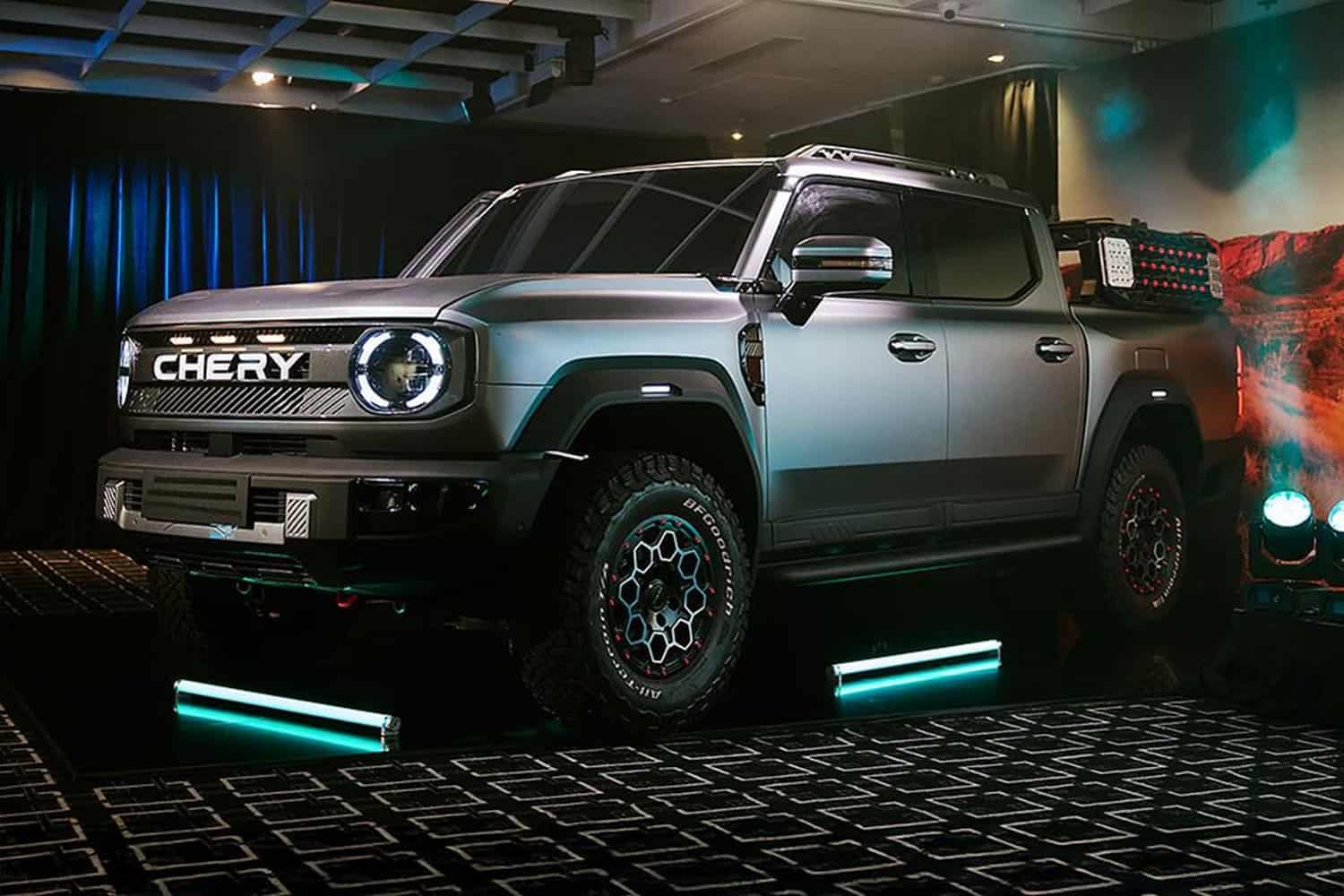
Last week in Australia, a key market for the Chery bakkie, the KP31 made its debut in concept form. Unlike the KP11, it is a body-on-frame design like traditional bakkies. While still in concept form, it matched the retro boxy design seen by us in Wuhu.
It now seems very likely that the KP31 might be on display at the Beijing Auto Show in April, which we’ll be attending as guests of Chery.
ALSO READ: Yet another Chery ‘bakkie’ shows its face in concept form in China
Five powertrains mooted
The five powertrains on the table include two internal combustion engines: a 2.5 litre turbodiesel, which produces 140kW/450Nm, and a 170kW/378Nm 2.0 litre turbopetrol.
The third is a mild-hybrid which adds electrical assistance to a 2.5 litre oil burner. It produces 200kW/600Nm.
Then there are two plug-in hybrids. A 2.5 litre turbodiesel hooked up to a battery and electric motor that produces 260kW/680Nm, and the 2.0 litre turbopetrol with an electrical system producing 300kW/620Nm.
As the KP11 is already in production and the KP31 is only expected to go into production later this year, there is a chance that Chery could start rolling out the KP11 bakkie locally during the course of the year and the KP31 either late in 2026 or early 2027.
About the Author