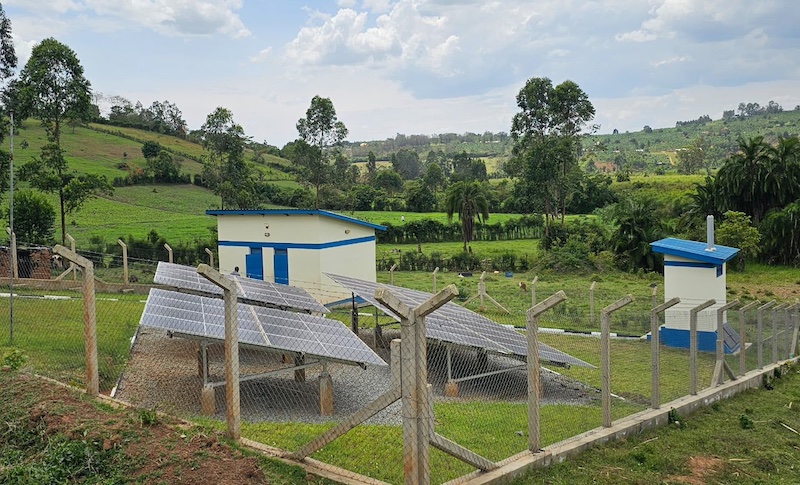
Nexus Green Limited, a UK-based renewable energy company, is on track to deliver 450 solar-powered water and irrigation systems across Uganda by the end of 2025.
The project, born from a presidential directive and backed by a €111 million partnership between the UK and Uganda, aims to bring clean water to over 2.5 million people and revolutionize agriculture for thousands of farming families.
The project directly supports the Ugandan government’s national goals of enhancing food security, empowering rural communities, and building climate-resonance. It is owned by the ministry of Water and Environment and financed by the ministry of Finance, Planning and Economic Development, with funding secured from UK Export Finance (UKEF).
FARMING REVOLUTION?
The core of the initiative is its empowerment of farmers. By enabling modern irrigation across more than 4,500 acres, the project is shifting agricultural practices from rain- dependent subsistence to year-round production.
“This project increases Uganda’s agricultural productive seasons from two to four per year,” said Dr Alfred Okot Okidi, the permanent secretary of the ministry of Water and Environment.
“Farmers gain agronomy training, access to market linkages, and support to grow high-value crops—including coffee, passion fruit and tomatoes. This will significantly boost household incomes and generate export revenue.”
The economic impact is projected to be substantial, with an estimated Shs 3.9 trillion ($1.06 billion) generated annually from direct crop sales. Beyond the fields, the project is a major public health intervention.
The installation of solar-powered domestic water systems is drastically reducing the distance women and children walk for water—from up to 10 kilometers to less than 500 meters. This improved access to clean water is also expected to reduce water-borne diseases by more than 30%.
To date, significant progress has been made, with over 250 solar irrigation systems and 150 solar-powered domestic water systems already completed. These systems are already serving communities, ranging from rural villages of 1,000-5,000 people to small urban centres of 7,000-15,000 people. Rikki Verma, Group CEO of Nexus Green, emphasized the project’s broader vision.
“This project is more than irrigation. It is about dignity, prosperity, and cleaner energy for Uganda,” Verma stated.
“Farmers are doubling their growing seasons and increasing their yields, all while reducing carbon emissions. Uganda is becoming a global example of how solar energy can be used for agricultural transformation, health improvement, and economic growth.”
About the Author