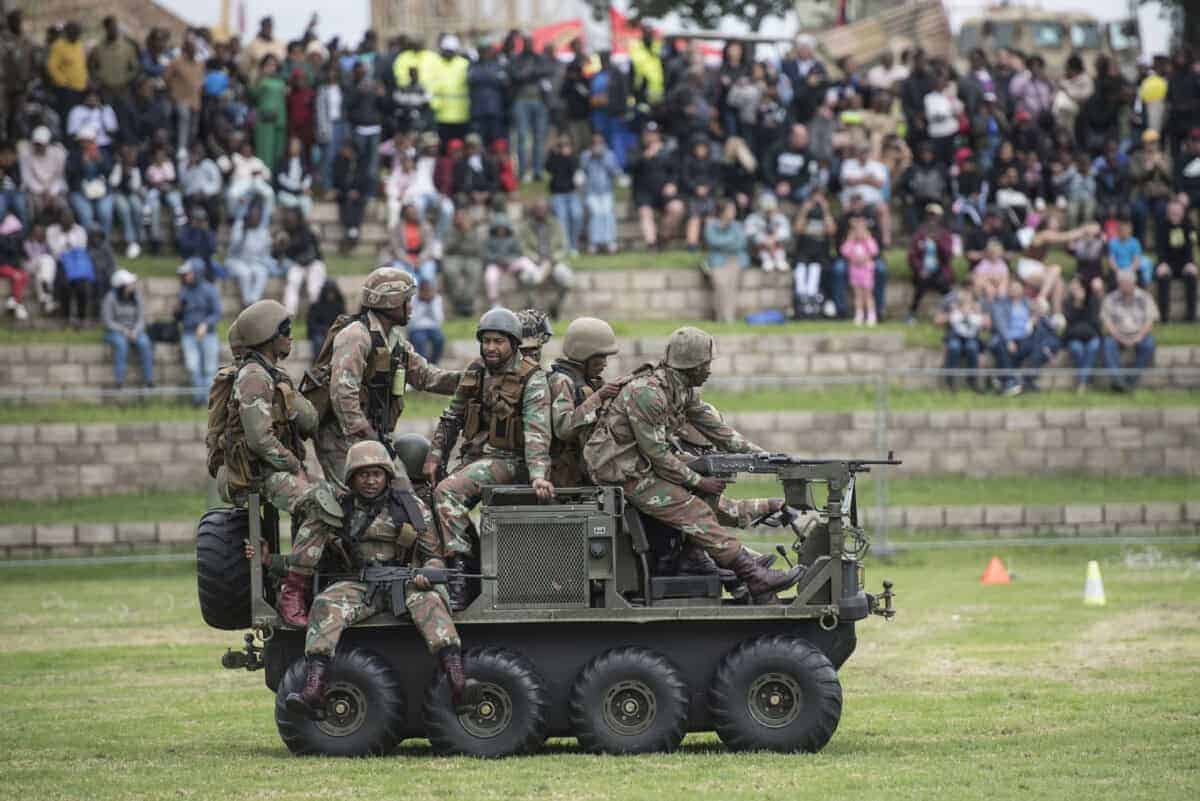
Members of the South African National Defence Force (SANDF) take part in a capability demonstration, 19 April 2025, at the Rand Show, at the Johannesburg Expo Centre in Nasrec. The display featured a combat simulation and static displays of military assets. Picture: Michel Bega/The Citizen
President Cyril Ramaphosa’s announcement in his State of the Nation Address last week that the South African National Defence Force (SANDF) would be deployed to tackle gang violence in the Western Cape and illegal mining syndicates in Gauteng was welcomed.
Communities battered by shootings, extortion and abandoned mine shafts have long demanded decisive action.
Yet the shadow of the Covid lockdown lingers. In 2020, soldiers enforcing restrictions often turned their combat training on civilians, leaving behind bruises, humiliation and even deaths.
That memory raises a haunting question: will this deployment restore order, or repeat the army’s mindset – which was eerily expressed by a general at the time – of skop, skiet en donner (kick, shoot and beat up)?
The deployment itself is an admission of failure. Armies are not designed to fight crime.
ALSO READ: Senior SANDF member in the dock for R1.5m bribe attempt
That is the job of police. When soldiers patrol streets, it signals that policing has collapsed, been overwhelmed, or lost legitimacy.
Gang violence in the Western Cape has festered for decades. Illegal mining in Gauteng has evolved into a parallel criminal economy, complete with heavily armed syndicates.
These are not new crises. They are symptoms of long-term state neglect, weak policing, corruption and socioeconomic inequality.
Deploying the military may temporarily suppress violence. Soldiers may bring discipline, firepower and intimidation. But intimidation is not the same as stability. It can silence violence without resolving it.
There is an uncomfortable truth politicians rarely admit: crime is not simply a security problem, but a structural one. Gang members emerge from communities affected by unemployment, poverty, broken education systems and limited opportunities.
ALSO READ: Will Ramaphosa’s decision degrade soldier morale? Professor explains why it could
Illegal miners, known as zama zamas, are not just criminals. Many are economic refugees from collapsed industries and failed job markets, willing to risk death underground because legal survival above ground is impossible.
Soldiers can arrest, disperse and intimidate. But they cannot create jobs. They also cannot rebuild broken communities or fix a failed economy.
Democracies draw a line between police and military for a reason. Police are trained to use minimum force, preserve rights and operate within civilian legal frameworks. Soldiers are trained to neutralise threats.
Blurring this line risks eroding civil liberties. It risks creating a culture where state force becomes the first solution, rather than the last resort. And it risks damaging the legitimacy of the military itself if deployments become the norm.
The SANDF’s reputation suffered during lockdown. Another controversial deployment could deepen public mistrust.
ALSO READ: Lesufi welcomes deployment of soldiers to tackle illegal mining in Gauteng
In the short term, military presence may disrupt gang operations, destabilise zama zamas and restore a sense of order.
But history suggests these gains are temporary if not backed with solutions to address root causes such as unemployment, inequality and institutional failure. Once soldiers withdraw, crime frequently resurges – sometimes more organised and more violent.
Ramaphosa’s decision reflects political pressure and public frustration. Citizens want safety and they rightfully deserve it. But true leadership requires more than deploying soldiers.
It requires fixing policing and prosecutions, if the allegations of corruption at the Madlanga commission are anything to go by. It also requires investing in economic opportunities, confronting inequality, not just containing its consequences.
If the SANDF is deployed under police command, with clear rules of engagement and strict accountability – the intervention could avoid past abuses.
ALSO READ: Ramaphosa deploys army against crime
Civilian oversight, parliamentary scrutiny, and community liaison structures must be built into the operation. Without these safeguards, the deployment risks becoming another chapter of skop, skiet en donner.
But if government learns from past failures, limits military scope and pairs force with social investment, this intervention could mark a turning point.
If not, SA risks trading one crisis for another, with boots on the ground and no lasting peace.