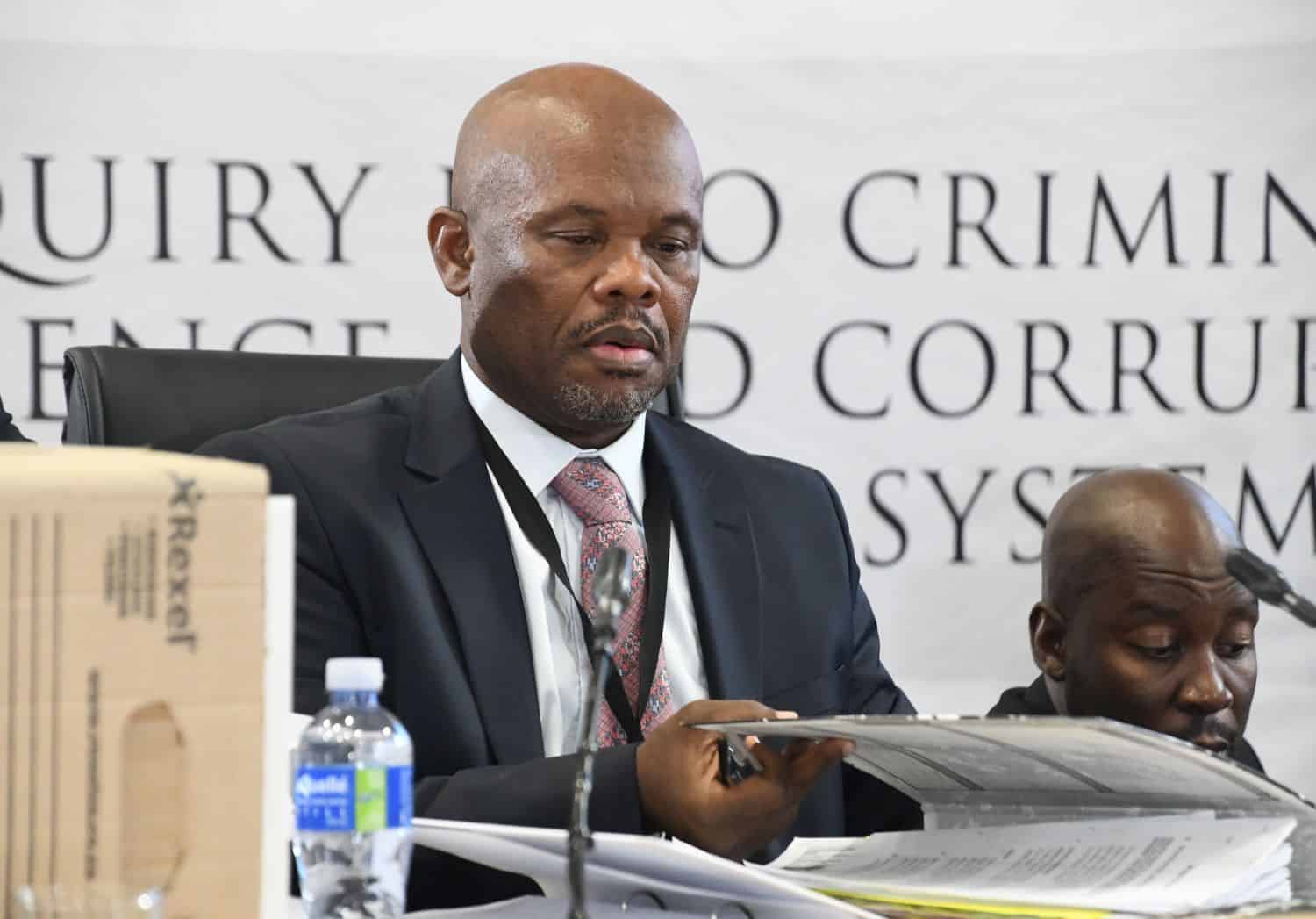
Suspended deputy national police commissioner Shadrack Sibiya has dismissed national police commissioner Fannie Masemola’s testimony at the Madlanga commission that he did not see the disbandment of the political killings task team (PKTT) coming.
Sibiya took the hot seat on Wednesday to answer several allegations against him, including receiving money from tenderpreneur Vusimuzi ‘Cat’ Matlala and the disbandment of the PKTT.
Masemola suspended Sibiya on 12 September 2025 on five charges of serious misconduct, all related to suspended Senzo Mchunu’s 31 December 2024 directive to disband the PKTT.
Among other things, he is accused of failing to comply with Masemola’s instruction to leave matters of the PKTT disbandment to the commissioner. Instead, Sibiya allegedly sent an instruction to Crime Intelligence head Dumisani Khumalo concerning the deactivation and disbandment of the PKTT.
ALSO READ: ‘Don’t make me feel guilty, I’m not guilty,’ Mchunu tells parliament
He allegedly further instructed that all case dockets, personnel and other resources of the PKTT be withdrawn with immediate effect, without the approval of the national commissioner.
However, Sibiya disputed all the charges against him and further defended Mchunu’s directive to disband the PKTT, saying it had long been coming.
PKTT ‘work study’
Sibiya used the same work-study that Mchunu used at the commission to explain the rationale for disbanding the PKTT. However, after cross-examination, Mchunu conceded that the work study did not speak of disbandment, but a review.
Sibiya further used certain clauses in the work study that referred to units rather than task teams.
“The provincial investigation units (PIUs) in the provinces that have been established be closed, and members currently placed at established PIUs will be subjected to a skills determination evaluation in order to be placed at murder and robbery, organised or commercial crime investigation units or cold case investigation units according to their skillset,” reads the two clauses.
He said these were clear on disbanding the PKTT.
ALSO READ: Masemola withheld information regarding PKTT disbandment, Mchunu tells parliament
However, the commissioners challenged his argument, saying Mchunu had previously made a distinction between units and task teams.
Sibiya agreed on the distinction, saying the author of the work study report may have used the two interchangeably.
This view was again challenged when commission chair Mbuyiseli Madlanga pointed out that the author of the report had made a clear distinction between the two, citing earlier clauses on task teams.
Meetings
Sibiya further raised the November 2024 meetings held by Mchunu and the generals. He said the disbandment of the PKTT was discussed in a meeting held on 1 November.
He said in that meeting, Masemola agreed with Mchunu that the PKTT was not meant to exist forever.
“The assertion of the national commissioner that the decision to disband the PKTT came as a surprise is difficult to reconcile with the events preceding the directive. He [Masemola] said the task team was meant to evolve into a unit at a later stage. He could not have been surprised because he participated in those meetings,” said Sibiya.
“I was not surprised by the directive. I didn’t expect that he would disband in December, or that it would happen; what I knew was that it was a subject of discussion.”
Minutes from the meeting
The general further raised the minutes from the said meeting, which he said proved the disbandment of the PKTT. However, Sibiya’s own statement, when read out, said Mchunu directed the generals to “reconsider” and “review” certain operational capabilities, specifically including PKTT, rather than to disband it.
In October, Mchunu told parliament’s ad hoc committee that he had not met with KwaZulu-Natal police commissioner Nhlanhla Mkhwanazi, Masemola and Khumalo, specifically to discuss the disbandment of the PKTT.
ALSO READ: Masemola says Mchunu’s anger over ‘police doing a good job’ was ‘quite strange’
“I did not have any particular meeting with Khumalo, Masemola and Mkhwanazi focusing on the PKTT. There is no such thing, but discussions about all these terms of reference did take place in the meetings that we had on 1 and 22 November 2024,” said Mchunu at the time.
“It’s not like I never had any discussions with anyone on the matters. There are challenges that are within Saps that we have been discussing in the top management of Saps, but not with a view to writing directives. Those are mine, and those I sat down to think about, and I came up with them.”
Pattern of communication
On the charges against him of acting without Masemola’s consent, Sibiya said he and the national commissioner had always communicated through Brigadier Lethoko. The directives for him to implement the disbandment of the PKTT came through that chain of command; hence, his innocence in the matter, he claimed.
“On 3 January 2025, Brigadier Lethoko communicated Minister Mchunu’s decision to myself and other officials. This communication directed me, ‘the DNC for Crime Detection’ to communicate the deactivation of the PKTT to the relevant teams, implement the deactivation of the PKTT and to further submit a close-out report by 14 January 2025 for the national commissioner’s consideration and sign-off,” he explained.
“I ordinarily receive regular communications from Brigadier Lethoko. In the execution of his functions, Brigadier Lethoko regularly conveys and copies communications and instructions on behalf of and emanating from the national commissioner.
“This pattern of communication forms part of the established chain of command. Accordingly, I have always acted on the basis of official instructions transmitted through these channels and at no stage have I acted outside or contrary to the directives communicated to me in this manner.”
NOW READ: Madlanga commission: Did Masemola’s testimony sink Mchunu?