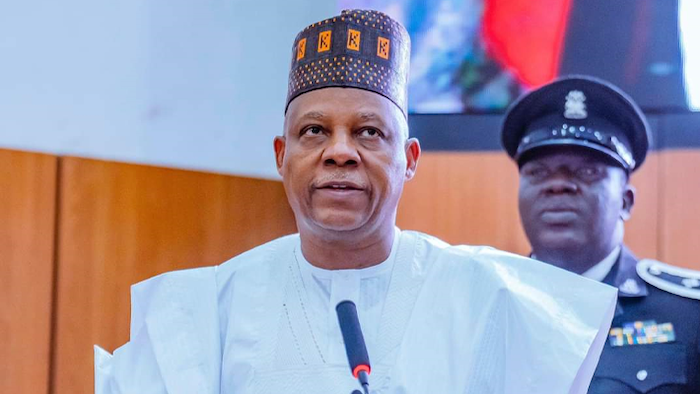
Vice President Kashim Shettima has reaffirmed Nigeria’s commitment to promoting and protecting human rights through constitutional guarantees and the integration of such rights into security operations.
He said the country remains fully committed to international cooperation and the universal application of International Humanitarian Law (IHL) in all conflict situations.
Shettima made the remarks on Thursday in Abuja while declaring open the 2026 High-Level International Humanitarian Law Dialogue.
He noted that the administration of President Bola Tinubu has adopted a comprehensive approach to addressing insecurity and conflicts, combining both kinetic and non-kinetic strategies.
“I wish to emphasise Nigeria’s unwavering determination to promote and protect human rights while ensuring the effective implementation of International Humanitarian Law treaties.
“Insecurity remains the greatest threat to peace and development, and our government accords the highest priority to a comprehensive response that combines both kinetic and non-kinetic measures,” he said.
The Vice President disclosed that the government has continued to evolve legal frameworks to respond to emerging security challenges.
He cited the recent domestication of the African Union Kampala Convention, which provides a legal framework for the protection and assistance of internally displaced persons in Nigeria.
Shettima observed that Nigeria continues to grapple with insurgency, terrorism and other forms of violent conflict, noting that these challenges have far-reaching social and institutional impacts.
He stressed that International Humanitarian Law is anchored on key principles, including the protection of civilians, humane treatment of persons affected by conflict and the preservation of human dignity.
According to him, Nigeria has adopted a proactive approach to implementing IHL through sustained military training, strengthened child protection systems, improved arms control mechanisms and accountability frameworks for sexual violence.
“These efforts reflect a simple truth: humanitarian law must be lived, not merely legislated,” he added.
Shettima commended development partners, including the United Nations, the International Committee of the Red Cross and the Office of the Prosecutor of the International Criminal Court, for their support in strengthening Nigeria’s compliance with international humanitarian standards.
Earlier, the Attorney General of the Federation and Minister of Justice, Chief Lateef Fagbemi (SAN), highlighted ongoing efforts to domesticate humanitarian law treaties and reform the justice system.
He noted that new laws and investments in correctional facilities are aimed at ensuring humane treatment and adherence to global standards.
Also speaking, the Solicitor General of the Federation and Permanent Secretary, Ministry of Justice, Mrs Beatrice Jeddy-Agba, said the dialogue provides an opportunity to reinforce the rule of law within Nigeria’s security framework.
She reaffirmed Nigeria’s commitment to the Geneva Convention and stressed the need for stronger compliance with international humanitarian standards.
Deji Elumoye in Abuja
About the Author