Shettima Pledges Nigeria’s Commitment to AU Peace, Security and Economic Priorities
Nigeria has expressed strong support for proposed reforms within the African Union (AU), emphasizing the need for stronger peace and security governance, democratic institutions, and sustainable development financing across the continent. Vice President, Kashim Shettima, presented the country’s position during a closed session of the 39th Ordinary Session of the Assembly of Heads of State …
Nigeria has expressed strong support for proposed reforms within the African Union (AU), emphasizing the need for stronger peace and security governance, democratic institutions, and sustainable development financing across the continent.
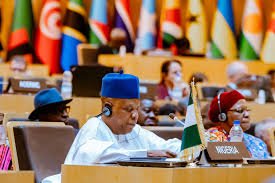
Vice President, Kashim Shettima, presented the country’s position during a closed session of the 39th Ordinary Session of the Assembly of Heads of State and Government in Addis Ababa. He highlighted Nigeria’s backing for initiatives aimed at enhancing cooperation with international financial institutions, the private sector, and regional mechanisms to mobilize resources for inclusive development.
Shettima also underscored Nigeria’s endorsement of a continental framework focused on reducing inequality through social protection, job creation, credible data collection, and industrial policies.
On security matters, he praised the AU Peace and Security Council for supporting the Combined Maritime Task Force in the Gulf of Guinea as a regional standby force to coordinate maritime security efforts. He reaffirmed Nigeria’s commitment to hosting the force and providing necessary infrastructure, including office facilities, ships, helicopters, and temporary personnel.
“The proliferation of small arms and light weapons remains one of the leading causes of armed conflict and violent extremism in our region,” Shettima said. “Our union must intensify efforts to curb these trends, and Nigeria will continue to play its part in strengthening the African Union Standby Force”.
The vice president also expressed support for proposed changes to the Peace and Security Council, including clearer criteria for membership and enhanced coordination with regional economic communities and mechanisms to ensure effective governance.
Shettima highlighted the importance of collaboration between the AU, its Peace and Security Council, and the C-10 committee on UN Security Council reform, particularly at the ambassadorial level, to improve predictability and operational efficiency.
He announced Nigeria’s endorsement of the AU decision to lift the suspension of Gabon and Guinea following the completion of their political transitions, encouraging other countries in protracted transitions to follow a similar path.
On economic and development matters, Shettima reiterated Nigeria’s view that Africa’s mineral resources are strategic assets that should drive industrialization, local processing, manufacturing, and technology development. He advocated for regular briefings by African mining ministers to promote transparency, accountability, and coordinated continental strategies for resource management.
Overall, Nigeria’s position reflects a commitment to advancing peace, security, and sustainable development within the African Union while strengthening the continent’s institutional capacity.
About the Author