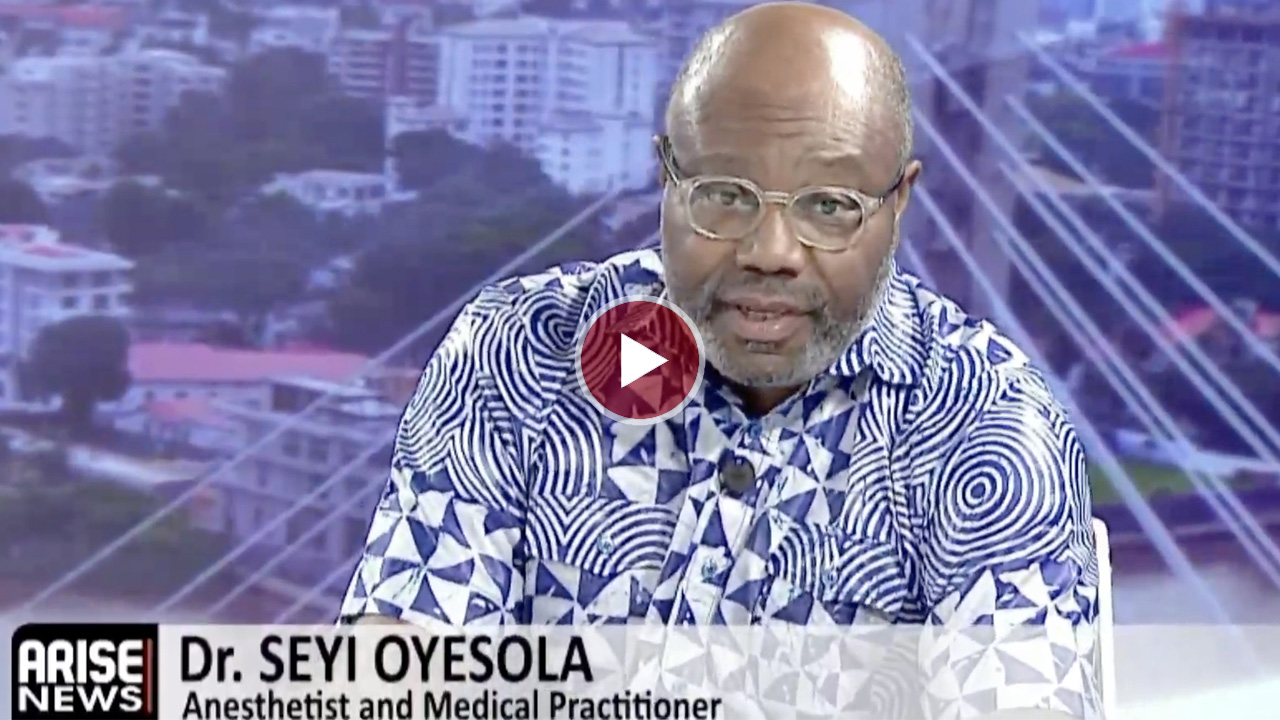
Renowned anesthetist and medical practitioner Dr Seyi Oyesola has said modern anesthesia is now significantly safer, with risks far lower than many everyday dangers people accept without hesitation.
Speaking on ARISE News on Thursday, Dr Oyesola stressed that advances in monitoring, training and critical care have transformed anesthesia outcomes, both globally and in Nigeria.
He emphasised how low the risk has become in modern practice.
“The risk has become so low that we know for a fact that if you go into surgery now, you are more likely to die crossing the road than having an anesthetic.”
He explained that public understanding of anesthesia remains limited, often reduced to the idea of “putting people to sleep”.
“If you ask the general person who knows a little bit about it, they will tell you, oh yes, of course, they put people to sleep, which is true. But the truth of the matter is that if it was just sleep, then when the surgeon comes with his knife, you wake up.”
Dr Oyesola said anesthesia also involves pain control and preventing involuntary movement to ensure surgical precision and safety.
“So there’s an element of pain relief that is involved. In order for you not to move and the accuracy of surgery can take place safely, it is also important that you are stopped from having reflex movements.”
He highlighted the central role of anesthesia and critical care in modern medicine, noting that many successful outcomes, including complex surgeries, depend on them.
“A lot of the successes that medicine has to be proud of these days, a lot of the positive outcomes that people record from going abroad, is because anesthesia and practical care have served as a fantastic basket to rescue people who are sick.”
Using open heart surgery as an example, Dr Oyesola said such procedures cannot proceed safely without proper critical care support.
“You cannot do that, you can’t even take such a person to the theatre without having a critical care unit ready and waiting.”
Addressing fears around anesthesia, he acknowledged that all medical procedures carry risks but stressed that informed consent is key.
“Every medical procedure, whether it be anesthesia, somebody removing your toenail, or just a circumcision, every medical procedure is risky.”
He added that patients must be clearly informed of possible outcomes, including rare but serious complications.
“I have to tell you at least the common complications, which may include death.”
However, Dr Oyesola said anesthesia risks have fallen dramatically over time, pointing to changes in malpractice insurance premiums as evidence.
“When I was still training on a junior doctor, the malpractice insurance premium anesthesiologists used to pay was one of the highest.”
“By the time I qualified and I started to learn anesthesia and critical care, we discovered that we have the lowest insurance premium.”
Dr Oyesola attributed this improvement largely to strict monitoring standards.
“There are five basic monitors that you need to use on every patient. They are their heart rate, their ECG, their oxygenation, their blood pressure, and so on.”
He also noted that anesthesia practice in Nigeria is governed by clear professional guidelines and legal documentation requirements.
“It’s a legal requirement. It’s called an anesthesia record chart that starts before the anesthesia is actually administered.”
According to him, every patient is entitled to this record after a procedure, reinforcing accountability and safety in anesthesia care.
Faridah Abdulkadiri
About the Author