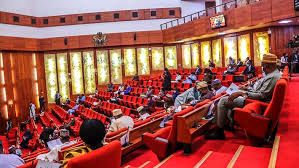
The Nigerian Senate has begun deliberations on a bill to amend the Banks and Other Financial Institutions Act (BOFIA) 2020, granting the Central Bank of Nigeria (CBN) enhanced powers to designate and supervise non-bank financial institutions.
The move aims to bring mobile money operators, digital lenders, payment service banks, wallet providers, and fintech switching companies—whose operations now constitute critical national infrastructure—under top-tier regulatory oversight.
Chairman of the Senate Committee on Banking, Insurance, and Other Financial Institutions and sponsor of the bill, Tokunbo Abiru, said the amendment is urgently needed due to the rapid growth of Nigeria’s financial ecosystem.
He emphasized that these fintech entities now serve tens of millions of Nigerians, process massive daily transaction volumes, and hold sensitive financial data, yet operate under a regulatory framework that does not reflect their systemic importance.
“The reality today is that a non-bank institution, because of its market dominance, data concentration, customer reach, or technological capacity, may pose risks equal to or even greater than those posed by a traditional bank,” Abiru said. “Without modernizing BOFIA, we risk exposing the country to data insecurity, foreign control of critical infrastructure, and threats to national security.”
Abiru highlighted that many fintech operators rely on foreign-owned networks or offshore servers, raising questions about data storage and access beyond Nigeria’s regulatory reach.
He cited the temporary CBN restriction on fintech onboarding in April 2024, prompted by concerns over KYC compliance, money laundering, and suspicious transactions, as evidence of the need for stronger oversight.
The proposed amendment sets out five key objectives: creating a statutory framework for designating systemically important institutions, establishing a national registry of fintechs, empowering the CBN to impose enhanced supervisory measures, strengthening data sovereignty, and improving consumer protection.
Abiru rejected calls for a separate fintech regulator, stressing that duplicative oversight could fragment regulation and weaken systemic-risk management.
Former NLC President Adams Oshiomhole shared personal experience highlighting fintech vulnerabilities, describing how his bank accounts were hacked through a digital platform.
He stressed that many fintechs have opaque ownership structures, making accountability difficult. “Proper regulation through enabling legislation will ensure these institutions operate in the interest of Nigerians,” he said.
Senator Natasha Akpoti-Uduaghan of Kogi Central called for addressing income disparities among Nigerians earning through global digital platforms, citing the stark difference between payments to local content creators and their U.S. counterparts. She urged engagement with global technology firms to protect Nigeria’s digital workforce.
After a robust debate, Deputy Senate President Barau Jibril referred the bill back to the Banking Committee for further legislative review following its second reading.
About the Author