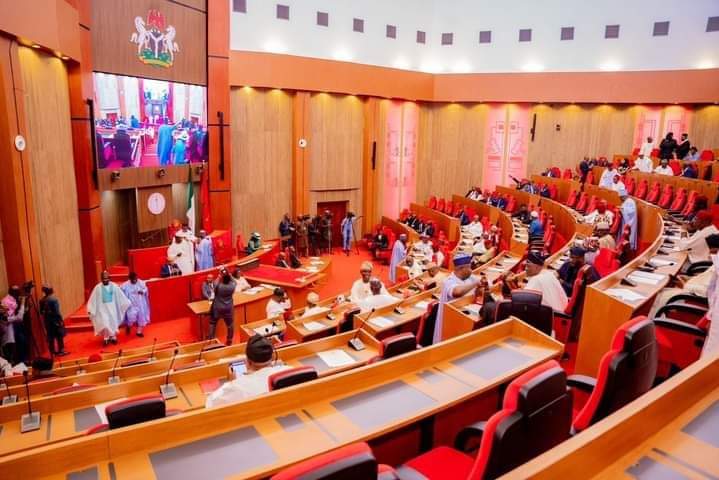
The Senate on Tuesday approved some far-reaching recommendations of its Committee on Finance on the 2026–2028 Medium-Term Expenditure Framework (MTEF) and Fiscal Strategy Paper (FSP), backing a lower and more realistic crude oil benchmark of $60.
The Upper Chamber also endorsed a N54.46 trillion federal spending plan for 2026 aimed at stabilising Nigeria’s economy amid global uncertainties.
In the same vein, Brent crude, Nigeria’s oil benchmark, fell over 2.56 per cent to below $60 per barrel on Tuesday, its lowest level since May 2025, due to rising hopes for a potential peace deal in the Russia-Ukraine conflict.
Specifically, Brent crude futures fell to $59.01 a barrel, while US West Texas Intermediate (WTI) crude was trading at $55.36, down 2.57 per cent, lowest since February 2021.
This came as the Governor of the Central Bank of Nigeria (CBN), Mr. OlayemiCardoso, on Tuesday reaffirmed the country’s commitment to rules-based economic management, transparent markets, and predictable policy frameworks, amid the heightened global economic uncertainty.
Also on Tuesday day, the CBN announced the revocation of operating licences of AsoSavings and Loans Plc and that of Union Homes Savings and Loans Plc for violation of various Sections of the Banks and Other Financial Institutions Act (BOFIA) 2020 and the Revised Guidelines for Mortgage Banks in Nigeria.
The approval of the MTEF/FSP, followed the presentation of the committee’s report by its Chairman, Senator Sani Musa, at plenary presided over by Senate President Godswill Akpabio.
Lawmakers said the adopted parameters were designed to promote macroeconomic stability, strengthen fiscal discipline and support the federal government’s ongoing economic reforms.
A key decision was the downward review of the crude oil benchmark price for 2026 from $64.85 per barrel to $60.
The Senate, however, approved benchmark prices of $65 and $70 per barrel for 2027 and 2028, respectively.
The committee explained that the conservative adjustment for 2026 was necessitated by heightened geopolitical tensions in Europe and the Middle East, as well as persistent volatility in the global oil market.
Despite the cautious oil price outlook, the Senate sustained crude oil production projections of 1.84 million barrels per day (mbpd) for 2026, 1.88mbpd for 2027, and 1.92mbpd for 2028.
It expressed optimism that improved security conditions, industry reforms, and investments in the sector would boost output.
On exchange rate assumptions, lawmakers endorsed projections of N1,512 to the dollar for 2026, N1,432.15 for 2027, and N1,383.18 for 2028.
The Senate noted that the figures were consistent with the Central Bank of Nigeria’s policy direction and efforts to stabilise the naira through better coordination of fiscal and monetary policies.
The upper chamber also approved inflation projections of 16.5 per cent for 2026, 13 per cent for 2027 and nine per cent for 2028, citing anticipated tightening measures by monetary authorities.
Real Gross Domestic Product (GDP) growth projections of 4.68 per cent, 5.96 per cent, and 7.9 per cent for the three years were equally sustained, with senators expressing confidence that recent tax and structural reforms would begin to yield measurable economic benefits from 2026.
In a bid to enhance revenues, the Senate urged strict implementation of newly enacted tax laws, describing them as critical to economic growth and development.
It also recommended the adoption of a National Scanning Policy within the National Single Window of the Nigeria Revenue Service, in collaboration with relevant agencies, to curb leakages, improve trade facilitation, boost transparency and enhance national security.
On fiscal aggregates, the Senate approved a total federal budget size of N54.46 trillion for 2026, comprising retained revenue of N34.33 trillion and new borrowings of N17.88 trillion from domestic and external sources.
Debt service was pegged at N15.52 trillion, while pensions, gratuities and retirees’ benefits were estimated at N1.376 trillion, with an overall fiscal deficit of N20.13 trillion.
Capital expenditure of N20.131 trillion, statutory transfers of N3.152 trillion, a sinking fund of N388.54 billion, and recurrent (non-debt) spending of N15.265 trillion were also endorsed.
The committee expressed appreciation to the Senate for its support, voicing optimism that the approved framework would lay the foundation for sustainable economic growth and long-term prosperity.
Nigeria’s Crude Oil Benchmark, Brent, Falls Below $60
Brent crude, Nigeria’s oil benchmark, fell over 2.56 per cent to below $60 per barrel on Tuesday, its lowest level since May, due to rising hopes for a potential peace deal in the Russia-Ukraine conflict.
Specifically, Brent crude futures fell to $59.01 a barrel, while US West Texas Intermediate (WTI) crude was trading at $55.36, down 2.57 per cent.
For the 2025 budget, the benchmark was set at about $75 per barrel of crude oil, with a production target of 2.06 million barrels per day and an assumed exchange rate of around N1,500/$1). This benchmark reflects the price at which the government expects to sell its crude to fund spending plans.
But in practice, global crude oil prices have frequently been below this benchmark for much of 2025. Brent crude, the global reference price that largely dictates what Nigeria earns for its oil, has often hovered in the $60–$70 per barrel range, but has now fallen well below the budget assumption.
This range means lower foreign exchange earnings and reduced oil revenue than planned, putting pressure on government finances and potentially increasing borrowing or forcing spending adjustments.
“Brent has dropped this morning to below $60 per barrel for the first time in months, as the market assesses a potential peace deal resulting in additional Russian volumes becoming available and oversupplying the market further,” said Rystad.
The US offered to provide NATO-style security guarantees for Kyiv and European negotiators reported progress in talks on Monday, sparking optimism that an end to the war was closer. Russia, meanwhile, said it was not willing to make any territorial concessions, state news agency TASS quoted Deputy Foreign Minister Sergei Ryabkov as saying.
“The grind in talks will be matched with the continued grind lower in prices as we enter 2026 with all its associated predictions of ‘glut.’ Brent will make a fresh year-to-date low, but will not break below $55 a barrel before the year is out,” said PVM Oil Associates analyst John Evans.
The six-month Brent futures spread moved into a contango for the first time since October.
Barclays analysts expect Brent to average $65/bbl in 2026, slightly ahead of the forward curve, due to the expected 1.9 million bpd surplus they see as being priced in already.
Adding to the pressure, soft Chinese economic data on Monday further fuelledconcerns that global demand may not be strong enough to absorb recent supply growth, said IG market analyst Tony Sycamore, quoted by Reuters.
China’s factory output growth slowed to a 15-month low, official data showed. Retail sales also grew at their slowest pace since December 2022, during the COVID-19 pandemic.
Fears of an oversupply were marginally offset by the US seizing an oil tanker off Venezuela last week, but traders and analysts said a glut of floating storage and a surge in Chinese buying from Venezuela in anticipation of sanctions were also limiting the market impact.
The prospect of a peace agreement could lead to an easing of sanctions on Russian oil, which would increase supply on an already well-supplied global market. Oil markets are closely watching developments, as Russia’s seaborne oil exports are struggling to find buyers, with India’s imports of Russian crude expected to drop significantly this month.
Cardoso Reaffirms Commitment to Rules-based Economic Management, Transparent Markets
The Governor of the Central Bank of Nigeria (CBN), Mr. Olayemi Cardoso, on Tuesday reaffirmed the country’s commitment to rules-based economic management, transparent markets, and predictable policy frameworks, amid the heightened global economic uncertainty.
Cardoso, at a meeting with senior business leaders and institutional investors at the US-Nigeria Executive Business Roundtable in Washington, DC, further reiterated the country’s commitment to economic stability, underscoring its reform agenda and renewed drive for macroeconomic stability.
Cardoso, at the meeting with investors in Washington DC, highlighted recent reforms in the foreign exchange market, the adoption of orthodox monetary policy, ongoing banking-sector reforms, and payments system modernisation as central to stabilising the economy and enabling sustainable, private-sector-led growth.
Convened by the US Chamber of Commerce’s US-Africa Business Center, the roundtable’s discussions focused on macroeconomic stabilisation, regulatory clarity, and opportunities to scale bankable projects across priority sectors of the Nigerian economy – reinforcing deepening commercial ties between Nigeria and the United States.
Commenting on the discussions, President of the US-Africa Business Center at the US Chamber of Commerce, Ms. Kendra Gaither, noted that investors were increasingly focused on policy credibility and consistency.
She said, “What investors are responding to today is clarity, clear rules, credible reforms, and a seriousness of purpose.
“Nigeria’s message is increasingly one of discipline and opportunity, and that matters in a global economy seeking actively for stability and predictability.”
CBN Revokes Aso Savings, Union Homes’ Licences
The CBN on Tuesday announced the revocation of operating licences of AsoSavings and Loans Plc and that of Union Homes Savings and Loans Plc for violation of various Sections of the Banks and Other Financial Institutions Act (BOFIA) 2020 and the Revised Guidelines for Mortgage Banks in Nigeria.
The central bank said the action was part of its efforts to reposition the mortgage sub-sector and promote a culture of compliance with relevant laws and regulations.
The revocation was contained in a statement issued by the CBN’s Acting Director of Corporate Communications, Mrs. Hakama Sidi Ali.
The apex bank, in announcing the licences’ revocation, further noted that the move was in exercise of the powers conferred on it under Section 12 of BOFIA 2020, and Section 7.3 of the Revised Guidelines for Mortgage Banks in Nigeria.
The CBN stated that the affected mortgage institutions had failed to meet the minimum paid-up share capital requirement for the category of the bank licencegranted to them by the central bank.
The banks were also said to have insufficient assets to meet their liabilities, and remained critically undercapitalised with a capital adequacy ratio below the prudential minimum ratio as prescribed by the CBN.
Sidi Ali further explained that the actions were warranted by the failure of the mortgage banks to comply with several directives and obligations imposed upon them by the CBN.
The CBN acting director, however, reaffirmed the apex bank’s commitment to its core mandate of ensuring financial system stability.
Senate Calls for Emergency Fertiliser Subsidy, Silo Overhaul to Tame Soaring Food Costs
In the meantime, the Senate yesterday called on the federal government and sub-national authorities to urgently subsidise fertiliser and other farm inputs and rehabilitate silos nationwide to stabilise food prices, protect farmers’ livelihoods and address deepening food insecurity worsened by insecurity across the country.
The resolution followed an extensive debate on a motion sponsored by Senator Mohammed Danjuma Goje (Gombe Central) on the widening gap between falling farm-gate prices of agricultural produce and the persistently high cost of farm inputs, which lawmakers warned now threatens the survival of millions of smallholder farmers.
While commending the federal government for policies, including import waivers and special permits, that have helped bring down food prices and offered temporary relief to consumers, senators cautioned that the same measures have created market distortions that are hurting local producers.
They noted that prices of staples have declined sharply, even as fertiliser, pesticides and other inputs remain prohibitively expensive, leading to massive post-harvest losses, income erosion and waste across farming communities.
The Senate observed that many farmers are unable to sell produce at profitable rates, discouraging reinvestment ahead of the next planting season and posing a clear danger to domestic food production, rural livelihoods and national food security.
Lawmakers also warned that rising dependence on imported food undermines food sovereignty, weakens local value chains, exposes the economy to global price volatility and places pressure on foreign exchange.
Accordingly, the upper chamber urged the federal government to introduce broad-based agricultural input subsidies, with particular emphasis on fertiliser, to reduce production costs and encourage sustained output.
It also called for urgent investment in strategic agricultural infrastructure, including the repair and completion of silos across the country, rural roads, processing centres and irrigation systems, to curb post-harvest losses and improve farmers’ profitability.
Crucially, senators asked the government to activate a guaranteed off-take mechanism through which produce would be purchased from farmers, stored in rehabilitated silos and released to the market at affordable prices during periods of scarcity, as a buffer against price spikes and shortages.
Leading the debate, Senator Goje said the current situation, if left unaddressed, would waste the enormous labour and resources invested by farmers and worsen insecurity, as rural communities lose their primary source of income.
He stressed the need for coordinated action among federal and state governments, MDAs, commodity boards, cooperatives and the private sector to stabilise markets and ensure fair pricing.
Supporting the motion, Senator Aliyu Wamakko commended the government for bringing down food prices but described the cost of farm inputs as “alarming”, urging decisive action to encourage farmers to produce more.
Senator Mohammed Dandutse warned that a bag of fertiliser now costs over N60,000, while a bag of maize sells for less than N20,000, describing the imbalance as devastating for farmers and a contributor to insecurity.
“Nigeria is blessed. We can feed Africa, but we are relying on importation,” he said.
Some lawmakers, however, urged caution against policies that could reverse recent gains for consumers.
Senator Sunday Karimi said the government must strike a balance between protecting farmers and ensuring food remains affordable, noting that Nigerians had only just begun to enjoy relief from soaring prices.
In his contribution, Senator Ede Dafinone expressed reservations about introducing new subsidies, warning of market distortions. However, he acknowledged the need to support farmers through alternative measures. Attention repeatedly turned to Nigeria’s idle storage infrastructure.
Senator Patrick Ndubueze lamented that completed silos across the country were “being occupied by lizards and cockroaches.”
He insisted that the government should immediately buy produce from farmers, store it and support agro-processing industries around the facilities.
This, he said, would stabilise prices without pushing food beyond the reach of the poor.
On fertiliser distribution, Senator Mohammed Sani Musa said the government was reviewing policies to ensure inputs reach genuine farmers rather than middlemen.
In his remarks, Senate President Godswill Akpabio, expressed optimism that the resolutions would help stabilise markets, assist farmers and ensure food availability nationwide.
He commended the administration of President Bola Tinubu for efforts to reduce food prices and expand access to agricultural inputs, urging “all hands ondeck” to secure Nigeria’s food future.
Emmanuel Addeh, James Emejo, Sunday Aborisade, NumeEkeghe
About the Author