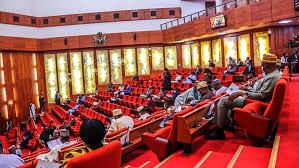
The Senate took a historic step on Thursday toward overhauling Nigeria’s military justice system, passing for second reading a transformative bill that seeks to repeal and re-enact the Armed Forces Act, making it constitutionally compliant, democratically accountable, and operationally modern.
The proposed legislation—“A Bill for an Act to Repeal the Armed Forces Act and to Re-enact a Modern, Constitutionally Compliant and Operationally Responsive Legal Framework for the Armed Forces of the Federal Republic of Nigeria, and for Related Matters, 2025”—was sponsored by the Chairman of the Senate Committee on Army, Senator Abdulaziz Musa Yar’adua (APC, Katsina Central).
A major highlight of the bill is a groundbreaking provision that would, for the first time, allow civilian judicial review of convictions issued by military tribunals—a reform lawmakers hailed as essential for ensuring fairness, transparency, and adherence to constitutional safeguards.
‘Outdated Military Laws Must Evolve’ — Yar’adua
Leading debate on the bill, Senator Yar’adua argued that the current Armed Forces Act—rooted in military decrees of the 1960s and last consolidated in 2004—no longer reflects Nigeria’s democratic realities or its complex security challenges.
“The Armed Forces remain the cornerstone of our sovereignty,” he said. “They have defended this nation gallantly, from combating insurgency to peacekeeping across Africa. However, our military law has not evolved alongside the defence environment.”
He explained that the re-enacted law would align military governance with constitutional norms and global best practices while modernizing disciplinary procedures, operational structures, and welfare systems.
Obsolete penalties such as ₦200 and ₦500 fines would be scrapped and replaced with percentage-based sanctions tied to officers’ salaries. Non-commissioned officers would also gain stronger rights, including enhanced fair-hearing protections.
The bill further seeks to criminalize unlawful command interference in courts-martial, bolstering the independence and integrity of military justice.
Constitutional Overhaul Wins Support
In one of the most notable contributions during the debate, Senator Tahir Monguno (APC, Borno North) emphasized the constitutional importance of allowing judicial oversight over military tribunal decisions.
He described the current framework—where military authorities serve as investigator, prosecutor, and judge—as incompatible with fundamental legal principles.
“This bill aligns our military laws with international norms and the oversight of democratically elected institutions,” Monguno said. “It introduces fair hearing and judicial review—core elements of any democratic system.”
Senator Ali Ndume (APC, Borno South) called the reform “long overdue,” insisting that Nigeria’s military justice system must evolve with its democracy.
“As the country progresses, our laws must reflect professionalism, transparency, and modern military standards,” Ndume said.
Senator Sampson Ekong (APC, Akwa Ibom South) praised the bill as a “profound reform initiative” that would strengthen defence policy and reinforce professionalism.
“This is not just a legal reform—it is a structural transformation ensuring accountability while safeguarding discipline within the Armed Forces,” Ekong added.
A Model for National Reform
Presiding over the session, Deputy Senate President Jibrin Barau commended the scope of the reforms, saying they should serve as a template for broader national governance improvements.
“Our laws must evolve with the times,” Barau said. “This effort to modernise the Armed Forces’ legal framework should inspire reforms across all sectors.”
The bill was subsequently referred to the Senate Committees on Defence, Army, Air Force, and Navy for further scrutiny, with a mandate to report back within four weeks.
About the Author