On day five of the escalating war between the United States, Israel and Iran, security forces Wednesday mounted a heavy presence across strategic locations in Abuja, triggering heightened vigilance in the Federal Capital Territory (FCT) amid fears of possible spillover risks.
Armed personnel were deployed around key government institutions, diplomatic zones and major transit corridors, as authorities moved to pre-empt any security breach linked to the intensifying Middle East conflict. While officials did not announce a specific threat, the precautionary lockdown indicated growing global anxiety over the widening confrontation.
The development came as hostilities between Washington, Tel Aviv and Tehran deepened, raising concerns about geopolitical instability, energy supply shocks and the potential for retaliatory actions far beyond the immediate theatre of war.
Besides, Iran has deferred a planned farewell to its murdered Supreme Leader Ayatollah Ali Khamenei, fuelling speculation about internal security calculations as Israeli officials publicly threatened to eliminate any designated successor.
The postponement, coming amid sustained aerial and missile exchanges, signalled heightened tensions within Tehran’s leadership circle, even as Israel hardened its rhetoric, warning that its campaign would extend to the highest echelons of Iran’s command structure if provoked.
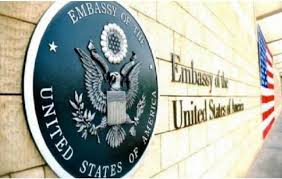
Also, the US Embassy in Abuja Wednesday cancelled scheduled visa appointments, citing security considerations linked to the rapidly evolving conflict between Washington and Tehran.
The move disrupted routine consular services and underscored diplomaticripple effects of the war, as missions worldwide reassessed their risk posture in response to the intensifying hostilities.
Security Forces Lock Down Abuja on Escalating Middle East Crisis
Abuja was on lockdown Wednesday as stern looking soldiers and policemen were deployed to strategic parts of the city to prevent potential anarchy following the Middle East crisis escalation that followed the attack on Iran by US and Israel.
The unusual security activities followed a security alert issued Wednesday by the United States Embassy to its citizens in Abuja about the likelihood of demonstration holding in the nation’s capital.
Traffic was at a near standstill on the arterial Abuja-Keffi road following a cordon set up by security forces to prevent members of the Islamic Movement in Nigeria (IMN) otherwise known as the Shiites, from protesting over the ongoing attack on Iran by the US and Israel.
Besides, pedestrians heading towards Abuja spent several agonising hours in the traffic Wednesday morning. Some persons were also arrested and taken to the police station for attempting to foment trouble.
The lockdown was perceived as a precautionary measure to prevent similar protests held in Niger, Kaduna and Sokoto states over the weekend by Shiites from spilling over to Abuja.
As early as 9 a.m. policemen and soldiers from Army headquarters, with some mounting gun trucks and personnel carrier vehicles, set up road blocks at Mopol Junction at the Mararaba- Nyanyan intersection.
There was a similar security checkpoint by soldiers at Kugbo and inside Abuja by the Ministry of Finance and Eagles Square, and several other key infrastructure in the nation’s capital.
US Embassy Cancels Visa Appointments in Abuja
In the same vein, the United States Embassy in Abuja cancelled all visa appointments scheduled for Wednesday following heightened security concerns linked to escalating tensions involving the United States and Iran.
In a security alert issued to American citizens in Nigeria, the embassy warned of the potential for protests and public demonstrations in the FCT, urging its nationals to remain indoors and avoid crowded areas.
The precautionary move came amid growing global reactions to the unfolding crisis in the Middle East. Although no specific threat was publicly disclosed, the embassy cited “an abundance of caution” in suspending consular visa services for the day.
However, applicants affected by the cancellation were assured that their appointments will be rescheduled. The embassy said those impacted would receive further instructions regarding new interview dates.
The embassy advised US citizens to stay alert, monitor local media for updates, keep mobile devices charged, and carry valid identification at all times. It also recommended avoiding any large gatherings or protest-prone locations until further notice.
While visa services in Abuja were suspended temporarily, the embassy indicated that emergency consular assistance would remain available. Operations at the US Consulate General in Lagos were not immediately affected.
Iran Defers Khamenei’s Farewell, Israel Threatens to Kill Successor
Similarly, a ceremony commemorating Iran’s late leader Supreme Leader Ayatollah Ali Khamenei in Tehran has been postponed, according to Iran’s Tasnim news agency, days after he was assassinated along with family members in joint air strikes by Israel and the United States.
The news agency quoted an official citing logistical issues for the delay, including requests from people in different provinces to attend the ceremony.
Funeral arrangements are ongoing and are expected to draw huge crowds, and, with them, the potential threat of US-Israeli attacks on a gathering of mass mourning. Some 10 million people attended Ayatollah Ruhollah Khomeini’s funeral in 1989.
The report came hours after Hojjatoleslam Mahmoudi, head of Iran’s Islamic Propagation Council, had initially said the farewell ceremony would start at 10pm at Tehran’s Imam Khomeini Prayer Hall and continue for three days.
“The prayer hall will be receiving visitors and the dear people can attend and take part in the farewell ceremony and mark a strong presence once again,” Mahmoudi said in comments carried by Iranian media.
Khamenei was killed on Saturday, aged 86. He had been Iran’s supreme leader since 1989, succeeding Khamenei, the founder of the post-shah Iran, who steered the country’s 1979 revolution.
The supreme leader holds ultimate authority over all branches of government, the military and the judiciary, while also acting as the country’s spiritual leader.
Ayatollah Ahmad Khatami, a senior Iranian cleric who is a member of both the powerful Guardian Council and Assembly of Experts, said the country was close to choosing the late Khamenei’s successor.
“The Supreme Leader will be identified in the closest opportunity, we are close to a conclusion, however the situation in the country is a war situation,” Khatami told state TV.
The 88-member Assembly of Experts is elected by the public every eight years. Candidates who run for the Assembly must first be vetted and approved by the Guardian Council, a powerful oversight body whose members are partly appointed by the supreme leader himself.
A simple majority is sufficient to appoint the new supreme leader. As per Iran’s constitution, the candidate must be a senior jurist with deep knowledge of jurisprudence in Shia Islam, as well as qualities such as political judgement, courage, and administrative capability.
Khamenei’s second son, Mojtaba Khamenei, is among the top contenders to succeed his father. Two Iranian sources cited by Reuters news agency said Mojtaba survived US-Israeli attacks on the country.
But Israel’s Defence Minister Israel Katz threatened on Wednesday to assassinate any Iranian leader picked to succeed Khamenei.
“Any leader selected by the Iranian terror regime to continue leading the plan for Israel’s destruction, threatening the United States, the free world and countries in the region, and suppressing the Iranian people, will be a certain target for assassination, no matter his name or where he hides,” Katz said in a post on X.
US President Donald Trump had publicly mused about the leadership he would like to see in Iran following Khamenei’s assassination. During an Oval Office appearance, he said the “worst-case scenario” in Iran would be another leader unfriendly to US priorities.
Luciano Zaccara, a research associate professor in Gulf politics at Qatar University, told Al Jazeera that Iran’s political system has been prepared for the current situation, knowing that Khamenei’s killing was a real possibility. “The structures remain, the line of power [and] the line of command remain in place,” he said.
Islamic Body Cautions Against Friction
As the war between the United States, Israel and Iran continues to rage, the League of Imams in Lagos State has warned Nigerians against taking sides or getting involved in any act that can jeopardise the security of the nation and the peaceful coexistence of people in the country.
The League, in a statement by the Chief Missioner of the Ansarudeen Society in Nigeria, Sheikh Abdul Rahman Ahmad, highlighted the protests staged in some parts of the country over the killing of Iran’s supreme leader, Ali Khamenei, during a recent US-Israeli strike on Iran.
This position was expressed during the 2026 Ramadan Tafsir programme held on Tuesday night at the Lagos House Ikeja. According to Ahmad who acknowledged that Nigeria is also affected by the current global happenings, there is a need for reflection, solution solving and constant prayers for the government to succeed at both the state and national level.
He said that Ramadan and Lent periods should be used to fervently pray for the country for continuous peace of Lagos and Nigeria, stressing that any form of demonstration or protest should be disallowed.
“This is a time for prayer, a time to be part of peace; this is not a time for protest and demonstration. This is not a time for insults. This is not a time for upheavals. It is a time of sober reflection. Allah has warned us to beware of a calamity, that when it happens, it will not just affect those who are responsible for it. And at the moment, it is affecting all of us.
“How may it go? I told the congregation, they should be prepared for an increase in fuel price. And today, if you have refilled your vehicle’s tank, you will know how much petrol is being sold per litre.
“Chances are that it could even go further. It could even hit N2,000 per litre. It may be the beginning of the third world war. It may even be worse than that, except we face it with prayer,” he added.
He said that many lives have been lost during several protests in the past including the current loggerhead in the middle east, saying it is needless to witness another bloodbath in the country.
“We are not happy that our brothers and fellow human beings have been attacked on a daily basis, but then, if we cannot be part of the solution, we should not be part of the problem.
“Don’t join a protest that you don’t know anything about. Remember that the country is still dealing with the effect of End-SARS protests. Don’t cause disruption. Your intention may be pure, may be good, but do you know about the next person who will hide under that and cause mayhem and cause destruction.
“That is why we have come to appeal to all of us that we should be part of the solution, not a part of the problem,” he advised.
Hegseth: Mastermind of Assassination Plot Against Trump Killed
An alleged mastermind of an Iranian covert unit accused of plotting to assassinate President Donald Trump in 2024 has been “hunted down and killed” amid Operation Epic Fury, Defence Secretary Pete Hegseth announced Wednesday
“Iran tried to kill President Trump, and President Trump got the last laugh,” Hegseth declared during a press briefing with reporters. “This is not a ‘mission accomplished’ situation. This is simply a reality check,” he added.
Iranian animus toward Trump traces back to his first term, when he authorised a January 2020 drone strike that killed General Qasem Soleimani, a powerful commander in the Quds Force. Since then, federal prosecutors have charged multiple people in two separate cases of Iranian murder-for-hire plots during the 2024 presidential campaign, though officials have not presented evidence directly tying Tehran to those schemes.
Hegseth did not name the alleged mastermind he said was killed in the ongoing operations.
In an interview earlier, Trump addressed how the threats to his life spurred his decision to wage war on Iran and kill the country’s supreme leader, Ayatollah Ali Khamenei.
“I got him before he got me,” Trump said in a phone interview with ABC News. “They tried twice. Well, I got him first.”
Hegseth described the broader US-Israeli campaign against Iran on Wednesday as “accelerating.” He indicated the two nations will establish complete control of Iranian airspace within days.
“It means we will fly all day, all night, day and night, finding, fixing, and finishing the missiles and defense industrial base of the Iranian military,” Hegseth said. “More and larger waves are coming. We are accelerating, not decelerating,” he explained.
Hegseth dismissed reports that stocks of munitions were running low, noting that the US will deploy 500-pound, 1,000-pound and 2,000-pound GPS and laser-guided precision bombs “of which we have a nearly unlimited stockpile.”
Iran Reports 1,045 Deaths
Iran said on Wednesday that 1,045 people had been killed in the country since Saturday as a result of US-Israeli strikes.
In a statement published on its official website, Iran’s Foundation of Martyrs and Veteran Affairs described the strikes as “aggressive and brutal.”
The toll followed a joint US-Israeli attacks on Tehran and several other Iranian cities starting Saturday morning, which resulted in the deaths of Iran’s Supreme Leader Khamenei, his family members, top military commanders, and civilians. Iran has since responded with multiple waves of missile and drone attacks targeting Israel and US assets across the region.
Goldman Raises Q2 Brent Price Forecast By $10, Predicts $100 Oil
Goldman Sachs Wednesday raised its second-quarter 2026 average price forecast for Brent crude oil by $10 to $76 per barrel and for WTI by $9 to $71. These forecasts assume that low oil flows via the Strait of Hormuz will lead to large declines in OECD inventories and Middle East oil production in March, according to the bank’s note.
The Strait of Hormuz, a narrow channel linking the Persian Gulf to the Gulf of Oman, is a critical global energy chokepoint, handling about a fifth of the world’s oil and liquefied natural gas shipments, Reuters reported.
Goldman said its forecasts remain heavily tilted to the upside, with risks including a longer than expected disruption to exports through the Strait of Hormuz and potential damage at oil production facilities.
“If Hormuz volumes were to remain flat for five additional weeks, Brent prices would likely reach $100, a level associated with larger demand destruction to prevent inventories from falling to critically low levels,” it said in a note.
Brent crude futures were near $82.57 a barrel by 0408 GMT, after closing at its highest since January 2025 on Tuesday. US West Texas Intermediate crude rose to $75.28, after settling at its highest since June. Both rose by around 5 per cent or more in the past two sessions.
Goldman sees a downside risk to prices from a faster normalisation in Hormuz flows. The bank also revised its fourth-quarter 2026 forecasts for Brent and WTI to $66 and $62, respectively, and for 2027 to $70 and $66, respectively.
Emmanuel Addeh, Wale Ajimotokan, Michael Olugbode and Segun James
About the Author