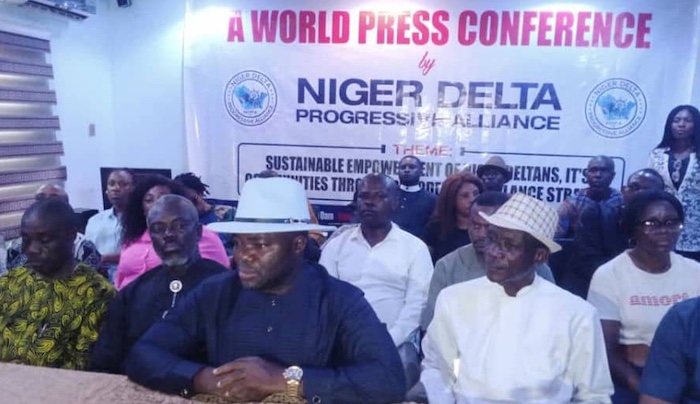
The Niger Delta Progressive Alliance (NDPA) has emphasised that safeguarding existing oil and gas infrastructure remains one of the most effective strategies for strengthening national revenue, improving macroeconomic stability, and accelerating sustainable development across Nigeria.
In a policy statement released by the Alliance, NDPA noted that recent production gains demonstrate a critical economic lesson that protecting operational assets can deliver faster fiscal returns than pursuing new exploration projects.
According to the statement, signed by Amb. Nse Udoh, National President, Niger Delta Progressive Alliance, Nigeria’s crude oil output increased from approximately 1.18 million barrels per day in August 2023 to over 1.7 million barrels per day by late 2024, an improvement of nearly 500,000 barrels daily without the discovery of new reserves.
“The geology did not change; governance and infrastructure reliability did. This recovery underscores that disciplined protection of pipelines and export corridors is fundamentally an economic intervention, not merely a security exercise”, the Alliance stated.
NDPA explained that at an average oil price of $70–$80 per barrel, every additional 100,000 barrels per day secured within the legal export chain translates to roughly $2.5–$3 billion in annual export value saying that a sustained 500,000-barrel increase could stabilize national revenue by an estimated 12–15 billion dollars annually.
The Alliance described oil theft not as an isolated criminal activity but as a structural economic disruption that weakens foreign exchange inflows, distorts fiscal planning, and increases borrowing pressures.
Udoh said; “When pipelines are breached, the nation loses far more than crude volumes”. “It loses budget certainty, currency stability, and development momentum.”
NDPA stressed that crude oil contributes the majority of Nigeria’s foreign exchange earnings, meaning uninterrupted delivery to export terminals directly influences exchange-rate stability, investor confidence, and public finance performance.
The group called for clearer differentiation between production figures and monetised receipts, warning that barrels produced do not benefit the economy unless they are securely transported, exported, and paid for.
Drawing comparisons with advanced energy-producing nations such as the United States and Norway, NDPA observed that pipeline networks in those jurisdictions are treated as critical national infrastructure, with rigorous monitoring systems designed to minimise disruption and financial volatility.
“Nigeria’s ongoing shift toward corridor-based accountability and integrated surveillance reflects global best practice,” the Alliance noted, adding that predictable supply chains reduce insurance costs, improve financing conditions, and strengthen sovereign risk perception.
The statement further highlighted the role of host-community participation in reducing repeat incidents of sabotage, noting that regions where local stakeholders are economically integrated into infrastructure protection frameworks consistently record lower breach frequencies.
“When communities see stability translating into livelihoods and development, cooperation replaces conflict. Ownership displaces alienation,” NDPA said.
NDPA urged policymakers to prioritise theft reduction within Nigeria’s broader energy reform agenda, describing it as one of the few interventions capable of delivering measurable fiscal benefits within a single budget cycle.
“Exploration takes years to mature; infrastructure stabilization yield returns immediately. Protecting what already exists is among the most practical and highest-yield economic decisions available to the nation,” the Alliance concluded.
It called for sustained institutional coordination, performance measurement, and investment in monitoring technologies to consolidate recent gains and ensure long-term production reliability.
Blessing Ibunge
About the Author