The South African National Space Agency (Sansa) announced late on Monday night that the expected geomagnetic storm had arrived and reached G4 level, the level with severe conditions.
The geomagnetic storm is expected to continue throughout today with G1 to G3 conditions and a possibility of further G4 levels.
Sansa expects geomagnetic storm conditions to increase over the next 24 hours with the arrival of a coronal mass ejection (CME) directed at Earth.
According to the space agency, a CME is “a massive cloud of hydrogen ions that is ejected from the surface of the Sun when stored energy is suddenly released.
“The CME produces a cloud of high-energy particles travelling at supersonic speeds (500-2000 km per second). When a CME is ejected towards Earth, it reaches us within a day or two. The impact of the CME on the Earth causes a disturbance to the Earth’s magnetic field.”
ALSO READ: SA aims to launch own satellite in next five to seven years
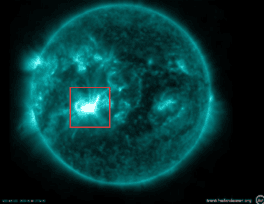
This CME was triggered by a long duration of a sudden burst of light from the sun and affects Earth during the day. The sudden burst of light, called a solar flare, occurred on Sunday.
It is ranked in five categories – A, B, C, M, and X.
A-class flares are the weakest, while X-class flares are the most energetic.
When it occurs, it disrupts high-frequency radio communications
Although the sun erupted with a severe X1.9 solar flare on Sunday evening, the African region was not affected by the high-frequency radio blackout, as it occurred during nighttime, which is mostly outside the flare’s impact range.
Geomagnetic storm on Tuesday
However, Sansa has warned that the CME is expected to affect Earth from the early hours of Tuesday.
“This impact will interact with the Earth’s magnetic field and cause a geomagnetic storm. The geomagnetic storm could reach G4/Severe storm conditions,” warned Sansa.
It expects G1 to G2 storms, with G3 storms likely and the possibility of G4 storms throughout Tuesday.
The good news? Geomagnetic storms are not like terrestrial storms, which cause visible destruction and loss of life.
“Geomagnetic storms largely go unnoticed by people because their effects are felt mainly through technological systems,” explained Sansa.
“Navigation, communication and electricity networks are the most at risk. Industries such as aviation and drone operations can be affected by the impact on navigation systems and should take note of the K-Index, a standardised, global measure (0-9) of geomagnetic activity, showing how much the Earth’s magnetic field is disturbed.”
READ NEXT: Exciting times for SA space industry – Why the MDASat constellation matters
About the Author