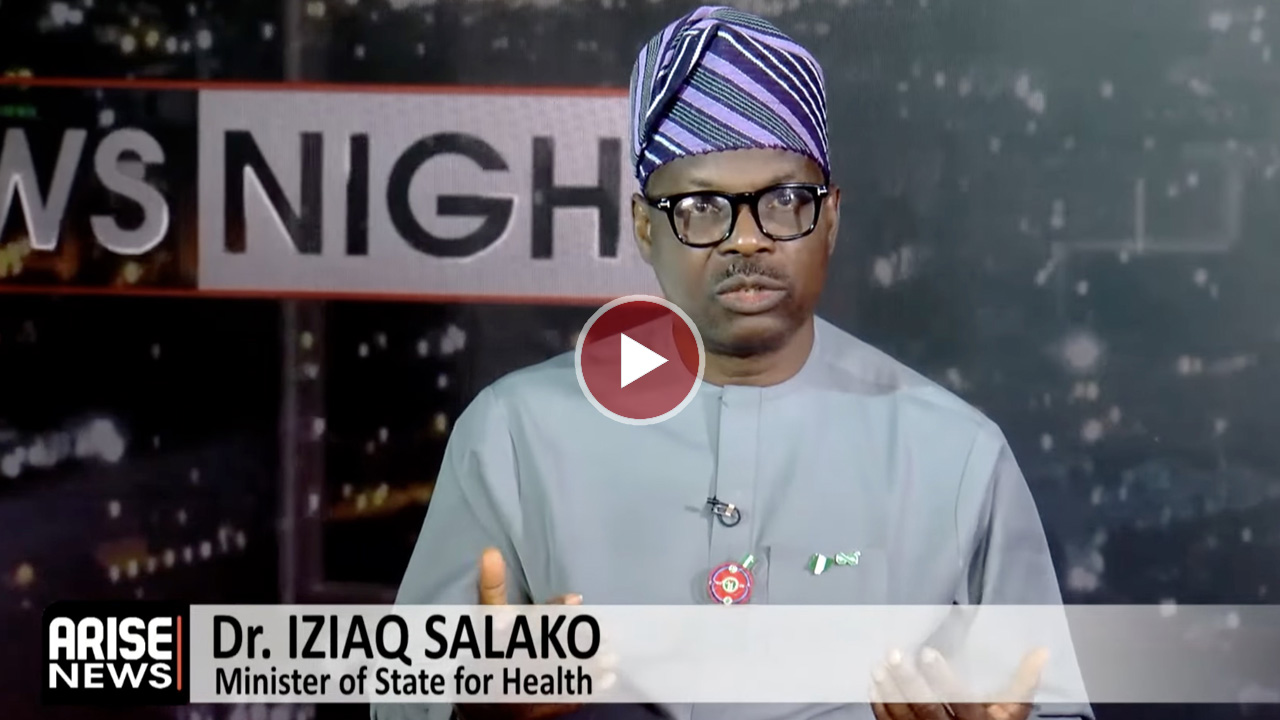

Minister of State for Health, Dr. Iziaq Salako, has said the Federal Government is making steady progress in resolving disputes with resident doctors, insisting there is no breakdown in negotiations and that all outstanding demands are being addressed.
In an interview with ARISE News on Tuesday, Salako rejected claims by the National Association of Resident Doctors (NARD) that the government abandoned agreements reached last year, stressing that sustained engagement had reduced the doctors’ demands from 19 to nine.
“We do not believe there is a standoff. A standoff would imply a breakdown in engagement, and that is not the case. We continue to engage and we are making progress. If we had dumped everything, we would not have been able to reduce the demands from 19 to nine,” he said.
Salako disclosed that the government had already implemented several key agreements, including the release of a circular increasing professional allowances for health workers, a move he said would cost the Federal Government about ₦90 billion annually.
“When the strike started, they were talking about call duty allowance, shift duty allowance, accoutrement allowance, non-clinical duty allowance and rural posting allowance. These allowances are already being paid. They also demanded an increase in professional allowances, and the circular has been released. That circular alone will cost the Federal Government an additional ₦90 billion annually,” he said.
He explained that the government had adopted a collective bargaining framework to prevent a recurring cycle of strikes triggered by piecemeal negotiations with different health unions.
“What we are introducing is the principle of collective bargaining. In the past, government negotiated separately with different health worker groups. Once you implement an agreement with one group, another group comes back to say it affects them, and the cycle continues. That approach has fuelled repeated negotiations and strikes,” Salako said.
“This time around, we said we are not going to implement agreements piecemeal. That is why when a circular was initially released last July and there were complaints, it was withdrawn. We went back to negotiate with all stakeholders, and eventually the circular was reissued. At that point, doctors themselves welcomed it.”
The minister also warned against forcing government into unsustainable agreements through industrial action.
“We have also decided that government should no longer be stampeded by strikes into agreements. Experience has shown that agreements reached under pressure are not enduring. Within months, you find yourself facing another dispute, either with the same group or another segment of the sector,” he said.
Addressing the contentious issue of specialist allowance, Salako said the government could not lawfully accede to the demand by resident doctors.
“On specialist allowance, the ministry wrote to the Head of Service in November. The National Salaries, Income and Wages Commission advised that specialist allowances are exclusively for consultants, not resident doctors who are specialists in training. If we were stampeded into agreeing otherwise, we would not even be able to implement it,” he explained.
On the threat of a fresh strike scheduled for January 12, Salako said the government was doing everything possible to avert it.
“I am not speaking for the resident doctors, because they are the ones who declared the strike notice. But what I can say is that every single item in their current nine-point demand is receiving the attention of government. There is none that is being ignored,” he said.
Clarifying the controversy surrounding the reinstatement of five doctors at the Federal Teaching Hospital, Lokoja, Salako said the cases were being wrongly lumped together despite differing circumstances.
“Those five doctors actually fall into three different categories. Two faced the Senior Staff Disciplinary Committee and were recommended for termination. Two others were recommended for reprimand. One could not appear before the committee because she was ill. They are not the same cases,” he said.
“For the doctor who did not appear before the committee, we said she should be allowed to present her case because reprimand is already a punishment. For those recommended for reprimand, we agreed they should be reprimanded and allowed to continue working. For the two whose appointments were terminated, we decided to reinstate them, but in other institutions.”
On professional allowance arrears, Salako insisted funding had already been captured in the 2026 budget.
“The professional allowance circular has been released since November, and the implementation cost of about ₦90 billion has been provided for in the 2026 budget. The Budget Office has assured us that there is enough provision in the service-wide vote to cover this and other wage awards,” he said.
He also addressed lingering disputes over salary grade skipping and entry levels, noting that the matter remained under judicial consideration.
“The issue of skipping dates back to 2013 when JOHESU obtained a court judgment allowing them to skip level 11. That judgment is under appeal. Doctors later requested similar treatment, but it was established that the equivalent level involved is the entry point for resident doctors. Pending the appeal court’s decision or harmonisation by the relevant authorities, the status quo remains,” he explained.
On the prolonged strike by JOHESU, Salako acknowledged longstanding contradictions in previous agreements.
“There was an agreement in 2009 on parity between salary scales, and later another agreement on relativity. You cannot implement parity and relativity at the same time. That contradiction is at the heart of the issue,” he said.
Asked about the implications of another strike on the health sector, Salako said the government was committed to finding lasting solutions.
“We are doing everything possible to ensure enduring solutions. Just today, we had meetings with directors in the ministry and with the Federal Minister of Labour. We hope health workers will see that the government is genuinely committed to long-term stability in the sector,” he said.
Boluwatife Enome
About the Author