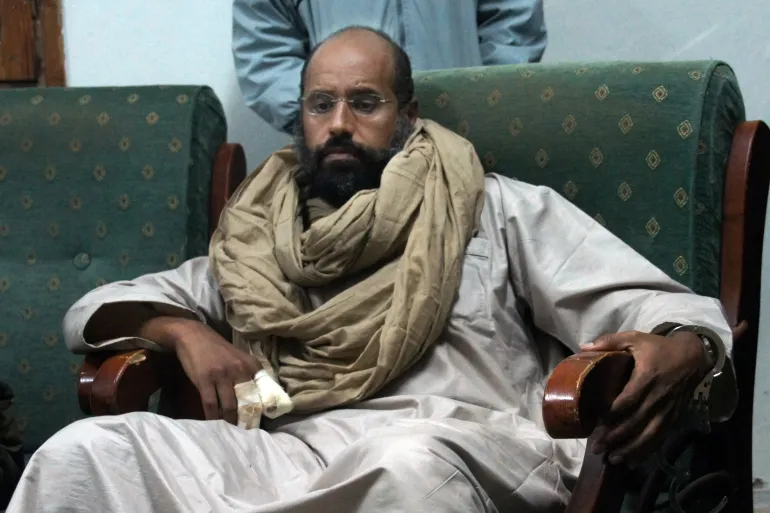
Saif al-Islam Gaddafi, the most prominent son of Libya’s late leader Muammar Gaddafi, has been killed in Libya, according to his lawyer, political advisers, and local media reports.
His lawyer, Khaled al-Zaidi, and political adviser Abdulla Othman confirmed the 53-year-old’s death in separate Facebook posts on Tuesday, though neither provided additional details.
Libyan outlet Fawasel Media reported that armed men shot Gaddafi inside his home in Zintan, roughly 136 kilometers southwest of Tripoli.
In a statement, Gaddafi’s political team condemned the killing as a “cowardly and treacherous assassination,” describing how “four masked men” stormed his home and shot him after he confronted them. “He clashed with the assailants, who shut down security cameras in a desperate attempt to hide evidence of their heinous crimes,” the statement added.
Reacting to the news, Khaled al-Mishri, former head of Tripoli’s High State Council, called for an “urgent and transparent investigation” into the circumstances surrounding Gaddafi’s death.
Though he never held an official government role, Saif al-Islam was widely regarded as his father’s de facto second-in-command from 2000 until Muammar Gaddafi’s fall in 2011, which ended more than four decades of authoritarian rule.
Following Tripoli’s capture, Saif attempted to flee Libya but was captured by local militias in Zintan. He remained imprisoned until 2017, when he was released under a general amnesty and continued living there.
A Western-educated figure fluent in English, Saif al-Islam was often portrayed as the face of reform within his father’s regime.
He played a key role in Libya’s rapprochement with the West, including negotiations over the country’s abandonment of its weapons of mass destruction program and compensation for victims of the 1988 Lockerbie bombing.
He earned a PhD from the London School of Economics, with a dissertation exploring civil society’s role in global governance reform.
However, during the 2011 uprising, Saif abandoned his reformist image and became central to the regime’s violent suppression of dissent, calling opponents “rats” and warning that “rivers of blood” would flow in Libya.
He faced international scrutiny for alleged torture and atrocities, leading to a United Nations travel ban and an International Criminal Court arrest warrant for crimes against humanity.
After the fall of Tripoli, he attempted to flee to Niger disguised as a Bedouin tribesman but was captured and returned to Zintan.
In 2015, a Tripoli court sentenced him to death in absentia for war crimes. Following his release in 2017, he largely remained underground amid fears of assassination.
In November 2021, he reemerged politically, announcing his candidacy for Libya’s long-delayed presidential election. His bid sparked fierce opposition, was blocked due to his previous conviction, and became a flashpoint in the country’s ongoing political deadlock.
Saif al-Islam Gaddafi’s death closes a tumultuous chapter in Libya’s post-revolution era, marking the end of one of the most controversial and polarizing figures to emerge from the Gaddafi dynasty.
About the Author