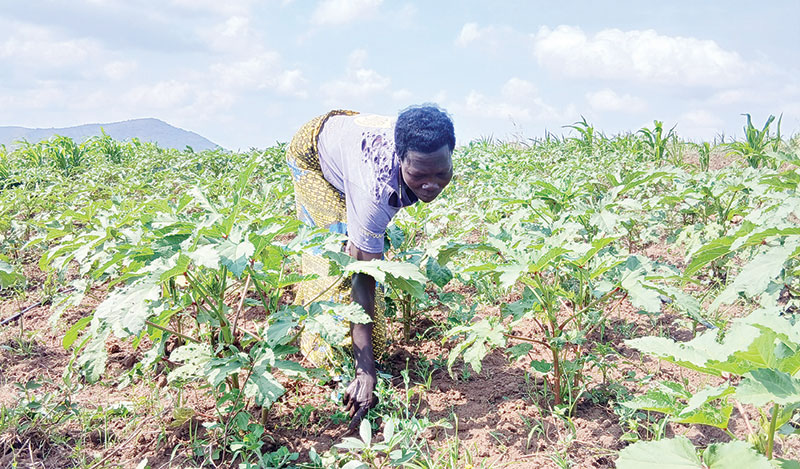
In Rwentunga village, Buseruka sub-county, Hoima district, lives Grace Feku, a 44-year-old single mother whose hope of improving her household income is firmly rooted in farming.
Thanks to government interventions, including the establishment of the Rwentunga irrigation scheme, hope is being restored among impoverished farmers in the area who previously depended entirely on rain-fed agriculture.
Feku grows okra and vegetables, and her dream is to raise Shs 6 million to purchase two acres of land where she can raise her children. A mother of seven, she is on the verge of leaving her husband’s home after constructing a mud-and-timber structure at her father’s residence, where she hopes to settle with her children.
“My husband neglected his responsibilities. We are on our own. He has gardens, but we do not get anything from him. He left me to struggle and fend for the family,” Feku told The Observer.
She explained that her eldest daughter is joining Senior Four, but paying school fees remains a challenge, forcing her to support only three children in school at a time.
“I get all the basic needs from farming and rearing goats and chickens. That is how I manage to survive,” she said.
Feku is among 30 farmers benefiting from the €212,939.79 Rwentunga solar-powered irrigation project, where participants are engaged in horticulture and maize production. Despite ongoing struggles, many farmers in the scheme are already reaping significant benefits.
Isaac Irumba, a farmer and treasurer at the scheme, said their incomes have greatly improved compared to previous years when they faced drought, pests, diseases, and poor yields.
“We now earn income daily because we supply vegetables to the market. On a weekly basis, we earn about Shs 800,000, and we expect to earn even more during the dry season starting in January,” Irumba said.
He added that improved access to vegetables such as tomatoes and other produce has enhanced children’s nutrition, reducing illness and medical expenses.
“Since we started farming here, our incomes have improved, and paying school fees is no longer a challenge,” he noted.
However, farmers decried limited market access and poor road infrastructure, noting that roads leading to the farm are often impassable, especially during the rainy season.
“We urge the government to invest in common storage facilities for perishable produce. We lose a lot of money because our products perish within two to three days,” Irumba said.
Like many others, Irumba hopes to raise Shs 10 million to build a decent home for his family. Meanwhile, James Ofoyuru, the chairperson of the scheme, said he has so far earned Shs 1.8 million from okra and onions and hopes to raise Shs 2 million to start a food store.
“I have benefited a lot. I bought a plot of land at Buhirigi trading centre. With tomatoes now flowering, I will be able to raise enough capital and take my children to better schools,” he said.
geofreyserugo1992@gmail.com
About the Author