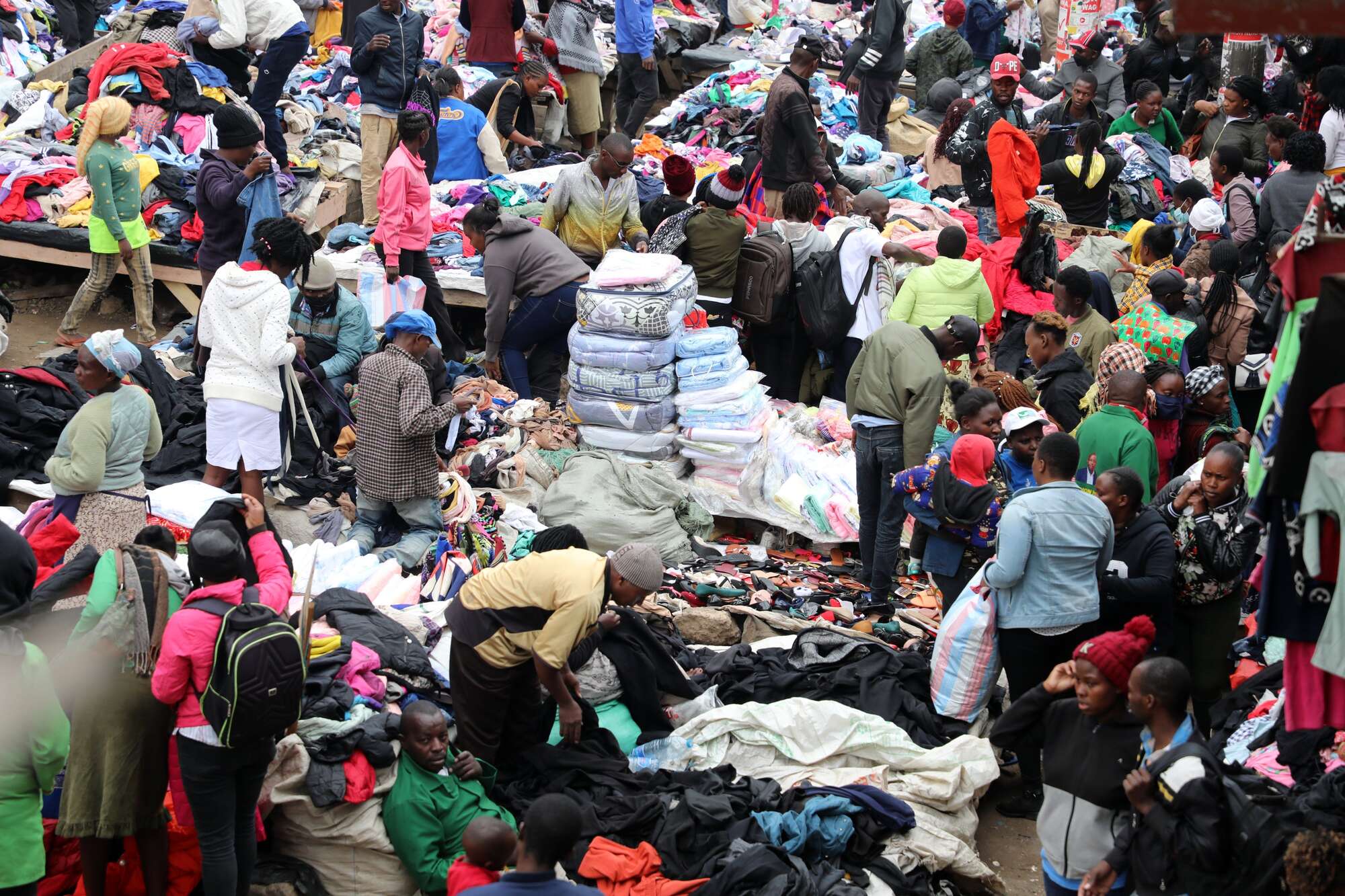
Booming business: Traders sell clothes at Gikomba Market in Nairobi County on Wednesday, August 3, 2022. Kenya imports at least 100,000 tonnes of second-hand clothes every year owing to high demand, and creating jobs for thousands of people across the country. PHOTO DENNIS ONSONGO.
A long-running dispute over the ownership of prime land hosting Nairobi’s Gikomba Market, East Africa’s largest open-air market, is expected to be resolved following intervention by the national government.
Speaking at a meeting at State House this week, attended by market leaders and Nairobi County Assembly MCAs from the Trade Committee, President William Ruto declared that Gikomba is public land owned by the government.
The declaration is likely to ease anxiety among hundreds of traders who have suffered losses over the years due to frequent fires that have destroyed stalls.
“I can assure you that Gikomba is public land. We cannot simply say it is public land without proper documentation; we must have documents to prove that Gikomba is public property,” the President said.
He directed Lands Principal Secretary Nixon Korir, to work with Lands Cabinet Secretary Alice Wahome to fast-track documentation and issuance of a title deed.
The absence of a title deed has been blamed for recurring fires, with traders alleging that individuals claiming ownership of the land may be behind some of the destruction.
The government is also constructing a permanent modern market at Gikomba, securing it with a perimeter wall, and has built a nearby fire station.
Additionally, 15 new markets are under construction across the city, including the nearly complete Gikomba facility.
President Ruto also announced closer collaboration between the national and Nairobi County governments to address waste management and poor lighting in the city.
He acknowledged the county’s challenges in keeping Nairobi clean and pledged national government support.
On market operations, the President urged leaders to crack down on illegal electricity connections, which he said contribute to fires and darkness, and to avoid cash payments, advocating for digital transactions through eCitizen to curb fraud.
Market leaders from several Nairobi markets raised concerns, including access to clean water, improved drainage, and a review of cess charges across counties. Wakulima Market chairperson Maina Nyaga called for harmonised cess payments to ease the burden on small-scale traders.
About the Author