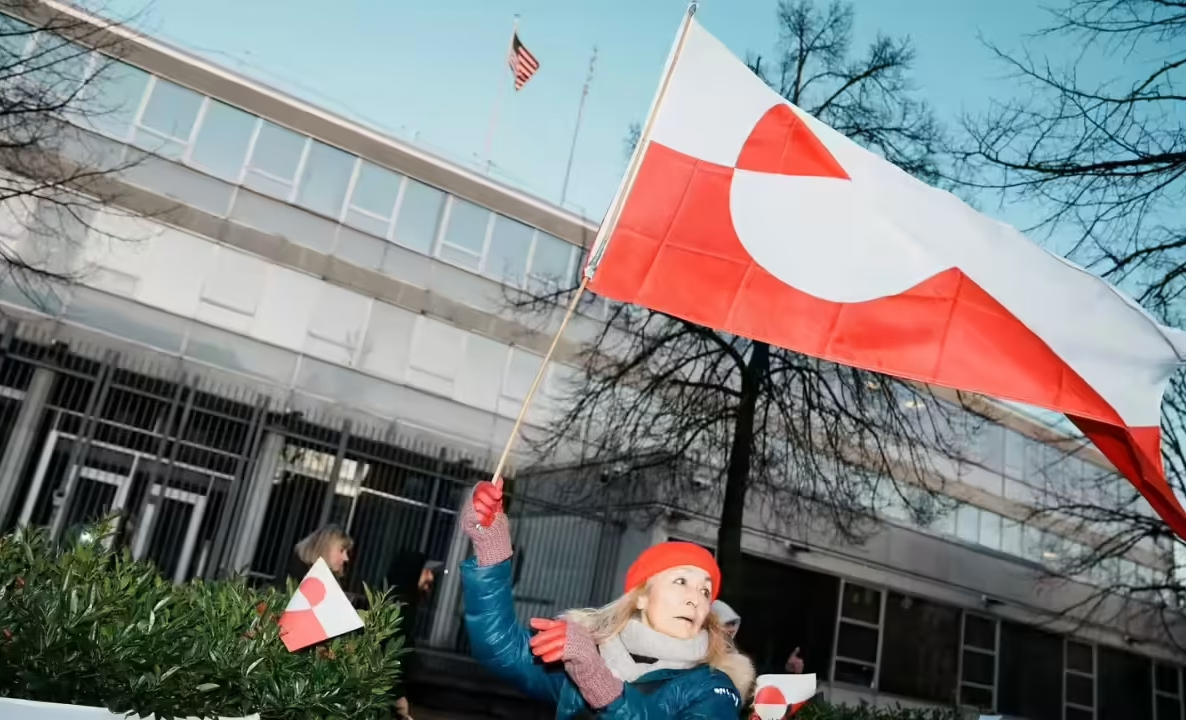
Russia has voiced strong concern over the deployment of NATO forces to Greenland, a strategically important and mineral-rich Arctic island that U.S. President Donald Trump has repeatedly said Washington should control.
France, Sweden, Germany, and Norway announced on Wednesday that they would deploy military personnel to Greenland’s capital, Nuuk, as part of a reconnaissance mission.
The move follows a high-level meeting in Washington between U.S., Danish, and Greenlandic officials that failed to dissuade Trump from his stated ambition to take over the island.
Trump has argued that Greenland—an autonomous territory of Denmark—is critical to U.S. national security, warning that if Washington does not assert control, “China or Russia will.”
Reacting late Wednesday, the Russian embassy in Belgium, where NATO is headquartered, said developments in the Arctic were deeply troubling.
“The situation unfolding in the high latitudes is of serious concern to us,” the embassy said in a statement, accusing NATO of expanding its military footprint in the region “under the false pretext of a growing threat from Moscow and Beijing.”
Neither the Russian Foreign Ministry nor the Kremlin—whose statements typically carry greater diplomatic weight—has commented directly on the deployment.
Both NATO and Russia have steadily increased their military presence in the Arctic in recent years, as climate change-driven ice melt opens the region to new international shipping routes and mining opportunities.
Trump’s remarks on Greenland have also placed unprecedented strain on NATO, an alliance that has underpinned Western security since the end of World War II.
According to the Russian embassy, internal disagreements within the bloc over Greenland are making NATO’s decision-making process “increasingly unpredictable.”
The situation underscores growing geopolitical tensions in the Arctic, a region fast becoming a focal point of global strategic competition.
About the Author