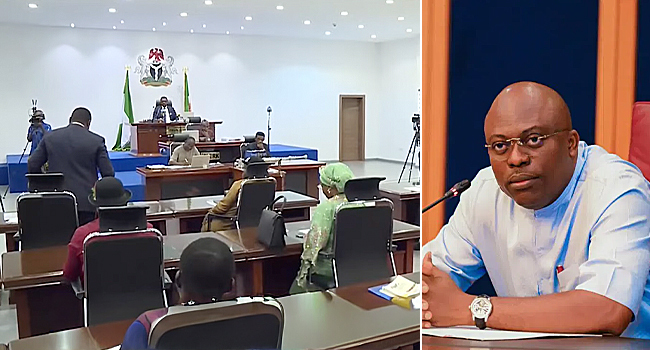
The Rivers State House of Assembly has escalated its confrontation with Governor Siminalayi Fubara, formally urging the Chief Judge of the state to constitute an investigative panel to probe allegations of gross misconduct against the governor and his deputy, Ngozi Odu.
The resolution, reached through a unanimous vote at plenary, signals the lawmakers’ determination to press ahead with impeachment proceedings, despite earlier political interventions aimed at resolving the protracted crisis in the oil-rich state.
Political Crisis Deepens
The move is the latest chapter in a long-running political standoff that erupted after the breakdown of Governor Fubara’s relationship with the state legislature and his predecessor, former Rivers governor and current Minister of the Federal Capital Territory, Nyesom Wike.
Tensions worsened as factions emerged within the Assembly, largely aligned with Wike, leaving the governor politically isolated despite repeated attempts at reconciliation.
Defection Fails to Calm Tensions
In December 2025, Governor Fubara defected from the Peoples Democratic Party (PDP) to the All Progressives Congress (APC), describing the move as an effort to align with President Bola Tinubu’s national agenda and promote stability in the state.
However, the defection has failed to repair relations with the Assembly or ease hostility from Wike’s loyalists. Several lawmakers had earlier defected to the APC, but political mistrust has persisted.
The crisis previously prompted President Tinubu to declare a state of emergency in Rivers State in March 2025, citing threats to governance and security. The governor, his deputy, and the Assembly were suspended for six months, during which a sole administrator governed the state. The suspended officials were reinstated late last year, but the truce proved short-lived.
Lawmakers Accuse Governor of Constitutional Breaches
Addressing journalists during a live press briefing in Port Harcourt, the Assembly accused Governor Fubara of intimidation, blackmail, and repeated constitutional violations that they say have crippled governance and eroded trust between the executive and legislature.
Deputy Speaker Dumle Maol said the House had exhausted all political options and was left with no alternative but to invoke constitutional provisions.
“It is obvious that the only solution now is to apply the remedy prescribed by the 1999 Constitution (as amended), which is the impeachment of the incorrigible governor and the deputy governor,” Maol declared.
He called on political leaders and residents of Rivers State to support the impeachment process, insisting it was the only viable path forward.
“We urge the Speaker to allow the constitutional process to proceed unhindered. We also thank our dear President, Bola Tinubu, who demonstrated genuine concern and did his best to resolve this impasse. Unfortunately, the governor and his deputy have remained adamant,” he added.
The lawmakers also accused the executive of attempting to undermine legislative oversight through intimidation.
Assembly Reconvenes, Backs Investigation
Following the briefing, lawmakers reconvened at the Assembly complex, where Speaker Martin Amaewhule presided over a plenary session.
In a notable reversal, four lawmakers who had previously advocated for a political solution publicly withdrew their support and joined the majority backing impeachment.
At plenary, members unanimously endorsed a motion calling for the investigation of alleged gross misconduct.
“This vote clearly reflects the decision of the House,” Amaewhule said, formally appealing to the Chief Judge of Rivers State to constitute an investigative panel in line with constitutional provisions.
How a Governor Is Impeached in Nigeria
Under Section 188 of the 1999 Constitution (as amended), the impeachment of a state governor follows a clearly defined process:
- Grounds for Impeachment: Proceedings can only be initiated for “gross misconduct,” defined as a grave violation of the Constitution or conduct deemed serious by the House.
- Notice of Allegation: At least one-third of Assembly members must sign a written notice detailing the allegations and submit it to the Speaker.
- Service of Notice: The Speaker must, within seven days, serve the notice on the governor and all Assembly members.
- Governor’s Response: The governor has the right to submit a written defence, which must be circulated to lawmakers.
- Initial Vote: Within 14 days, the House votes—without debate—on whether to investigate the allegations. A two-thirds majority is required.
- Investigative Panel: If approved, the Speaker requests the Chief Judge to appoint a seven-member panel of individuals of unquestionable integrity, unaffiliated with politics or public service.
- Investigation: The panel has up to three months to investigate. The governor may appear personally or through legal representation.
- Panel Report: If the allegations are unproven, the process ends. If proven, the House considers the report.
- Final Vote: Within 14 days, the House votes on whether to adopt the report. A two-thirds majority removes the governor from office immediately.
- Succession: The deputy governor is sworn in. If both governor and deputy are removed, the Speaker becomes acting governor and elections must be held within 90 days.
- Finality: Once due process is followed, courts are barred from questioning the impeachment proceedings.
As events continue to unfold, Rivers State stands at a critical political crossroads, with the Assembly firmly set on a path that could reshape the state’s leadership and political future.
About the Author