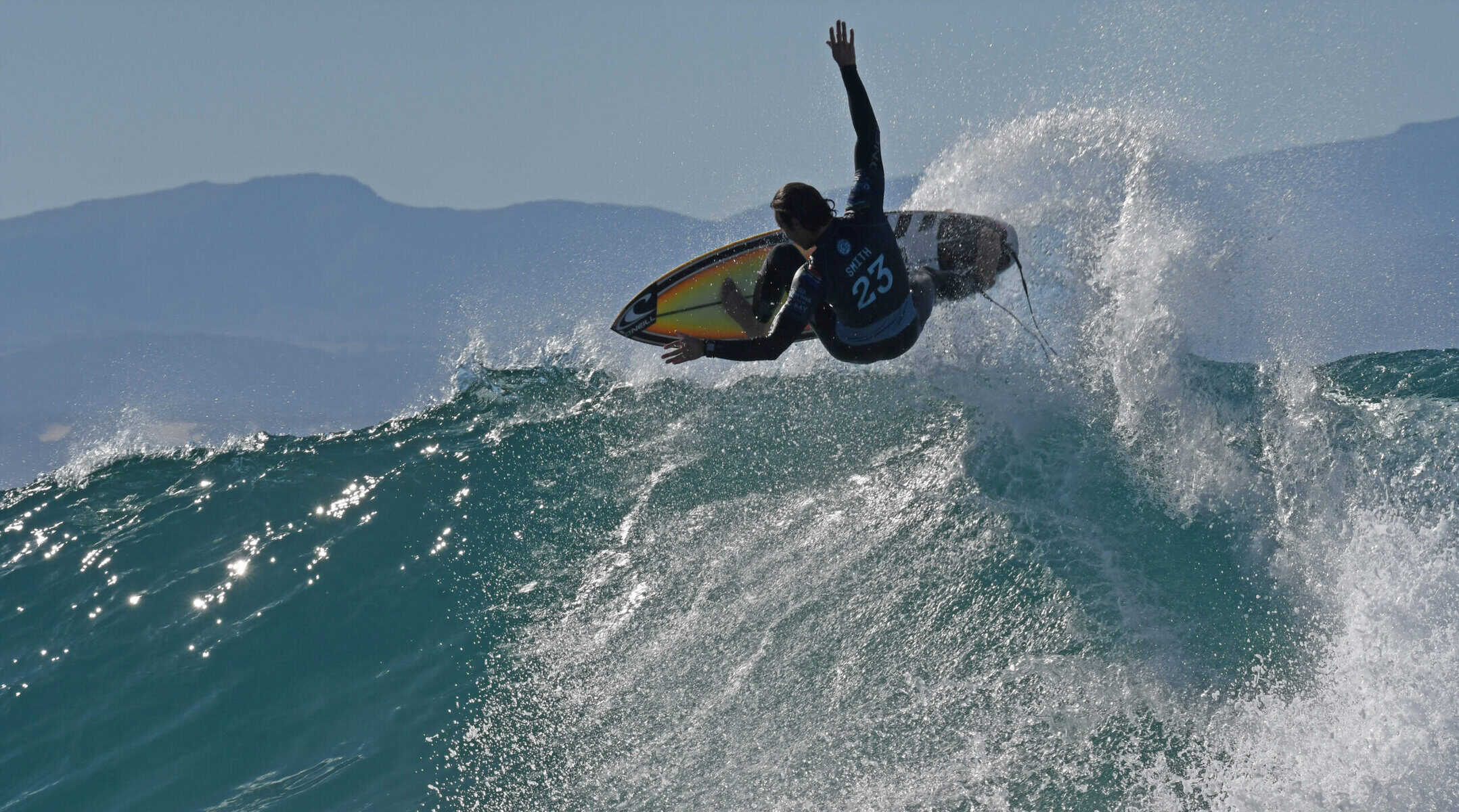
JEFFREYS BAY, SOUTH AFRICA - JULY 05: Jordy Smith from South Africa places third the Corona Open J-Bay on July 05, 2018 in Jeffrey's Bay, South Africa.and moves up to number 5 in the world (Photo by Brenton Geach/Gallo Images)
While everyone argues about who is to blame for the cancellation of the World Surf League in Jeffreys Bay in July, word on the street and in surf circles is the town has priced itself off the calendar in recent years.
Supertubes Collection Guest House owner Maresa Meyer said the cancellation was a big loss.
Tourism and winter economy at stake
“It’s usually nice and vibey, even though it’s winter, and while other coastal towns are quiet, Jeffreys comes alive.
“The street is closed off with pavilions for spectators and stalls with big screens to watch the surf,” she said.
Meyer said New Zealand snatched the slot because it had a sponsorship – and the SA government didn’t get behind the event.
“Jeffreys Bay is one of the best surf spots in the country. We have everything except the financial backing of government,” she said.
“World Surf League holds 11 competitions a year across the world and they naturally go where it’s cheapest.
“Why would they want to come to South Africa if they have to pay for everything out of their own pockets, while New Zealand gets it given to them?”
Longstanding funding pressures
Meyer said Sports Minister Gayton McKenzie wasn’t the main obstacle as issues have been coming for a few years.
ALSO READ: ‘Scapegoating’: Sports department denies costing Jeffreys Bay World Surf League slot
“There’s a lot of foreign money coming into the town, so even if they do a local competition, it won’t be the same or have any impact financially. We’re disappointed in the government because it doesn’t support us,” she added.
The department of sport, arts and culture said the narrative that the World Surf League was cancelled in Jeffreys Bay because McKenzie had withdrawn support from the event, leading to its demise, was inaccurate.
Spokesperson Zimasa Velaphi said the department did not receive any formal application for the World Surf League event, in accordance with the regulations.
Government rejects blame
“As no request for national government funding, guarantees, or associated services was formally submitted for consideration, a no funding decision was therefore taken at the national level.
“All public comments that are now seeking to place the blame at the feet of the minister for the inability to secure a World Surf League event in 2026 are misguided, a form of deflection and unjustified scapegoating.”
Velaphi said the Jeffreys Bay event is a privately owned and promoted event that has formed part of the professional global surfing circuit since the mid1980s.
It featured on the Championship Tour calendar for more than 30 years.
“Many of the commercial realities around sustainably promoting and holding this event have changed, leaving the organisers searching for sources of funding that were not needed in the past.
“It must be noted that the World Surf League event was hosted in South Africa for many years without the involvement of, or direct financial support from, the department of sport, arts and culture,” Velaphi said.
ALSO READ: ‘Stay alert’: Rabies-infected Cape fur seals pose risk to coastal visitors
Impact on local surf development
Founder and owner of Jeffreys Bay Surf School and St Francis Bay Surf School Etienne Venter said for any sport to grow in a country, you need to see how the best perform.
“That has been one of the big things of the Open J-Bay. It was where local surfers could enter as a wildcard and get to surf with the best,” Venter said.
“Besides the event, the pro surfers come from across the world, live in the town, and practise in the waves before the event, where they also meet the locals.
“There’s nothing better than for a young surfer to paddle out to a wave and find one of the top surfers catching a wave. So, for the development of South African surfing, it’s a massive loss,” he added.
Venter said there were local surfers who participated on an international level. All watched the pros in J-Bay and competed against the best to get to where they are.
“Unfortunately, surfing isn’t a big sport in SA and wasn’t even recognised on any governmental level, despite people surfing from Jeffreys Bay to St Francis Bay, Cape Town, George and up the coast to the Transkei, KwaZulu-Natal.
“I’m not sure who failed who. Surfing is often seen as an elite sport, but it’s not,” said Venter.
“It attracts so many young people who lived in poorer areas and it’s often a way of getting out of the house and doing something healthy.
“It’s not only a healthy sport that takes kids off the street, but also a community activity.”
NOW READ: Gayton McKenzie denies censoring South African artwork about Gaza genocide
About the Author