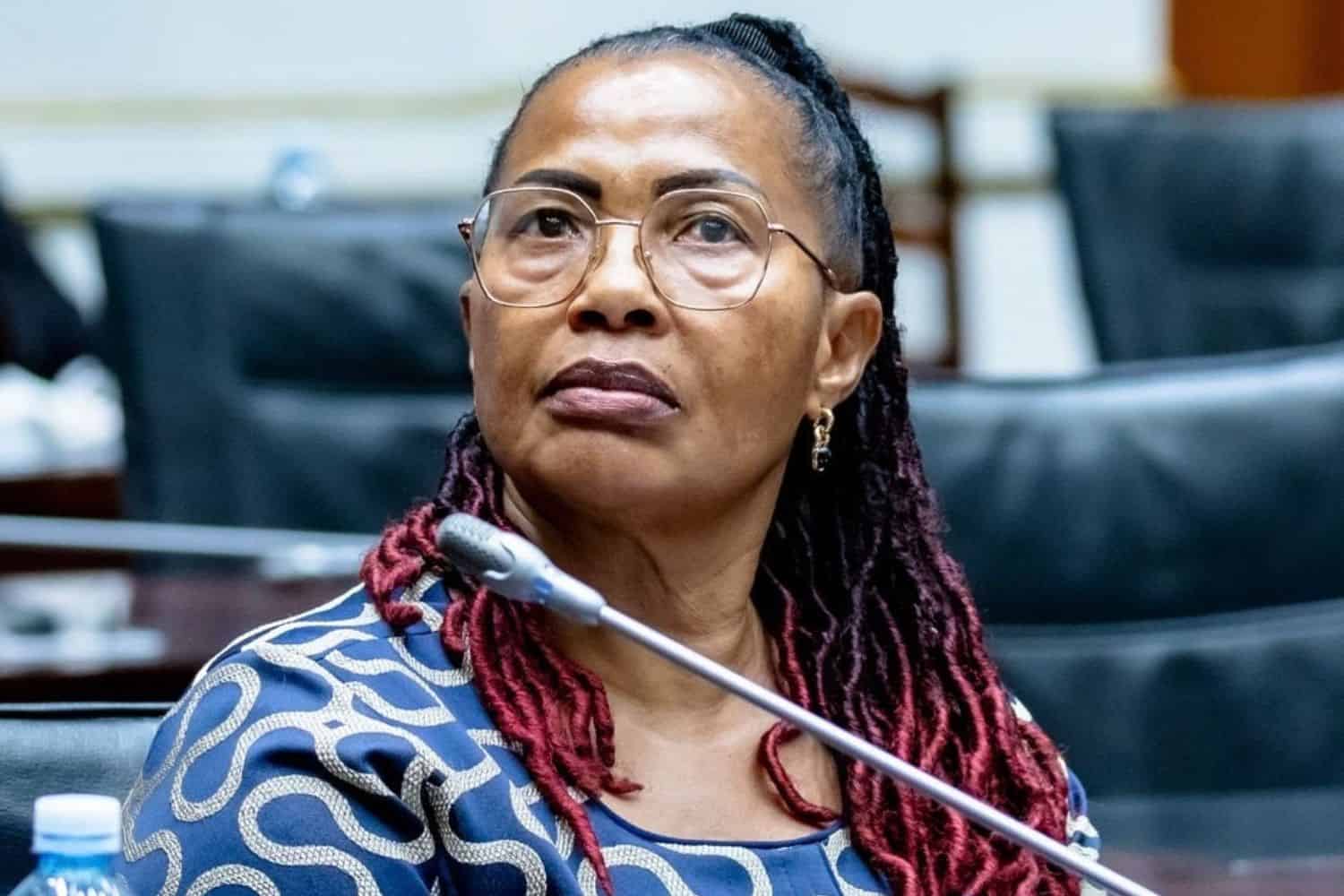
Former deputy national police commissioner Francinah Vuma says she still believes her suspension from the South African Police Service (Saps) may have been linked to disciplinary investigations she was pursuing against senior officials.
Vuma appeared before parliament’s ad hoc committee in the Good Hope Chamber in Cape Town on Wednesday, 11 March, where she testified about the events leading up to her suspension and raised allegations of interference by senior leaders within Saps.
Francinah Vuma testifies before ad hoc committee
In her testimony, Vuma told the committee that when she was appointed deputy national police commissioner for support services in 2020, she assumed responsibility for overseeing corporate services, supply chain operations and human resources.
She testified that at the time of her suspension in July 2022, she had been tasked with investigating senior officials implicated in wrongdoing after an audit report flagged irregularities in several contracts.
According to her, National Police Commissioner Fannie Masemola instructed her to stop pursuing those disciplinary processes in May 2022.
“My suspicion was that because I was busy with these matters – making follow-ups and ensuring that disciplinary steps were taken in the relevant business units – it might have been one of the reasons they decided to remove me from office,” Vuma said.
ALSO READ: Ex-Crime Intelligence cop links career downfall to R45m slush fund dispute
The former top cop indicated that disciplinary proceedings against her were initiated under the “expeditious process”, also known as Regulation 9, which allows for swift disciplinary action in cases of serious misconduct.
However, Vuma claimed the process was never concluded.
“The suspension was never uplifted for a period of three and half years up until I retired by the first of February 2026,” she said.
Watch the ad hoc committee’s inquiry below:
She added that she submitted several protected disclosures to President Cyril Ramaphosa and bodies, including the National Prosecuting Authority (NPA), claiming she was being “victimised” within Saps.
The former deputy police commissioner explained that the move was meant to protect her from “occupational detriment”.
Legal battles over suspension
Vuma’s suspension stemmed from a 2021 High Court judgment involving her, former national police commissioner Khehla Sitole and former deputy national commissioner Lebeona Jacob Tsumane.
The court ruled that the three officials had failed in their duties by not declassifying and submitting key documents to the Independent Police Investigative Directorate (Ipid), which was probing alleged tender fraud and corruption.
Their appeal bid to overturn the judgment at the Constitutional Court (ConCourt) was unsuccessful.
The documents sought were linked to the procurement of software used for surveillance monitoring and cellphone interception equipment.
READ MORE: Ex-national police commissioner Phahlane takes dismissal fight to ConCourt
The controversy centred around a “grabber” allegedly bought at an inflated price of R45 million for the ANC’s Nasrec elective conference in December 2017.
Vuma later failed to have her suspension lifted after the Labour Court dismissed her application in October 2022.
The Safety and Security Sectoral Bargaining Council (SSSBC) ruled in May 2023 that Saps had forfeited its right to discipline Vuma over the Ipid matter due to the five-year delay.
Despite being cleared to return to work, Masemola served her with new misconduct charges.
Those charges were based on a 2022 Special Investigating Unit (SIU) report into the procurement of personal protective equipment (PPE), which resulted in roughly R500 million in irregular expenditure.
Tender dispute
Vuma also detailed tensions around the Saps RT15-2021 transversal contract for mobile communication services.
She told the committee that Masemola had described her as stubborn and indicated there was pressure to suspend her.
MTN received a large share of the tender to support Saps in implementing its infrastructure development programme with the Independent Development Trust (IDT).
Although it was suggested that Deputy Police Minister Cassel Mathale was behind the selection of MTN, Vuma insinuated that pressure around the contract came from Masemola and former police minister Bheki Cele.
READ MORE: Political interference in Saps intensified after ANC’s 2007 Polokwane conference – Phahlane
Vuma testified that following a minister and members of the executive council (Minmec) meeting in Durban, KwaZulu-Natal (KZN) in March 2022, Masemola warned her that Mathale planned to use the tender to channel funding to the EFF – an allegation the political party previously denied.
“In other words, he wanted it to look like [the instruction] came from Mr Mathale,” she said.
“I said I don’t know what he is insinuating, and I don’t want to mix my responsibilities with the politics he was telling me.
“He made it very clear to me that your stubbornness is going to cost your career. Then I said so be it because there are witnesses that were there in the meeting,” Vuma continued.
She highlighted that there was nothing to substantiate the allegations against Mathale.
Vuma further claimed that Cele accused her of awarding the tender to MTN rather than Vodacom, despite concerns that MTN lacked the infrastructure needed for the development programme.
According to Vuma, Masemola later informed her during a meeting in Limpopo in July 2022 that he had received both internal and external pressure to suspend her.
Threats
Vuma earlier told the committee that she faced threats during her time in Saps.
In 2021, her children noticed vehicles parked outside their home, and she began receiving threatening calls.
She later filed an affidavit after claims surfaced that a hitman would be hired to kill her.
Officials from the State Security Agency (SSA), according to Vuma, subsequently confirmed the threat.
“The national commissioner needed to make sure he puts certain measures to make sure I’m not exposed to that threat that existed at the time.”
NOW READ: Police whistle-blower rejects ‘information peddler’ label, calls for greater protection
About the Author