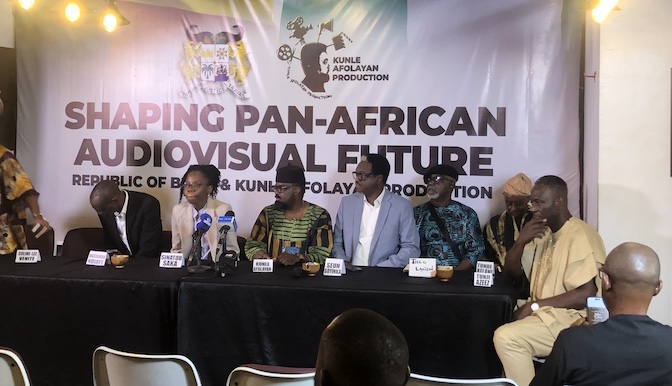

In a landmark move for African cinema, Kunle Afolayan and the Republic of Benin on Thursday signed a Memorandum of Understanding (MoU) aimed at transforming the region’s audio-visual and film production landscape.
The signing ceremony, held at the KAP Hub in Ikeja, Lagos — Afolayan’s renowned training centre, marks the formal commencement of a strategic partnership initiated at the instance of Benin President Patrice Talon. The collaboration reflects a shared vision to leverage cinema, youth empowerment and creative infrastructure as tools for cultural diplomacy, economic growth and global competitiveness across Africa.
Speaking at the event, Afolayan described the agreement as a bold step towards dismantling linguistic and cultural barriers in African filmmaking. He explained that the MoU goes beyond film production, encompassing training and capacity building. Under the agreement, KAP Academy will collaborate with Sèmè City’s film lab to train young creatives from both Nigeria and Benin.
He said, “For me, this further buttresses the fact that film does not have a language barrier. We’re all telling stories and the important thing is you looking for stories that have cultural value at least to a large extent and it won’t matter what language you speak or where you’re from. And that is what we’re trying to do here.
“This MOU is not only covering film making, it is also covering training, which is what we call capacity building. So, KAP Academy is going to be dealing with Sèmè lab and we’re going to form an alliance and train the young people from Nigeria and Benin Republic. We’re also going to be partnering in building a multi-purpose film city in Benin Republic.
“I feel that it will further help to empower a lot of young people and then also our local content. I think that is one of the areas where we need to support the Republic of Benin. I feel there are a lot of young people there who are hungry to do content. They have the idea, they have the potential. They just need a bit of mentorship from other people. And these are things we’re going to contribute.”
He further revealed plans to establish a Museum of African Cinema within the KAP Film Village, designed to preserve and celebrate the continent’s filmmaking heritage.
He said, “It’s our intention to also have a museum within the KAP village and this is going to be a museum of African cinema, meaning it’s going to capture the essence of why we’re even called African filmmakers. For me, training is very important. We’re going to make sure that we influence and also help with building the capacity. I believe by the time this partnership starts, we’ll see more content from Benin that we’ll release in Nigerian cinemas.
“So we are going to focus on ensuring that we do co-production of films that will break barriers. Those are some of the areas we’re going to focus on.”
Sinatou Saka, representing the Beninese delegation, described the partnership as a defining moment for her country.
She said, “Benin will become a very big country in cinema. It’s important for us to tell our stories and improve our talent competence. This is a big moment for us.”
Meto Adoglo, Programme Manager for Incubators in Storytelling and Cinema at Sèmè City, noted that the partnership was rooted in a broader ambition to build national champions capable of competing globally.
He said, “I think it began with a dream to build national champions. Champions that we want to be seen globally and we have to accept the fact that Nigeria is huge in the creative space and we cannot achieve that without Nigeria. Hence, the partnership with KAP. Benin dreams to be one of the centers of the industry in terms of creating infrastructure.”

Adoglo explained that Sèmè City, a development agency for young creatives, has been investing in studios, incubators and training programmes. The agency is currently collaborating with EbonyLife Group on the Sèmè City Film Lab, where Nigerian creatives have already received funding to develop pilot projects.
“We want to attract Africa to Benin,” he said. “It’s also a way to make money and also a way to provide visibility of our country and help our young ones.”
Responding to questions about the partnership’s regional impact, Afolayan described it as a significant move for West Africa and beyond. “This should spread to Cameroon to Gabon, to Kenya to South Africa and all of that.”
Veteran filmmaker Tunde Kelani hailed the collaboration as long overdue, saying, “The lesson is that we have neglected ourselves for so long. But I’m happy that this is happening in my lifetime through Kunle Afolayan Productions and this collaboration with Beninois, it’s sort of an African cultural asset. We are teaming up and this is going to contribute to the richness of African storytelling and African film making.”
As Nigeria and Benin bridge linguistic divides and pool creative resources, the partnership signals a broader continental shift — one where African stories are told by Africans, for the world.
Melissa Enoch
About the Author