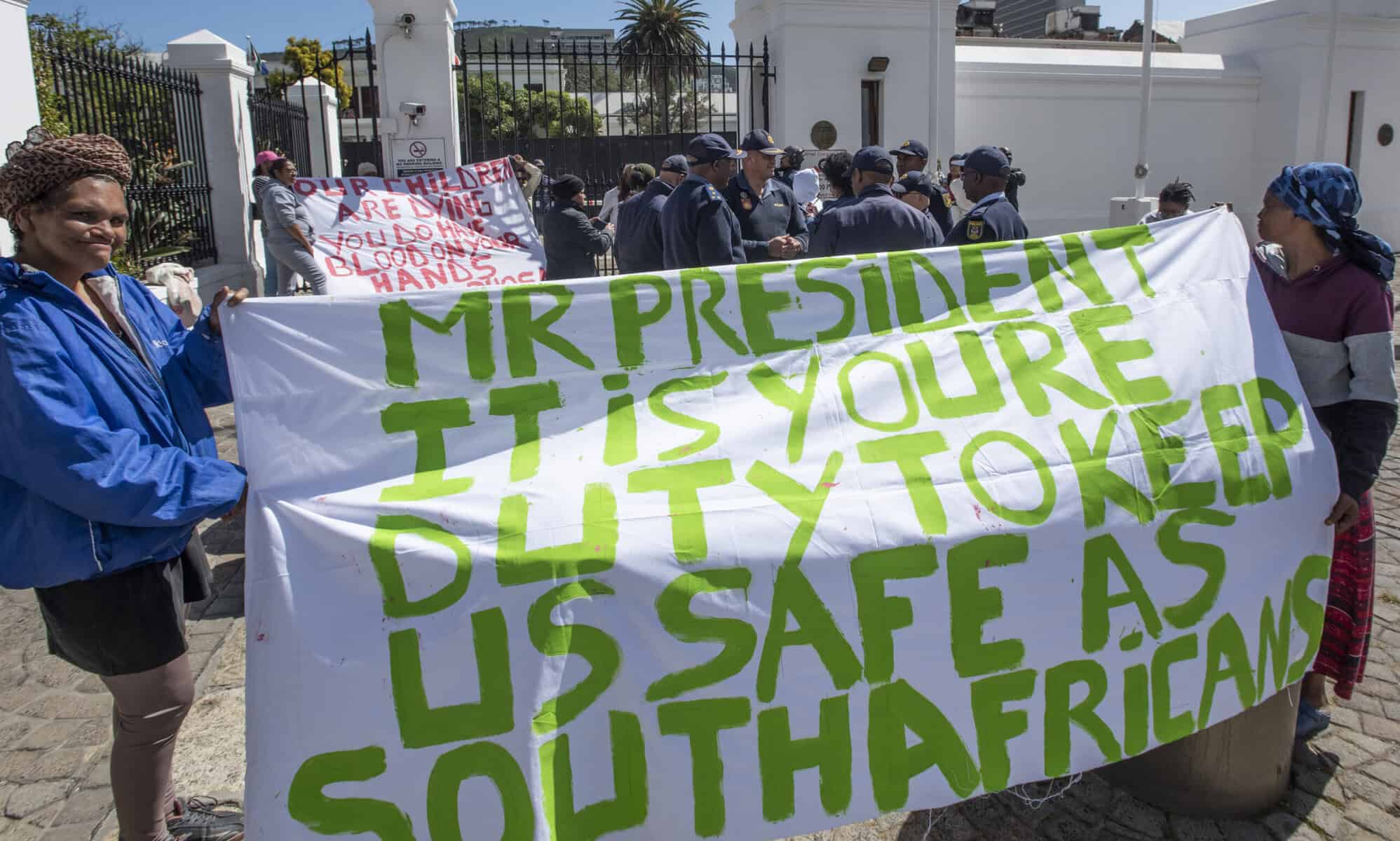
CAPE TOWN, SOUTH AFRICA - SEPTEMBER 16: 25 women from Overcome Heights near Muizenberg picketed outside Parliament and 4 women chained themselves to the Parliaments gates during a protest against violence and shootings in the Western Cape on September 16, 2025 in Cape Town, South Africa. Recent reports highlight a severe increase in gang violence in the Western Cape, including a mass shooting in Overcome Heights in August 2025. (Photo by Gallo Images/Brenton Geach)
The involvement of civil society groups in the fight against gangsterism in the Western Cape – and also declaring it a provincial disaster – will help to fight the scourge, according to experts.
Recently, the Cape Crime Crisis Coalition (C4) announced that it was negotiating with the authorities to declare the crisis a provincial disaster and also to officially include civil society groups in a fight against the crisis, which has claimed the lives of many young people in the Western Cape.
Civil society challenges government silence on gang violence
In an interview with The Citizen yesterday, C4 chair reverend Llewellyn MacMaster, said: “While the Western Cape provincial government, under premier Alan Winde, is rightly and urgently advocating for a provincial state of disaster in response to recent wildfires and the impending drought, it continues to maintain a disturbing and morally indefensible silence on a far more deadly, persistent, and entirely human-made catastrophe.
“[This] is the ongoing gang violence crisis devastating communities on the Cape Flats. This stark contrast in urgency and political will raises a deeply troubling question,” said MacMaster.
“We are appealing to the government to meet with us and design a new plan together as civil societies, because previous plans did not work. They initially sent the army but that never helped.”
‘The law is clear’
MacMaster said communities and religious leaders had appealed for a long time to the government to declare gangsterism a provincial disaster so different government departments could also play a role.
He said it appeared the communities most impacted by gang violence and murders do not constitute a disaster worthy of the same decisive action.
“The law is clear. The Disaster Management Act defines a “disaster” as a progressive occurrence that causes death, injury, social disruption, or material damage on a scale that exceeds the ability of the affected community to cope using its own resources.”
He said in October, approximately 400 people, including young men and women and children, were murdered in the Western Cape.
Experts warn policing alone cannot solve gangsterism
Christo van der Rheede, executive director of the FW de Klerk Foundation, said the organisation supports the renewed calls by the C4 and other civil society bodies for a provincial state of disaster to respond to escalating gang violence on the Cape Flats.
ALSO READ: ‘Declare gangsterism a crisis’ — crime experts warn
“The foundation supports this call in principle, as the current trajectory reflects a complete failure of prevention, investigation, and prosecution, and requires urgent, coordinated and lawful intervention.”
University of Limpopo criminology expert Prof Witness Maluleke said there was a need to include the help of civil society, and also declaring the matter a provincial disaster.
Maluleke said the government’s work against gang-related death and gangsterism was flawed and not working.
The root causes of this cannot be fully understood without addressing the social ills, which were beyond the work of the police.
“The help of other relevant stakeholders remains relevant because police cannot win this war alone.
“This is a national disaster, with the provincial levels obviously mostly affected. This is downscaled to the rural communities and townships, where less policing is witnessed.”
Maluleke added gang-related deaths and gangsterism should be prioritised and a multidisciplinary approach should be applied to effectively respond to this never-ending scourge.
Trust deficit and safety risks for activists highlighted
Willem Els, an expert from the Institute for Security Studies, said if the government was winning, the country would not have been in this dire situation.
“It is, however, an ideal opportunity for the minister, the national and provincial commissioner to tackle the challenges with fresh, evidence-based solutions.”
ALSO READ: Defeating gangsterism means disarming gangs
Els said it was vital for civil society, the private sector and communities to breach the trust deficit between them and the police to work on a unified response to the threat of organised crime and gangsterism.
“Without them, the police will continue to lack an effective response.
“When a provincial state of disaster is declared, it has far-reaching effects on the whole province, so a more focused response prioritising service delivery with a well-equipped and resourced plan against the threat may be a better response.”
Activists could be ‘targeted and killed’
Mike Bolhuis, an investigator specialising in serious violent and economic crimes and cybercrime, has welcomed the call for declaring the issue a provincial disaster and the involvement of civil society.
However, Bolhuis said civil society groups must be well organised to avoid a situation in which activists will find themselves targeted by the criminals.
“The groups must be careful on how they intervene because, should the criminals believe they are directly working with the police, they will be targeted and killed.
“However, if the groups will be working like Red Cross Society, they will be safe.
“Some of the most important things in this fight are to have well-resourced informants, who will be working with well-trained police officers, who are not corrupt,” Bolhuis said.
Bolhuis reiterated a need for upscaling the training level of the police.
NOW READ: ‘It isn’t ordinary gang violence’: Cachalia says boys aged 13 recruited into organised crime
About the Author