Religious Coalition Raises Alarm Over AI Misuse Against Faith in Nigeria
Concerns over the impact of artificial intelligence on religion took centre stage in Lagos, as faith leaders cautioned against the misuse of emerging technologies to distort religious teachings. The warning came from the Nigeria Religious Coalition on Artificial Intelligence (NRCAI), which includes the Christian Council of Nigeria (CCN) and Jama’atu Nasril Islam (JNI), during a …
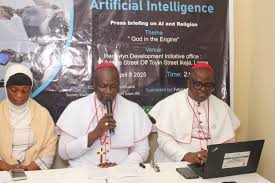
Concerns over the impact of artificial intelligence on religion took centre stage in Lagos, as faith leaders cautioned against the misuse of emerging technologies to distort religious teachings.
The warning came from the Nigeria Religious Coalition on Artificial Intelligence (NRCAI), which includes the Christian Council of Nigeria (CCN) and Jama’atu Nasril Islam (JNI), during a media engagement aimed at examining the growing intersection between technology and religion.
Leaders of the coalition said they are increasingly uneasy about how AI-powered platforms are being used to circulate misleading claims about religion, particularly among young people who are deeply engaged with digital tools. They noted that the speed and reach of AI-generated content make it easier for false or harmful narratives to spread widely.
General Secretary of the CCN, Evans Onyemara, said the trend appears to be deliberate and warned that it could create confusion and weaken long-held beliefs if not properly addressed. He stressed the importance of ensuring that technology is not used in ways that promote division or discredit faith.
Also speaking, Kolade Fadahunsi of the CCN’s Institute of Church and Society acknowledged that artificial intelligence offers many benefits but warned that its use must reflect Nigeria’s religious and cultural realities rather than undermine them.
Adding a broader perspective, Executive Director of the Renevlyn Development Initiative, Philip Jakpor, said Africa must take a more active role in shaping AI development to protect its identity. He explained that many existing AI systems rely heavily on foreign data and perspectives, which may not fully represent African traditions and beliefs.
Jakpor further noted that Africa’s limited participation in AI innovation is due to infrastructure challenges, funding constraints, and insufficient local data. He urged journalists to improve their understanding of artificial intelligence and report responsibly, while encouraging stakeholders to develop technology that supports, rather than erodes, Nigeria’s cultural and religious values.