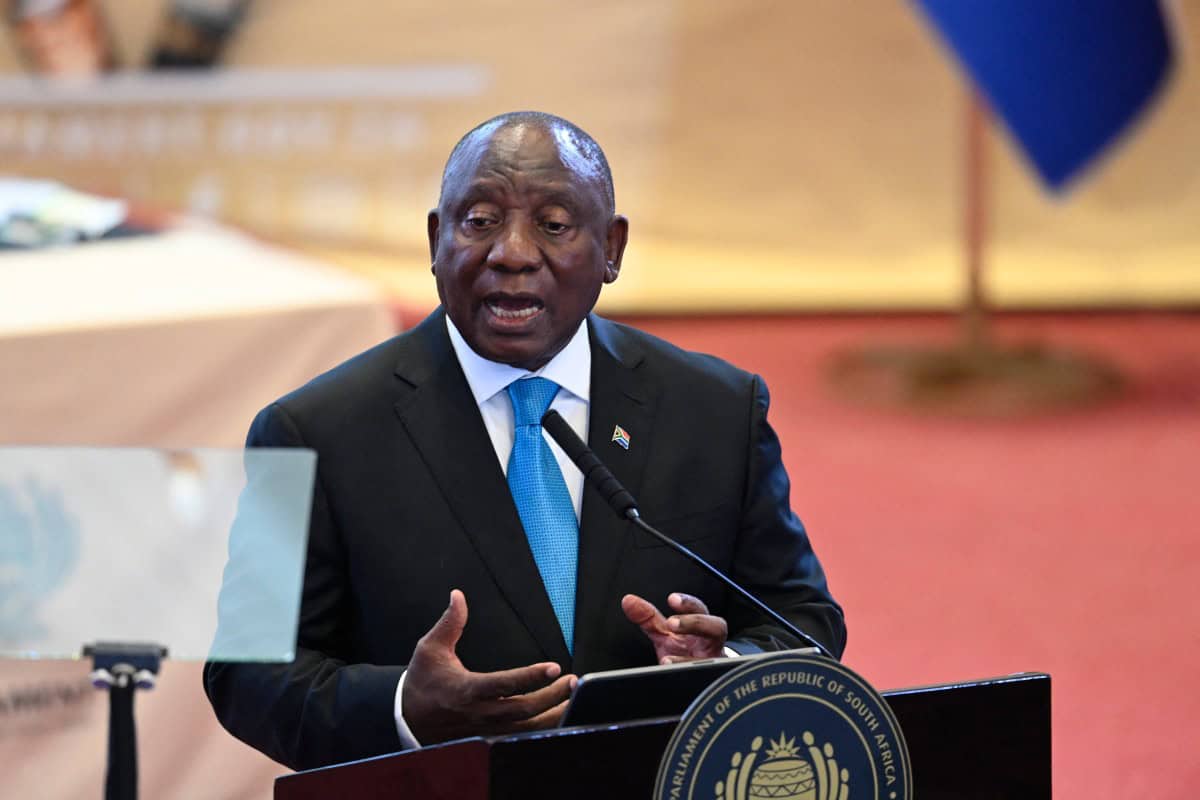
South African President Cyril Ramaphosa gestures as he delivers the State of the Nation (SONA) address in Cape Town on February 12, 2026. (Photo by Rodger Bosch / POOL / AFP)
President Cyril Ramaphosa promised last night to wield the big stick in two crisis areas which most concern South Africans at the moment – crime and water shortages.
In his State of the Nation Address (Sona) at parliament, he pledged to deploy the South African National Defence Force within days to two major flashpoints area: gang-tormented areas on the Cape Flats and those parts of Gauteng where zama-zama illegal miners have become a law unto themselves as criminal bands and displacing residents from their homes.
The country’s high murder rate of about 60 deaths a day includes killings in wars between drugs gangs in areas of Cape Town and mass shootings linked to illegal mining in Gauteng.
Ramaphosa deploys army against gangs and illegal mining
“Organised crime is now the most immediate threat to our democracy, our society and our economic development,” Ramaphosa said.
“I will be deploying the South African National Defence Force to support the police.”
ALSO READ: Sona: SA army to march into Cape Town and parts of Gauteng, says Ramaphosa
Ramaphosa said he had directed the police and army chiefs to draw up a plan on where “our security forces should be deployed within the next few days in the Western Cape and in Gauteng to deal with gang violence and illegal mining”.
Other measures to fight crime included recruiting 5 500 police officers and boosting intelligence while identifying priority crime syndicates, he said.
“The cost of crime is measured in lives that are lost and futures that are cut short.
Cost of crime
“It is felt also in the sense of fear that permeates our society and in the reluctance of businesses to invest,” Ramaphosa said.
After pleas from across the spectrum to address the water crisis besetting some area of the country, Ramaphosa announced that national government will start intervening directly in those municipalities which could not deliver basic services.
ALSO READ: READ: President Cyril Ramaphosa’s State of the Nation Address in full
He said the priority was Johannesburg, where water outages have spread rapidly and widely in the past month.
He confirmed the deployment of ministers to the city to help implement plans to tackle the problem.
However, he also disclosed government would be taking stern action against those who failed to deliver on their mandate.
Stern action against those who failed to deliver
He said 56 municipalities had already been “criminally charged” because of failures in service delivery.
He did not specify, however, what laws the towns and cities had allegedly broken.
ALSO READ: Best and worst of Sona’s red carpet: Nomvula Mokonyane wins it again!
However, he said it was government’s intention to also hold criminally accountable those officials who failed to carry out their duties.
If municipalities and metros were unable to deliver basic services, such as water, then the responsibility would be taken away from them, he said.
This increased speculation among ANC critics – especially in organised labour – that the government planned to privatise water delivery functions.
Local govt not up to the task of service delivery
However, the president also admitted, frankly, that the current system of local government was not up to the task of service delivery.
He quoted from the recent Auditor-General’s report on towns and cities which was a laundry list of failings: from lack of accountability to deficient book-keeping to incompetence.
ALSO READ: Ramaphosa pulls two ministers from Sona: Here’s why
He said that the government would soon be publishing a White Paper which would outline proposals for a radical transformation of the entire local government structure.
Ramaphosa claimed South Africa, as a whole was “in much better shape” than it was a year ago.
SA ‘in much better shape’
He cited the lowest inflation in 20 years, an improvement of the rand against the dollar, the removal of the country from the global financial greylist and three consecutive quarters of GDP growth as reasons for optimism.
This was also reflected, he said, in an improvement in investor confidence in South Africa.
About the Author