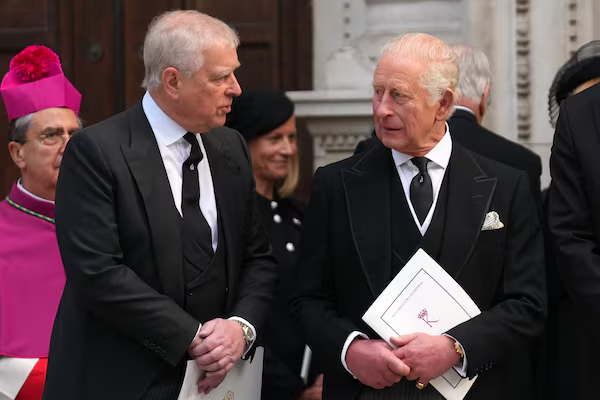
The arrest of Prince Andrew has plunged King Charles III into what many observers describe as the most serious crisis of his reign, compounding a series of personal and institutional challenges that have tested the British monarchy since he ascended the throne.
Charles became king in September 2022 following the death of his mother, Queen Elizabeth II, whose 70-year reign embodied continuity and stability. His coronation on May 6, 2023, was steeped in tradition and pageantry, designed to signal a seamless transition. Yet even before the ceremony, strains within the royal family were surfacing.
In January 2023, the king’s younger son, Prince Harry, released his memoir Spare, offering candid and often critical accounts of royal life.
The publication deepened divisions within the family, with Harry — now living in California with his wife Meghan — accused by critics of undermining the institution for personal and commercial reasons. Although there have been gestures toward reconciliation, relations remain fragile.
Further strain came in February 2024 when King Charles III revealed he was undergoing treatment for cancer, prompting him to scale back public duties. Weeks later, Catherine, Princess of Wales announced she too was receiving cancer treatment. While Catherine has since said she is in remission and the king has indicated his treatment is being eased, the illnesses cast a shadow over the royal household.
Throughout his diagnosis, Charles earned praise for his candor and composure, publicly visiting cancer patients and advocating early detection and prevention. However, analysts suggest the gravest threat to his reign stems from the renewed controversy surrounding his younger brother, Prince Andrew.
Andrew’s long-standing association with disgraced financier Jeffrey Epstein has dogged the monarchy for years, severely damaging his public standing.
In October, Charles sought to distance the institution from the scandal by stripping Andrew of his remaining titles. Yet newly released documents from the U.S. Department of Justice reignited scrutiny.
On Thursday, Andrew was arrested and questioned for several hours by police on suspicion of passing confidential information to Epstein during his tenure as the United Kingdom’s trade envoy between 2001 and 2011. It marked the first time in modern history that a senior British royal has been arrested.
In a rare personally signed statement, Charles said the “law must take its course” and expressed his “deepest concern.”
Commentators have drawn parallels to past constitutional shocks, including the 1936 abdication of Edward VIII and the 1997 death of Diana, Princess of Wales — crises that required years to repair public trust.
For some analysts, the current moment represents a pivotal test of the monarchy’s resilience. They argue that if it were shown that senior royals knowingly protected Andrew, the fallout could be severe, potentially shaking confidence in the institution’s moral authority.
Others note that Charles inherited longstanding issues. The late queen, they suggest, shielded Andrew from the full force of public accountability during her reign, leaving her successor to confront the consequences.
Restoring public confidence, experts say, may require visible reform. Prince William has signaled a desire to modernize aspects of the monarchy, and observers argue that such change may now become more urgent than ever.
As the legal process unfolds, the episode threatens not only to define Charles’s reign but also to test the durability of an institution long associated with continuity, stability and tradition.
About the Author