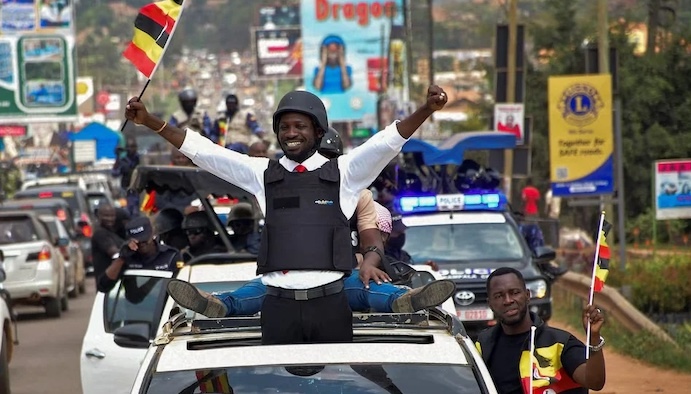
Ugandan pop star and opposition candidate Bobi Wine says he has been beaten, tasered and attacked with teargas and pepper spray while campaigning against long-serving President Yoweri Museveni.
Now 43, and nearly a decade into his political career, violence on the campaign trail, opens new tab comes as no surprise to a man who has built his political identity on uncompromising opposition to what he calls Museveni’s “dictatorship”.
Wine, whose legal name is Robert Kyagulanyi, is not widely thought to have any chance of winning Thursday’s election against a president who has been in power since 1986, when Wine was just three.
But by mobilizing millions of disenchanted young Ugandans in his second bid for the presidency, Wine has emerged as Museveni’s most formidable challenger in years, at a time when the 81-year-old Museveni is thought to be planning his succession.
“Every time we go through this treacherous atmosphere and we get to the people, it’s like a breath of fresh air,” Wine told Reuters this month.
“The knowledge that the regime is actually doing this to ‘break my back’, that they’re doing this to demoralize us – we choose to deliberately not stop, just to show them that we can keep going.”
The government has said the security forces intervened only when Wine supporters violated campaign rules by blocking traffic or holding events outside prescribed times.
Museveni has often dismissed Wine as an agent of foreign interests, including those who wanted to promote homosexuality.
The charge aims to erode Wine’s support in the predominantly Christian and conservative country, which has some of the world’s harshest anti-gay laws.
Wine took on Museveni in 2021 in an election marred by the security forces killing more than 50 opposition supporters on the campaign trail and by accusations of widespread fraud. Wine was detained several times during the campaign and started wearing a bullet-proof jacket and helmet.
He later withdrew a court case challenging the result, in which Museveni was credited with winning 58% of the vote, and accused the judges hearing it of bias. The U.S. government said the poll was neither free nor fair, charges rejected by Museveni’s government.
During this campaign, security forces have repeatedly fired live bullets and teargas at Wine’s campaign events, killing at least one person, and have arrested hundreds of his supporters.
With Museveni’s election victory all but assured, attention has focused on the vote’s implications for the president’s eventual succession.
Museveni is widely believed to want to hand power eventually to his son and military chief, Muhoozi Kainerugaba, and is seeking a wide margin of victory to assert his authority. He will also be keen to avoid widespread protests that might undermine his position and fuel divisions in the ruling party.
Museveni has denied grooming Kainerugaba to succeed him.
The 20th child in a polygamous family of 33 siblings, Wine has said his music and politics were inspired by the struggles his mother faced as she hawked street food in the capital Kampala’s Kamwokya slum.
His musical career took off in the early 2000s with songs decrying urban poverty and political oppression, backed by catchy, feel-good beats that made him one of East Africa’s most popular artists.
“When the going gets tough, the tough must get going especially when leaders become misleaders and mentors become tormentors,” he sang in a 2016 song titled “Situka”, which means “Rise Up” in the local Luganda language.
He joined parliament in 2017 after securing a surprise landslide victory in an election for a constituency near Kampala and increased his political clout by channeling the anger of young people.
Over 73% of Uganda’s about 46 million people are under the age of 30, and the percentage of young people not working, studying or training is over 42%, according to a government census from 2024.
Wine says that if he were elected, he would focus on restoring the rule of law, boosting employment and stamping out corruption.
Some Ugandans, including government critics, have bemoaned the lack of specificity in Wine’s proposals. LGBTQ rights activists have criticised him for not more vigorously opposing a 2023 law that imposed the death penalty for certain same-sex acts.
Wine criticised the law as a political ploy and has pledged not to persecute LGBTQ people, but did not directly condemn its contents.
He has also been unable to unite Uganda’s opposition behind him, so six other candidates are also challenging Museveni.
Writing on social media in 2024, Wine attributed the opposition’s lack of unity to Museveni’s success in co-opting it.
Some people, he wrote, are “zero concerned about removing Museveni as long as they’re comfortable in the opposition”.
His musical career took off in the early 2000s with songs decrying urban poverty and political oppression, backed by catchy, feel-good beats that made him one of East Africa’s most popular artists.
“When the going gets tough, the tough must get going especially when leaders become misleaders and mentors become tormentors,” he sang in a 2016 song titled “Situka”, which means “Rise Up” in the local Luganda language.
He joined parliament in 2017 after securing a surprise landslide victory in an election for a constituency near Kampala and increased his political clout by channeling the anger of young people.
Over 73% of Uganda’s about 46 million people are under the age of 30, and the percentage of young people not working, studying or training is over 42%, according to a government census from 2024.
Wine says that if he were elected, he would focus on restoring the rule of law, boosting employment and stamping out corruption.
Some Ugandans, including government critics, have bemoaned the lack of specificity in Wine’s proposals. LGBTQ rights activists have criticised him for not more vigorously opposing a 2023 law that imposed the death penalty for certain same-sex acts.
Wine criticised the law as a political ploy and has pledged not to persecute LGBTQ people, but did not directly condemn its contents.
He has also been unable to unite Uganda’s opposition behind him, so six other candidates are also challenging Museveni.
Writing on social media in 2024, Wine attributed the opposition’s lack of unity to Museveni’s success in co-opting it.
Some people, he wrote, are “zero concerned about removing Museveni as long as they’re comfortable in the opposition”.
Faridah Abdulkadiri
About the Author