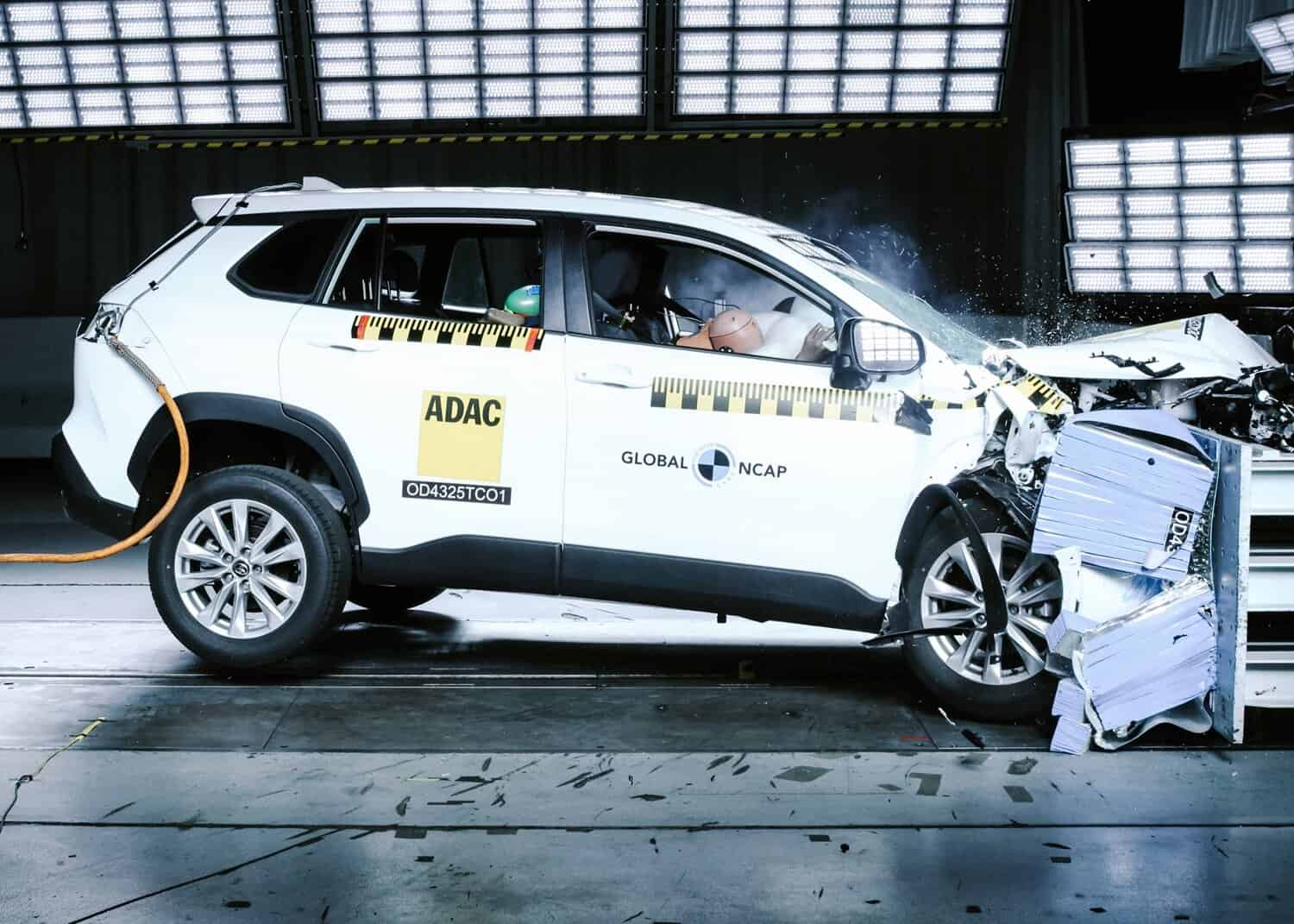
A big hoo-ha was recently made of the fact that the Toyota Corolla Cross “only” scored two stars during a crash test.
And just before that, the zero stars obtained by the Hyundai Grand i10 hatchback.
Both tests were done by Global NCAP in conjunction with the AA’s #SaferCarsforAfrica campaign.
Corolla Cross under microscope
On this week’s episode of The Citizen Motoring’s Pitstop podcast, we discuss the two cars that were heavily scrutinised after the announcement of the test results. And we say why these test results mean little until all models on sale locally are subjected to similar testing.
The Toyota Corolla Cross that was used during the Global NCAP crash test was reportedly a lower specced model. This could have resulted in the test findings indicating a lack of side head protection. Rear side airbags, which is likely to increase the level of protection, is offered on higher specced models.
Hyundai reacted to the zero-star rating by saying the hatch adheres to the National Regulator for Compulsory Specifications on-road requirements. That was also Nissan’s response in the early days of the #SaferCarsforAfrica campaign after the NP300’s zero-star rating.
Vision not feasible
The AA said during the early days of the campaign that its vision is for the safety rating of every car on every showroom floor to be displayed in its window. While this vision is the ultimate solution, it will be virtually impossible to pull off.
ALSO READ: Global NCAP hits Toyota Corolla Cross with two-star safety rating
The cost of taking every single local model derivative to Europe for testing will need a massive investment. And if you take into account the regularity at which models are updated, the investment will need to be an ongoing one.
Therefore the National Regulator for Compulsory Specifications on-road requirements remains the only set of regulations all models adhere to.
About the Author