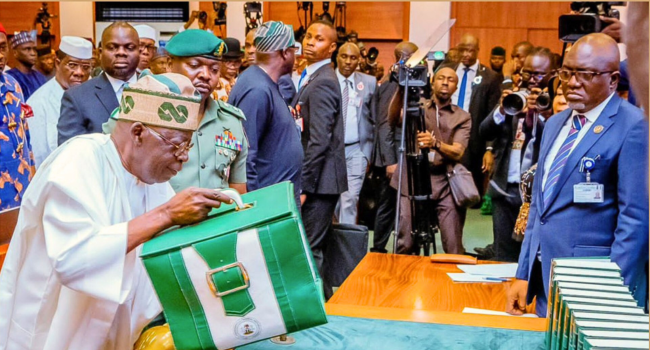
Opposition party questions GDP growth claims, cites rising poverty and insecurity despite record spending proposal
The Peoples Democratic Party (PDP) has criticised President Bola Ahmed Tinubu’s proposed 2026 federal budget, describing it as a plan that would further entrench economic hardship rather than ease the suffering of Nigerians.
President Tinubu on Friday presented a ₦58.18 trillion 2026 Appropriation Bill to the National Assembly, projecting gradual economic recovery and pledging tighter fiscal discipline under his administration.
However, the PDP, in a statement issued by its spokesman, Ini Ememobong, rejected the optimism surrounding the proposal, branding it a “budget of consolidated renewed sufferings.”
According to the party, Nigerians have endured worsening living conditions since the current administration took office, while those in government continue to enjoy comfort and privilege.
“What we see is not relief for the people but a continuation of unmitigated hardship, even as the governing class lives in affluence,” Ememobong said.
President Tinubu had cited a 3.98 per cent Gross Domestic Product (GDP) growth rate as evidence of economic stabilisation. The PDP, however, argued that the figure does not reflect the reality faced by millions of citizens.
Referencing the 2025 World Bank Poverty and Equity Brief, the party noted that more than 30.9 per cent of Nigerians currently live below the international extreme poverty line.
“This confirms that Nigeria is experiencing growth without prosperity,” the statement said. “Despite reported GDP growth, poverty remains widespread, showing that whatever economic gains exist are not reaching the majority of Nigerians.”
The PDP also faulted the President for failing to specify the sectors responsible for the reported economic growth or identify the segments of the population benefiting from it.
Ememobong compared the current growth rate with the 6.87 per cent recorded in 2013 under the last PDP-led federal government, noting that the earlier performance was largely driven by non-oil sectors such as agriculture and trade.
The opposition party further raised concerns over the country’s security situation, calling for greater transparency and accountability in the use of security funds.
It urged the federal government to ensure that allocations to the security sector translate into modern equipment, adequate ammunition, improved intelligence gathering, and better welfare for security personnel confronting increasingly well-armed criminal groups across the country.
About the Author