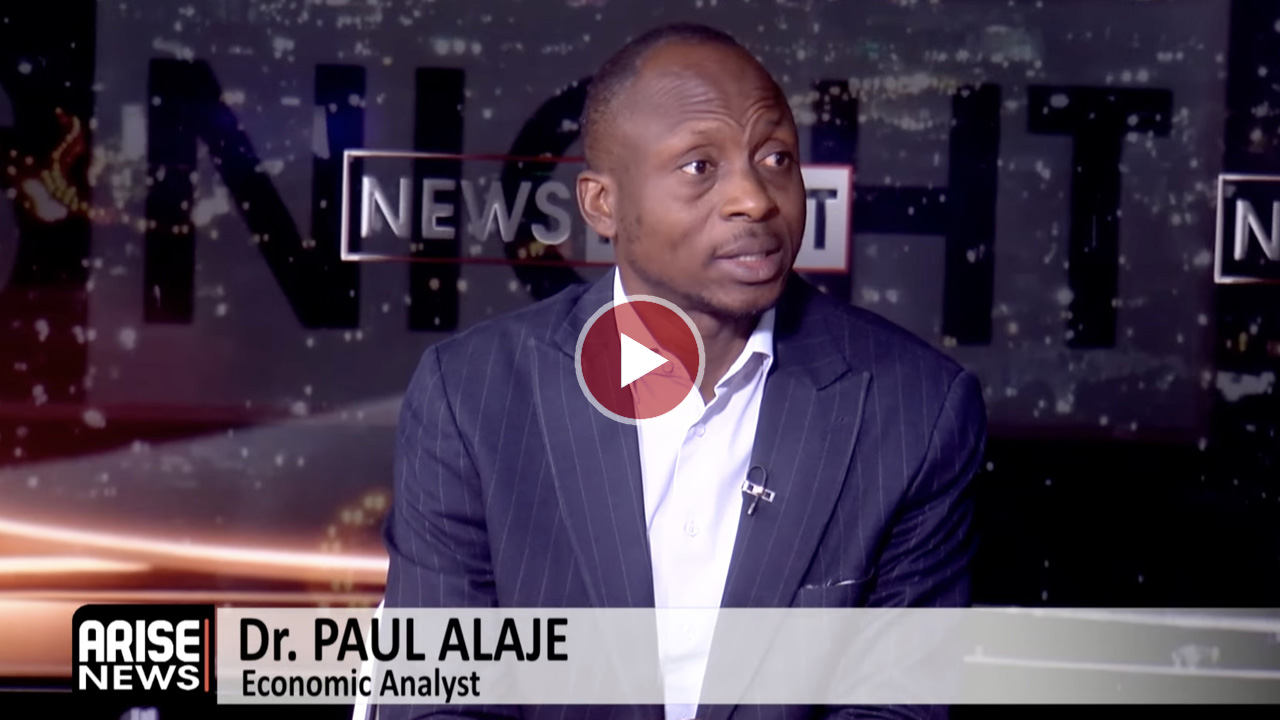

Economic analyst Dr Paul Alaje has said Nigeria’s projected 4 per cent GDP growth in 2026 is achievable largely because of heightened political activity ahead of the 2027 general elections, warning that such growth will remain unsustainable without deliberate investment in manufacturing and supply-side reforms.
Speaking in an interview with ARISE News on Friday while analysing President Bola Tinubu’s New Year message, Alaje said Nigeria’s economy has historically expanded in pre-election years, driven not by productivity gains but by politics-fuelled spending.
“For the GDP growth rate, I believe strongly it is possible because 2026 is a pre-election year,” he said. “Pre-election years are marked with a lot of election activity, and we are going to see a lot of economic activity in 2026.”
He explained that increasing political realignments and campaign spending would inject liquidity across multiple layers of the economy.
“What drives Nigerian pre-election years in terms of economics is politics,” Alaje said. “You will see this up to the second quarter of the main election year, which is 2027. You see more people moving, realigning from one party to another. This is happening at the executive level and the legislative level.”
According to him, politicians who believe they can win elections tend to spend heavily across sectors that boost short-term economic activity.
“Those who feel they can win elections will put money in different areas that will help them. From studies, we have seen clearly that this influences economic activity in Nigeria because it affects all sectors,” he said.
Alaje added that government intervention programmes outlined in the President’s address would further lift GDP figures.
“When you look at the President’s media presentation, you see programmes government is organising for different Nigerians, even at ward level. This is government trying to push funds directly into the grassroots, and you are going to see an improved GDP level.”
On inflation, the economist said the government’s expectation of inflation falling below 15 per cent is largely a statistical outcome of rebasing, not necessarily an immediate improvement in living conditions.
“Why this may be so again is that we have rebased inflation,” he explained. “When inflation is rebased, what you should expect is that the number will drop. In economics, we call this the rebasing effect, and we are going to have it until around April.”
He said rebasing has reduced Nigeria’s official inflation figures, which in turn affects real GDP calculations.
“Based on the upper and lower limits, real GDP is expected to remain between 3.5 and 4.8 per cent,” Alaje said. “But whether people will feel it or not is another conversation entirely.”
Alaje stressed that falling inflation figures do not automatically translate into reduced cost of living.
“Inflation numbers and living conditions are not the same thing,” he said. “The reduced inflation you are seeing is not what you go to the market and feel.”
He recalled the sharp inflation drop recorded in 2025.
“Inflation dropped from about 34 per cent to 24 per cent. People expected prices to go down, but that drop happened because we rebased inflation and adjusted the commodity basket.”
According to him, Nigeria is currently experiencing a statistical outlier period.
“This period where you compare two base years together is usually posted as an outlier,” he said.
On whether election-driven liquidity benefits manufacturers, Alaje said the impact is uneven and largely short-lived.
“People around political activities feel the impact directly,” he said. “However, manufacturers may not all benefit. Printers will benefit, but producers of other items may not. This has been the pattern since 2003.”
He warned that Nigeria’s long-term economic recovery depends on industrial expansion, not political cycles.
“If you’re looking for what will help Nigeria come out of economic quagmire in the long run, we must be deliberate about the manufacturing sector,” he said.
Citing official data, Alaje expressed concern over the sector’s weak performance.
“The Bureau of Statistics reported that manufacturing growth was only 1.5 per cent. Manufacturing alone should contribute at least 30 to 33 per cent over the next 20 to 30 years,” he said.
Without structural change, he warned, GDP growth will continue to spike only during election seasons.
“By 2030, if we don’t change some indicators, you will still see GDP shoot up because of political activity,” he said. “We need to change from a politics-driven economy to a production-driven one.”
On foreign reserves, Alaje acknowledged improvements but attributed much of the gains to reduced fuel imports.
“It is good and true that foreign reserves have increased to about $45 billion,” he said. “But we must acknowledge the contribution of the Dangote Refinery.”
He said domestic refining has saved Nigeria billions in import costs.
“If only 50 per cent of local PMS production can boost reserves this much, imagine having two or three refineries and no need to import at all,” he said.
Alaje also stressed that security remains critical to attracting sustained foreign investment.
“Imagine Nigeria being safe from Sokoto to Calabar, Lagos to Maiduguri. We will see far more investment inflows,” he said.
He reiterated his long-held position on subsidy reform.
“It was never about removing subsidy first. It was about ensuring functional local refineries. Once that is done, you can remove subsidy.”
The economist said Nigeria has the potential to become a global economic leader if it builds a manufacturing-led economy.
“Nigeria has the capacity not just to lead Africa, but to lead the Global South,” he said. “But that will not happen without sacrifices — manufacturing, production, and linking schools, farms and markets.”
Alaje concluded with a warning over election-year pressure on foreign reserves.
“Foreign reserves may drop quickly in a pre-election year if politicians spend dollars,” he warned. “My advice to President Tinubu is to ensure everything spent on elections is in naira.”
“Save the soul of the naira by not allowing dollar spending. Then we will have a great economy at the end of the day.”
Boluwatife Enome
About the Author