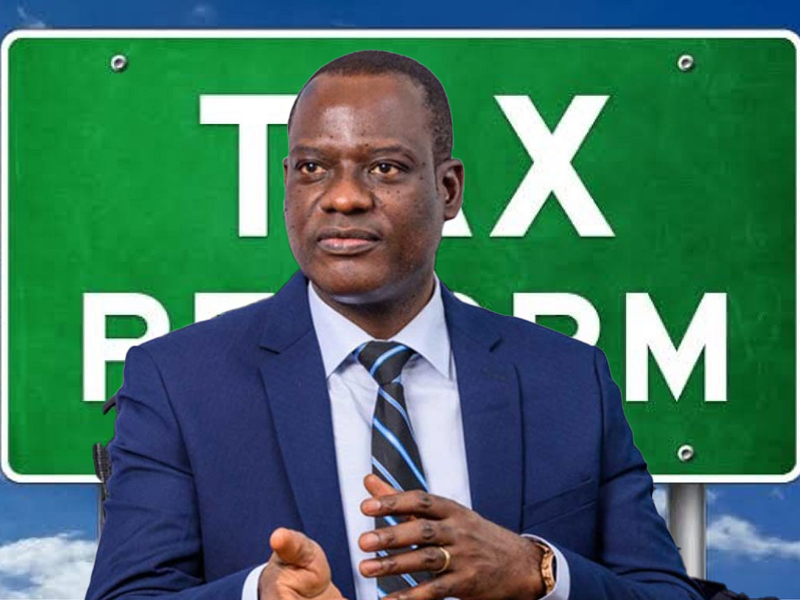
Taiwo Oyedele, Chairman of the Presidential Fiscal Policy and Tax Reforms Committee, has clarified that Nigeria’s new tax laws will not allow government agencies to debit citizens’ bank accounts, stressing that taxpayers will instead self declare their income and pay taxes accordingly.
Oyedele made the clarification during a television interview clip shared on his X account on Wednesday, explaining how the proposed tax system works, who is required to pay, and how small businesses and vulnerable Nigerians will be protected under the reforms.
“Nobody will debit your account, any amount of money you transfer, whether it’s 1billion, whether it’s 1 thousand, it doesn’t matter how you describe it, nobody will debit your bank account,” Oyedele said. “At the end of the year you tell the government yourself. You know the amount that is your income you know the one that is not your income. So you tell the government this is my income and here is the tax.”
He added that individuals who are exempt from tax obligations are not required to make payments, saying, “If you’re exempted you don’t need to pay any tax, just say this is my income and you’re exempted from tax. So it’s a very simple process that we’re even simplifying even further.”
Oyedele also highlighted that the reforms offer significant relief to small businesses, including informal operators and sole proprietors, noting that the committee developed mechanisms to protect those with limited earning capacity.
“Now if you run a small business, this is even one of the biggest benefits of the tax reform, if you run a small business as a sole proprietor, as an enterprise, or you don’t even have a name for the business just hustle,” he said.
According to him, the reforms introduce a presumptive tax regime for businesses with low turnover, adding, “We have developed what we call a presumption tax regime… if your annual income turnover is 12million or less, you have no capacity to pay tax because that 12 million is not the money you can spend right.”
Oyedele said specific categories of low income businesses have been clearly identified to prevent arbitrary assessments by tax officials. “We went further and listed certain businesses that can not make money, vulcanizers, somebody is roasting corn by the roadside… there’re some businesses where if you have customers for 24 hours and you manage not to sleep you’re still a poor person,” he said.
To protect such operators, he disclosed plans to introduce tax exemption stickers, explaining that “what we’re planning to do is for us to get tax exemption stickers, so nobody will bother them.”
On tax administration at the subnational level, Oyedele said the committee worked within constitutional limits to promote uniformity, noting that “the constitution says the center can not dictate to the state and local government, so we then drafted… a tax harmonization law for subnational.”
He revealed that several states have already begun the process of adopting the framework. “Ekiti state started, we have Zamfara, Anambra, we have Kano… Lagos state has promised to do their own,” he said.
Oyedele argued that the reforms are designed to protect vulnerable Nigerians who are often excluded from policy formulation. “The reform really is interested in the most vulnerable because they’re usually not at the table when people are formulating policies,” he said, adding that despite limited public advocacy from such groups, the government believes “the right thing to do is to press forward until there’s any reason to do otherwise.”
His comments come amid widespread public debate over Nigeria’s new tax laws, which the Federal Government has said will take full effect from January 1, 2026. President Bola Ahmed Tinubu has insisted the reforms will proceed as scheduled, describing them as a “once-in-a-generation opportunity” to reset Nigeria’s fiscal framework and promote fairness and harmonisation.
The Presidency has maintained that the reforms are not intended to increase taxes but to simplify the system, protect low income earners, and strengthen trust between government and citizens, with assurances that genuine concerns raised during implementation will be addressed.
Ademide Adebayo
About the Author