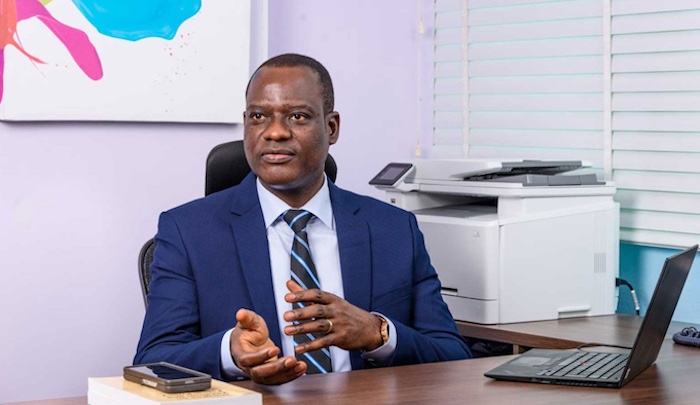
Chairman of the Presidential Fiscal Policy and Tax Reforms Committee, Taiwo Oyedele, has said the Federal Government will not compromise Nigeria’s future to protect individuals and entities that have profited for years without paying taxes, insisting that ongoing reforms are necessary to fix the country’s weak revenue base.
Oyedele made the remarks at the January Business Breakfast of the Franco-Nigerian Chamber of Commerce and Industry (FNCCI) held recently in Lagos, where he addressed resistance to the government’s tax reform agenda and highlighted stark gaps in Nigeria’s tax performance compared to peer economies.
Drawing a comparison with South Africa, Oyedele said the country generated over ₦60 trillion (naira equivalent) from personal income tax alone in 2024, a figure he noted exceeds Nigeria’s total tax revenue from all sources combined.
He explained that Nigeria’s combined revenue from petroleum profit tax, corporate income tax, value-added tax (VAT), and taxes collected by federal, state and local governments still falls short of what South Africa earns from a single tax stream.
“That is one tax from about 60 million people, compared to Nigeria’s 240 million people,” Oyedele said.
While acknowledging that South Africa’s per capita income is higher, he argued that Nigeria still has sufficient economic capacity to significantly increase personal income tax collection if the system works efficiently.
“If you take the top 60 million people in Nigeria based on income, it will be comparable to the per capita income of South Africa,” he said.
Oyedele questioned Nigeria’s poor tax yield, noting that even a conservative benchmark should produce far higher revenues than what is currently collected.
“Let’s say we can’t collect ₦60 trillion, why not ₦30 trillion? Guess how much we collected? It was under ₦3 trillion. Something is wrong — the math is not adding up,” he said.
According to him, the sharp disparity explains the intense pushback against the reforms from certain quarters, stressing that resistance is largely driven by vested interests rather than public concern.
“This is one of the reasons why we find the motivation to keep going, because the people fighting the reforms are not telling you why they’re fighting them. It is because they made money for so long and they never paid taxes,” Oyedele said.
He said the reforms are aimed at building a fair and transparent system where compliance is mandatory and no one is above the law.
“We are designing a system that says nobody will be above the law anymore. You will fight it because it is hard to pay tax anywhere in the world — we understand that — but we will not compromise the future of the country, because what is at stake is much bigger than any of us,” he added.
President Bola Ahmed Tinubu signed four tax reform bills into law on June 26, 2025. Despite calls from some groups for the suspension of their implementation, the new tax laws are scheduled to take effect from January 1, as planned.
Boluwatife Enome
About the Author