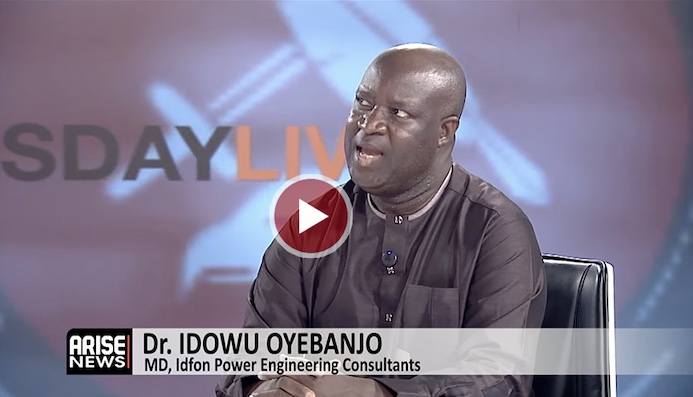
Power systems engineer and Managing Director of IDFON Power Engineering Consultants, Dr. Idowu Oyebanjo, has described Nigeria’s recurring national grid collapses as a “national disgrace,” blaming the crisis on decades of underinvestment, weak planning, and the absence of merit-based leadership in the power sector.
Speaking during an interview with ARISE News on Sunday, Oyebanjo said a national grid collapse is a catastrophic event that would trigger serious consequences in many developed countries.
“A national grid collapse event is a disaster. It is a sad event for any nation. It is bad. In developed economies this will be a showdown, this will be very disappointing. I mean, a person can lose their position. Heads will roll if it were elsewhere. You lose elections and so on and so forth because of grid collapse. It is a national disgrace,” he said.
Nigeria’s power system recently came under renewed scrutiny after the national grid collapsed twice within four days in January 2026, plunging millions of Nigerians into darkness and disrupting economic activities. The outages followed similar incidents in late December 2025 and January 23, 2026, intensifying concerns about the stability of the country’s electricity infrastructure.
Oyebanjo argued that the situation reflects decades of neglect since the country inherited its power infrastructure from the British.
“It is unfortunate that several years after Great Britain built the Nigerian power system and left it for Nigerians to handle, the lack of investments for over six decades has meant that we are struggling with grid collapse, shamefully, at this point in our national development. So I want to say that there is no country that experiences a grid collapse in the manner that we do that should not be ashamed of the situation,” he said.
He added that Nigerians have become so accustomed to the failures that the issue no longer shocks the public.
“Nigerians are now so frustrated about it. They are concerned, but they know now that there will be grid collapse. It has become an everyday thing. So that is not a very good situation.”
Explaining how grid collapses occur, Oyebanjo said the national electricity network operates as an integrated chain, where failure in one segment can destabilise the entire system.
“You have to put the customer first for you to have a very functional power system. You have to want to serve the customers. So why do we have this grid collapse? In a simplistic form, the reason why you have a grid collapse is because of a sudden change in what we call the voltage or frequency of the integrated power system,” he said.
He noted that Nigeria’s electricity generation relies heavily on gas-fired plants.
“Nigeria is a predominantly gas-fired power system. Over 80 per cent of our power generation comes from gas sources. There are other sources like hydro — Jebba, Shiroro and others — but we rely mainly on gas.”
According to him, disruptions anywhere in the electricity value chain — from gas supply to generation, transmission or distribution — can trigger a collapse of the entire grid.
“When this gas is obtained from gas wells, it must be transported through gas infrastructure to generating stations where electricity is produced. When they generate this electricity, it goes on transmission systems — those very tall towers moving power from various parts of the country — and then to the distribution networks that deliver it to the consumer,” he explained.
“If there is a problem in one section, the weakest link will affect the rest.”
He cited several scenarios that can destabilise the system.
“Grid collapse can come from absence of gas. If the gas supplier decides that you owe them a lot of money and they stop supplying gas, the generating companies cannot produce electricity and the grid will eventually collapse.
“If the gas infrastructure is vandalised and the generating company cannot get gas, you can have grid collapse. If the generating station itself has machine failure or cannot repair its equipment because of debts, then you will not have enough generation on the system and the voltage or frequency will change suddenly, and you can have grid collapse.”
He also blamed weak networks and electricity theft for worsening instability.
“You often have faults on transmission and distribution systems because of weak networks. When these faults happen, suddenly you lose voltage or you have frequency changes, either higher or lower. There are set thresholds and once you go outside them, the grid will collapse.
“From the distribution point of view, you also have customers who steal electricity. Because of that, distribution companies sometimes reject power. They know customers want electricity, but they also know some areas will not pay or people steal electricity. If they keep taking power they cannot recover money for, they will become more indebted.”
Oyebanjo also blamed the absence of a fully functional national monitoring system for worsening grid instability.
He noted that Nigeria has struggled for decades to deploy a Supervisory Control and Data Acquisition (SCADA) system that allows operators to monitor and control electricity networks in real time.
“Since 1988 they have been investing in SCADA in this country and we have never seen the end of it. Since 1988 there has been one scandal or the other about getting this SCADA system,” he said.
He noted that the responsibility for acquiring the system now lies with the newly established Nigerian Independent System Operator, which was recently separated from the Transmission Company of Nigeria.
Another major problem, he said, is the lack of proper protection systems and planning in the grid.
“Another thing that is critical is what we call protection. Nigeria has protection systems, but they are not properly coordinated. The absence of coordination of protection systems on the network means that we will always have grid collapse.”
He also warned that poor infrastructure placement and weak planning are causing voltage imbalances across the network.
“You must do proper power system planning to determine the viability of projects economically and technically. But where you don’t do that and you put power system assets in places where there are very few people, what you are doing is causing grid collapse.”
According to Oyebanjo, the single most important reform Nigeria needs in the power sector is merit-based leadership.
“The most important part of having a good power system in Nigeria is meritocracy. Meritocracy is meritocracy is meritocracy,” he said.
He cited Singapore’s founding leader, Lee Kuan Yew, as an example.
“Lee Kuan Yew said when he wanted to transform Singapore there were three things required: meritocracy, pragmatism and honesty. You will never have a vibrant power system in any country where there is no meritocracy.”
He stressed that electricity systems are highly technical and require deep expertise.
“The total concept of power systems is technically intensive. It requires brain power to the highest degree. You do not put people who are not thoroughly trained in key positions because they will take wrong decisions. Some of them don’t even understand the meaning of frequency or voltage.”
Oyebanjo also pointed to Nigeria’s new electricity decentralisation framework as a potential solution.
He noted that the Electricity Act signed by President Bola Ahmed Tinubu in 2023 allows states to develop their own electricity markets independent of the national grid.
“One of the most critical actions is this Electricity Act. This decentralisation of the power system is the fastest way,” he said.
He pointed to developments in Abia State as an example.
“What happened in Abia State is historical. Geometric Power built an integrated power plant where electricity is generated from nearby gas supply and distributed within an enclave in the state. When the national grid collapsed, they did not feel it because they had their own power supply.”
Although the project does not yet cover the entire state, Oyebanjo said it demonstrates what decentralised electricity markets could achieve.
“If all states sign on to this Electricity Act and create their own electricity markets, investors can build integrated power plants where they generate electricity and distribute it locally.”
He stressed that states do not necessarily need to finance projects themselves but must create enabling environments for investors.
“You don’t really need a state government to invest directly. What they must do is create an enabling environment — provide land, rights of way, tax incentives and regulatory certainty. Investors go anywhere they can get returns and repatriate their money.”
However, he warned that leadership quality remains decisive.
“One of the things investors will look for is the people you appoint. If you appoint the wrong people, they know you are going nowhere. If people believe you have appointed the wrong person in a key power sector portfolio, you will not get anything out of it.”
Boluwatife Enome
About the Author