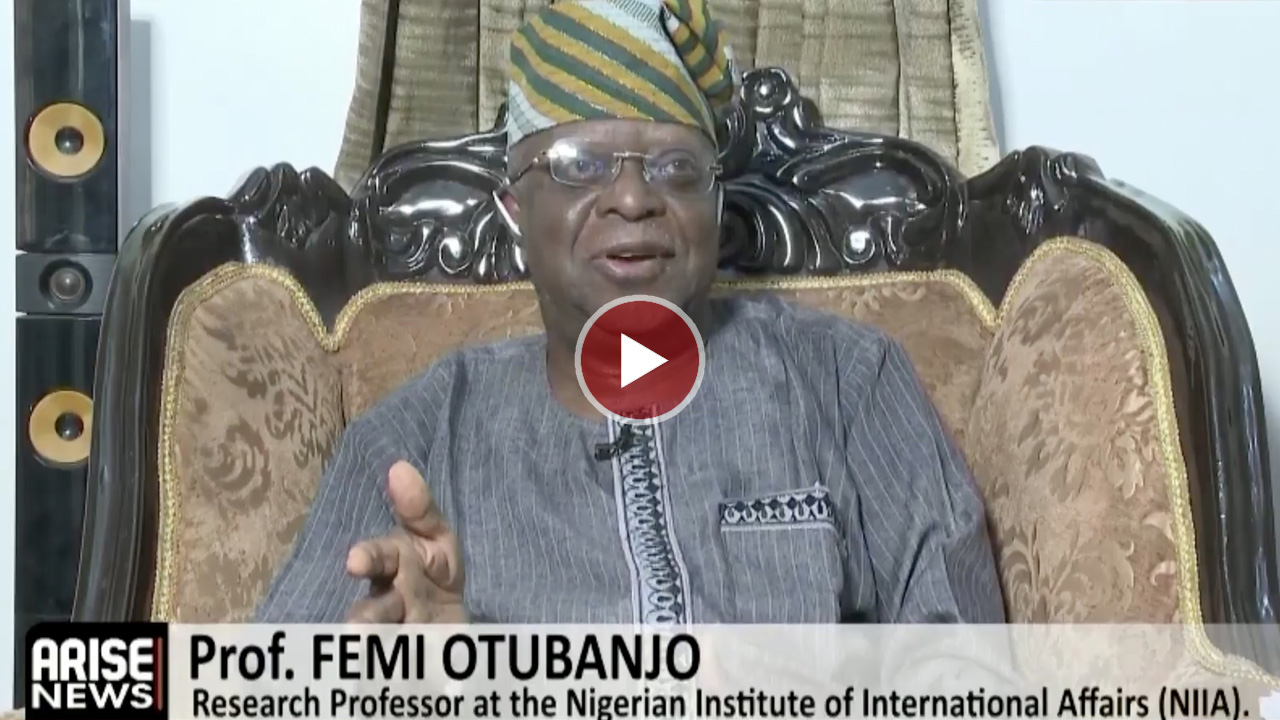
Femi Otubanjo, a research professor at the Nigerian Institute of International Affairs (NIIA), has delivered a scathing assessment of US President Donald Trump’s speech at the World Economic Forum in Davos on Wednesday, describing it as ill-suited to the setting and reflective of what he termed “spatial confusion.”
Speaking during an interview with ARISE NEWS on Thursday regarding the address, Otubanjo said Trump appeared unaware of the significance of his audience and location. Davos, he noted, is a global symbol of multilateralism and international cooperation, yet Trump’s rhetoric was framed around American exceptionalism and campaign-style messaging more typical of rallies for his domestic political base.
According to Otubanjo, much of the speech was delivered without reliance on the teleprompter, resulting in what he characterised as a rambling and undisciplined performance.
He said, “My impression of Trump when he was making that speech yesterday was that he was suffering from what you might call location disorientation or spatial confusion. He probably did not know where he was.
“Here was a man addressing an audience at Davos. Davos is a symbol of global multilateralism. And here he was, preaching American exceptionalism. He thought he was speaking to a MAGA audience. That’s why I talked about spatial confusion. Because if you listen to the rambling speech, some part of it, he allowed himself to use the teleprompter. But for the most part, it was on his own. The usual things you hear when he goes on campaign with his favorite audience. The speech lacked grace, lacked wit, lacked quality. The kind of thing that you expect from an American president was not there. You would notice that all through the speech, there was no laughter. There was no applause. And even when he finished, the applause was just there with just politeness.”
Otubanjo also criticised what he described as excessive personal attacks and inflammatory language. He noted that President Joe Biden was repeatedly mentioned in the opening minutes of the speech, often in derogatory terms, alongside dismissive remarks about other countries and industries. In his view, a significant portion of the address was devoted to self-praise and grand claims about Trump’s achievements, which he said bordered on narcissism and megalomania.
“There was so much bombast about what he had done. There was that display of narcissism and megalomania. ‘I did this.’ Trump has turned himself to a king. ‘I built the United States Army.’ So he has turned America into paradise. The speech was not appropriate for that place.”
He pointed to Trump’s comments on tariffs and references to Switzerland as examples of what he saw as economic intimidation rather than diplomacy.
Otubanjo further highlighted what he described as a troubling display of ignorance on international relations, particularly regarding Greenland. He noted that Greenland is part of Denmark, a NATO member, and therefore already covered by the alliance’s collective defence provisions under Article 5 of the 1949 Washington Treaty. Questioning the need for separate negotiations over Greenland’s security, he said such remarks suggested a lack of understanding of existing international frameworks.
“This is a president who does not read, who does not listen. That was on display there. So if you want to, what he’s saying is that we are the hegemon. We are the superpower of the world. You have to deal with us. So he has thrown out multilateralism, international laws, and so on.
“This is a man who has forgotten that America, the founding fathers of the UN, the presidents of the world during the Second World War, had a multilateral view of the world, a world in which we would all be a global community. He has no sense of history. He has no sense of global humanity, and so on. And therefore, there is a man, an empty man, speaking to a very enlightened audience.
“It was only in the last part of his speech, when he returns to the teleprompter, that he remembers that he was speaking to some of the best managers of the economies of the world.”
Melissa Enoch
About the Author