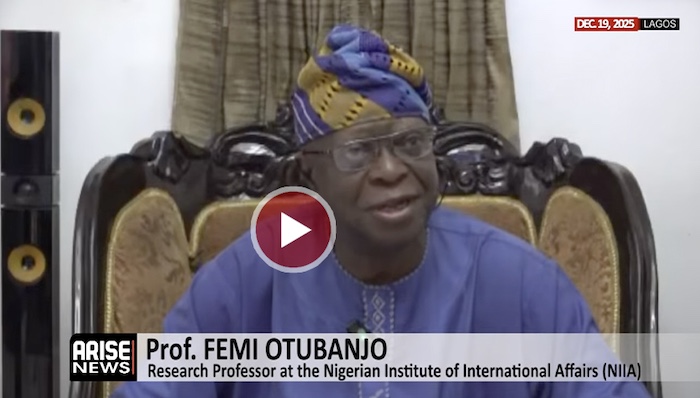

Research Professor at the Nigerian Institute of International Affairs, (NIIA) Professor Femi Otubanjo, asserted that Nigeria’s diplomacy continues to demonstrate resilience despite recent controversies surrounding ambassadorial appointments and regional security tensions.
In an interview with ARISE NEWS on Friday, Otubanjo provided insight into the government’s foreign policy decisions, assessing the confirmation of 68 ambassadorial nominees and the diplomatic standoff with Burkina Faso following the temporary detention of Nigerian troops and a C-130 aircraft.
“Well, on the matter of ambassadorial nominees, I try to be cautious about assessments and judgement, because what you expect in an ideal organisational setting is not what you get in a political setting. A great deal of compromises of back room and negotiations go into the approval of nominees. Those who are nominated, to try to get in touch with their own representatives or senate members who then try to level the ground for them. So it is not always a very thorough process. It is not always a very thorough process. So whether that affects the quality of the outputs, I’m not so sure. The problem is, what do we want? What do we want to see? Most people simply pass judgement without having the basic parameters for what they’re talking about. I’m not a member of the House. Sometimes I’m not happy with what they’re doing. But in the circumstance, you have to look at circumstances, the context of what they are doing before you pass judgement. It’s a compromised context already. It’s a political environment. It is not a corporate environment.
Therefore, there will be a lot of compromises.”
Reflecting on the incident in Burkina Faso, Otubanjo described the standoff as a manageable situation rather than a crisis. “The Burkina Faso problem seems to me like a storm in a teapot. Given the level of animosity between Nigeria and Burkina Faso, it’s understandable that they took such drastic action as seizing the plane and the crew. Since the AES, the coup, and Nigeria’s threats to invade the country and restore constitutional governance, the AES countries have alienated themselves from the rest of the coerce. So this is a continuation of that seizure of the plane.
It’s a demonstration of that alienation. I’m happy that it’s been resolved diplomatically. Nigeria has been very maturely, very carefully, and sent its ambassador, its minister, and everything was resolved. But it just shows that the AES countries are not happy with Nigeria. It also shows that they were suspicious of the movement of the plane. Although it’s a cargo plane, it’s a C-130. I’m not sure that Nigeria has the sophistication to pack a C-130 with intelligence gathering gadgets. I don’t know whether they have one like that. But it is a possibility. And so the Burkinans have a right to be suspicious. But it was supposed to be an emergency landing. And emergency landings are regarded as humanitarian affairs. So they should have treated it like that. But given the history of hostility since the movement of the coerce, one can understand why they decided to treat it as a security matter, not as a political matter. But I’m sure with the intervention of the minister and his delegation, our understanding with Burkina Faso will have improved significantly. If any such things happen in the future, it will be treated differently.”
On the role of ambassadors in advancing Nigeria’s interests abroad, he said, “Ambassadors are very important because they have access. They have access to governments, unlike the civil servants who are charged affairs where there are no ambassadors. They do not have easy access. So, this one should be able to phone the minister and say, I want to come and see you, or can you get me to see the president, and so on. Ambassadors are useful. I hope that they will be able to promote Nigeria’s interest effectively. What you find is, as in all situations, that you have 50 to 60 ambassadors. There will be good ones, there will be mediocre ones, there will be excellent ones. You can never really guarantee what they will do. But the important thing is to have appointed people who have some basic administrative background, who have experience of governance, who can adjust. Because being an ambassador is a different bargain. It’s not just being a different civil servant. You have to learn all the graces of diplomacy, all the language of diplomacy. So, you have to attend many cocktails, and simply take every opportunity to push the country’s interests.”
Addressing concerns about the quality of appointments, Otubanjo added, “Yes, they are mixed in the bastorial list. In fact, there are some that they’ve never done anything tangible in their entire lives, you know. They’ve just probably retired politicians, lived from hand to mouth, and surrogates here and there. We know them. This is the kind of country we live in. If you ask them, what was the locus of their career path, nothing tangible. But we know, it’s Nigeria. It’s the worst of us that leads the best of us.”
Turning to Nigeria’s broader foreign policy priorities, Otubanjo emphasised that occasional reform and strategic adjustment are necessary but that the fundamentals remain strong. “In terms of administration of foreign policy, you have the embassies, you have the Ministry of Foreign Affairs. Implementation, you have the executive as well. And really, right now, I’m not so sure that there’s anything fundamentally wrong. Even at the end of every year, you have to be able to access what had gone before and then see whether there will always be a need for adjustment. There will be a need for adjustment in terms of implementation strategies, even in terms of the policy itself, in terms of the personnel that are implementing, and so on.”
He further highlighted the Turugu administration’s “four Ds” approach as a framework for Nigeria’s diplomatic engagements. “The Turugu government has just introduced what they call the four Ds. One of which is what they have implemented, democracy. Democracy as a major instrument of Nigeria’s foreign policy was demonstrated by interventions in the Republican Party. They’re using development as a major focus, demography as a major focus, and diaspora. So we are just implementing those principles and hopefully they will work. And if they don’t work, they will be reformed.”
Erizia Rubyjeana
About the Author