Easter Sunday meeting sparks debate as citizens question impact of high-level talks amid ongoing reforms…
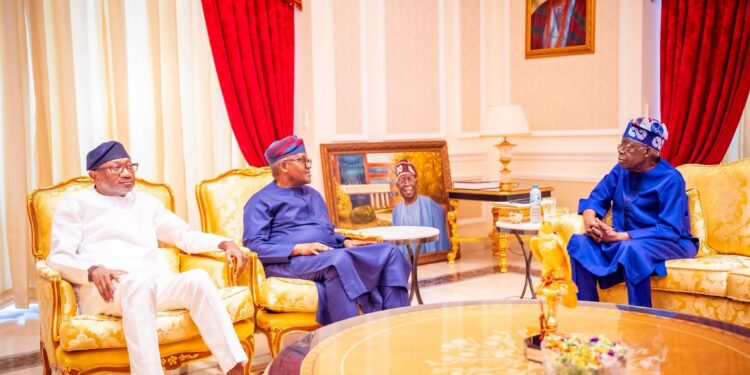
Two of Nigeria’s most influential businessmen, Femi Otedola and Aliko Dangote, met with President Bola Tinubu on Easter Sunday to discuss the state of the nation’s economy and the potential impact of ongoing reforms.
The meeting, which took place on April 5, 2026, was made public by Otedola in an Instagram post shared the following day. In his message, the billionaire described the gathering as both symbolic and substantive, noting that conversations centered on how government policies could translate into tangible benefits for Nigerians.
Reflecting on the visit, Otedola highlighted the President’s work ethic, pointing out that even on Easter Sunday a day typically associated with rest and reflection, Tinubu remained engaged in national matters.
“We discussed the economy and how Nigerians can benefit from the reforms… That kind of commitment gives you hope for Nigeria,” he wrote.
While the post painted an optimistic picture, the reaction online told a more complicated story.
Mixed reactions trail high-profile meeting
The post quickly gained traction across social media, drawing heavy engagement and sparking a wave of reactions from Nigerians. While some users welcomed the show of collaboration between government and top business leaders, many others questioned what such meetings actually deliver.
A number of commenters dismissed the engagement as largely symbolic, arguing that similar high-level discussions in the past have not translated into meaningful improvements in everyday life.
Others went a step further, interpreting the tone of Otedola’s message as a subtle endorsement of the President. They suggested that prominent figures should be more direct about their political positions rather than framing interactions as purely economic conversations.
Still, a segment of users expressed support, praising both the President and the business leaders for what they see as efforts to steer the country toward economic recovery.
Backdrop of ongoing reforms
The meeting comes at a time when the Tinubu administration is rolling out a series of reforms aimed at stabilizing key sectors of the economy.
Among recent developments is the inauguration of a N73 billion customs complex in Ogun State, designed to strengthen trade operations, enforcement, and revenue generation. The facility spans 100 hectares and includes over 140 buildings, positioning it as a major boost to Nigeria’s trade infrastructure.
In the power sector, the government has also approved a N3.3 trillion payment plan to clear longstanding debts under a financial reform programme. The move is expected to improve liquidity in the sector, stabilize electricity generation, and enhance service delivery.
Challenges remain
Despite these initiatives, persistent challenges continue to cast a shadow over the country’s economic outlook. Rising insecurity in parts of the country including Benue, Plateau, Zamfara, and Borno has raised concerns about the broader impact of reforms, particularly on investor confidence and economic stability.
For many Nigerians, the key question remains whether high-level engagements like the Easter meeting will lead to measurable change or simply remain conversations among the country’s elite.
As reform efforts continue, public scrutiny is unlikely to fade anytime soon.