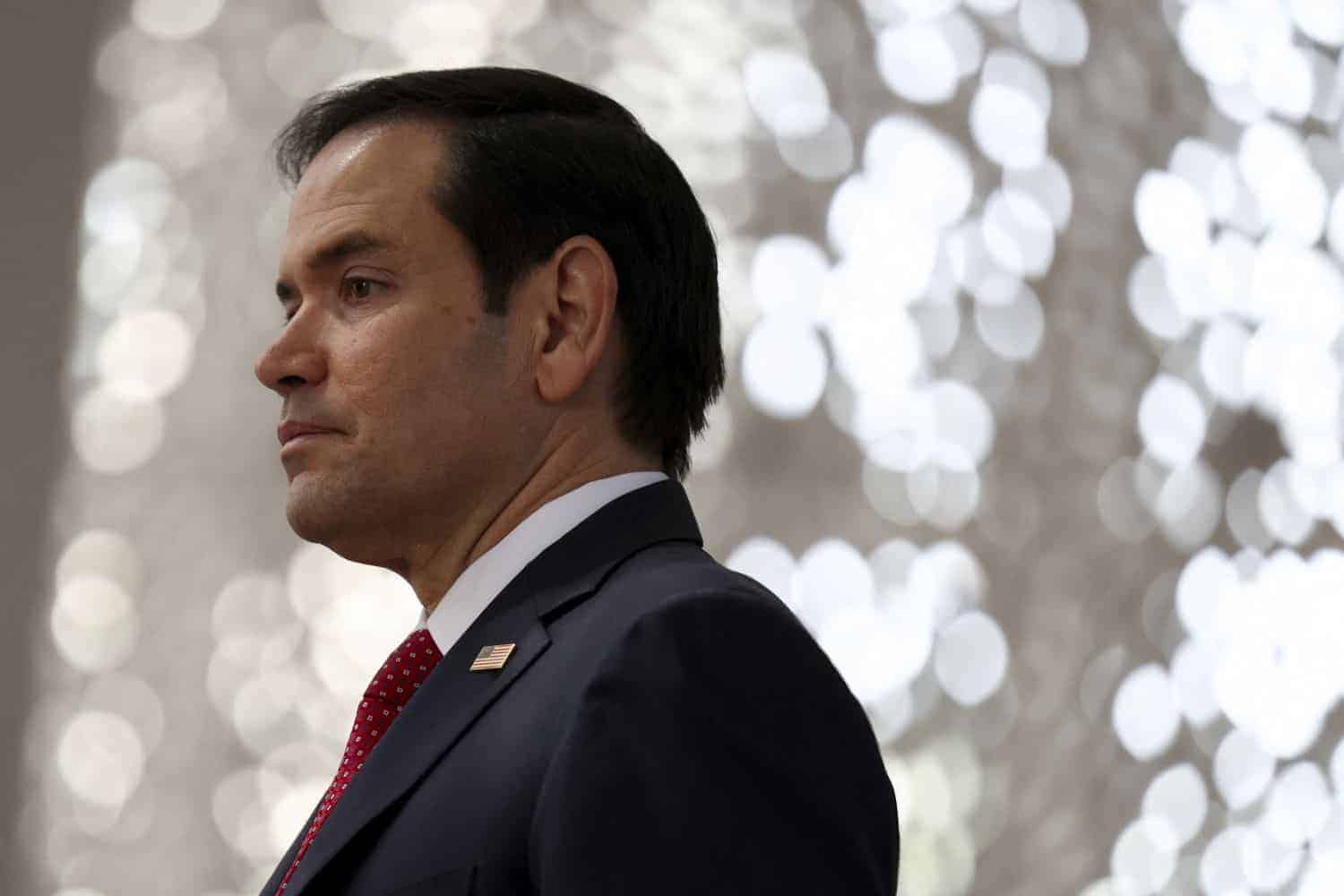
US Secretary of State Marco Rubio visits the Abrahamic Family House in Abu Dhabi, United Arab Emirates, on February 19, 2025. (Photo by Evelyn Hockstein / POOL / AFP)
US President Donald Trump has ordered “a total and complete” blockade of all “sanctioned” oil tankers entering and leaving Venezuela ports, which is technically an act of war.
How seriously should we take this? Trump has certainly threatened war with Venezuela in the past.
Former US national security advisor John Bolton reports that Trump said during his first presidential term (2017- 2020) that invading Venezuela would be “cool” because it is “really part of the US”.
Gustavo Petro, the president of Colombia, says his predecessor Iván Duque was approached by Trump in 2020 with a plan to invade Venezuela via Colombia. (No need for an amphibious landing operation. Just disembark the US troops in Santa Marta and march them across the border.)
Trump’s Maga promise
Trump’s advisors talked him out of that one. It sounds pretty damning, until you recall that Trump is a blowhard who almost never acts on his threats (Taco – Trump always chickens out).
Or just count the numbers and realise that there are not enough American troops in the Caribbean to make a full-scale invasion of Venezuela a viable military option.
And if you are still in doubt, remember that Trump is politically allergic to wars. His promise to his own Maga base was “no more forever wars” in exotic places.
He is famous for echoing the views of the last person who spoke to him, but it would take some truly masterful manipulation to persuade him to go against his own gut instincts.
On the other hand, blockade alone is unlikely to bring down the Maduro regime. Losing the oil income will hurt the regime, but Venezuela has already seen its oil production collapse (now less than one million barrels per day) for purely domestic reasons.
They did it to themselves through incompetence and corruption, and they are already sort of used to being poor.
Moreover, the Venezuelan regime is not so foolish that it will give the warhawks in the US administration a pretext for invasion by trying to break the blockade by force.
The frustration will build up on both sides, but it is unlikely to explode into major violence unless some senior figure in the Trump government goes rogue.
“In my opinion, the three regimes that exist in Nicaragua, Venezuela and Cuba are enemies of humanity,” said US Secretary of State Marco Rubio in Costa Rica early this year.
He was making a special point of saying it there because Nicaragua is Costa Rica’s next-door neighbour, but he actually says it almost everywhere he goes.
Rubio’s fantasy
That is the bee in his bonnet. Rubio is a second-generation Cuban-American whose parents immigrated to Miami in the mid-1950, several years before Fidel Castro’s Communist regime took power, but like many other Cuban-Americans his politics have been defined by that event.
Rubio had lots of access to Trump as a senator of Florida and he was sharp enough to see that Trump might be his instrument to end those regimes.
His plan of campaign ended triumphantly with his elevation to Secretary of State in January, in charge of America’s foreign policy.
Is it also the reason why there has been a strong focus on Venezuela? There is an analysis which holds that it is the road to Havana.
It is complete nonsense, of course. If the Cuban revolution managed to survive after the Soviet Union collapsed, it is unlikely to fall just because Venezuela suffers a violent regime.
If and when it goes under, it will fall of its own weight. However, Rubio’s fantasy could lead the US into a forever war in Venezuela if Trump doesn’t keep him on a short leash.
NOW READ: Ukraine hasn’t lost the war yet
About the Author