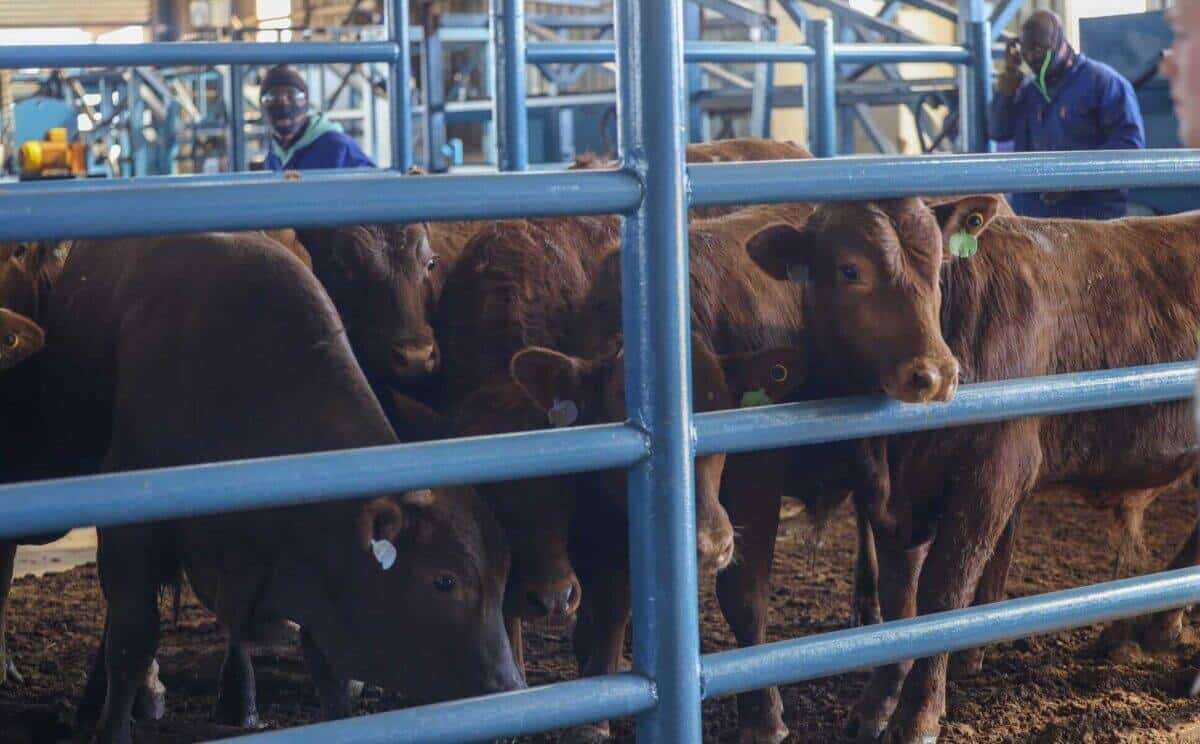
HEIDELBERG, SOUTH AFRICA - JUNE 23: The vaccination process during a visit to the Karan Beef Feedlot as part of visits to foot-and-mouth disease vaccination sites on June 23, 2025 in Heidelberg, South Africa. The visit forms part of ongoing efforts to strengthen biosecurity and disease management protocols in partnership with both provincial authorities and the private sector. (Photo by Gallo Images/OJ Koloti)
More than a million doses of vaccines are expected to arrive in South Africa this weekend after foot-and-mouth disease (FMD) was classified as a national disaster this week.
National Disaster Management Centre deputy director-general Elias Sithole, has given notice that FMD has been classified as a national disaster.
In the notice, Sitole calls upon all organs of state across the three spheres of government to further strengthen their support provided to existing structures and to ensure that appropriate measures are put in place to enable the government to effectively deal with the effects of this national disaster.
Over a million FMD vaccines arrive this weekend
Minister of Agriculture John Steenhuisen on Tuesday announced that the first batch of one million high-potency vaccine doses from Argentina arrives in South Africa this weekend.
A further five million doses will follow in March.
As of Monday, 836 cases of FMD had been reported in South Africa, of which Eastern Cape reported 18, Free State 245, Gauteng 188, KwaZulu-Natal 202, Limpopo 10, Mpumalanga reported 63, North West 106, Northern Cape one and the Western Cape reported three cases.
ALSO READ: Is vaccination the answer to foot-and-mouth disease?
Steenhuisen said the vaccines were a critical component of the department’s new strategy against FMD to vaccinate the national herd of over 14 million cattle.
He added that veterinary capacity was being expanded in terms of the Animal Disease Act, which means that private veterinarians can register to administer vaccines as part of the roll-out strategy.
“All FMD-infected properties are immediately placed under quarantine on suspicion of disease. Movement of live cloven-hoofed animals and unprocessed products off these farms is not allowed. Farmers are advised on the implementation of biosecurity on their farms,” he added.
Massive drive
Steenhuisen joined premier Alan Winde and other Western Cape Government colleagues on Monday in Fisantekraal in a massive drive to vaccinate the national herd.
Animal Health in the Western Cape director Dr Noluvuyo Magadla said that during the vaccinations, the animals were not marked with the F mark, despite receiving the vaccine.
“We are using ear-tag identification, which has been a huge shift in the identification of vaccinated animals,” he said.
ALSO READ: Western Cape moves to secure own vaccines to protect province from FMD [VIDEO]
Southern African Agricultural Initiative (Saai) CEO Francios Rossouw said while the announcement that the department was going to vaccinate the national herd was a step in the right direction, “it does not mean they have the capacity to do it”.
TLU SA chair Bennie van Zyl said theoretically, when you declare a national disaster, it means you can allocate more resources from the state to address the issue.
“The question is, do those resources exist and do you have the capacity to implement them?” he said.
Classification as a national disaster
AfriForum disaster management specialist Tarien Cook said in terms of Section 23 of the Disaster Management Act 57 of 2002, the classification of a disaster merely acknowledges that a serious situation exists and thereby determines which sphere of government should deal with the matter.
“In contrast, the declaration of a disaster, as defined by Section 27 of the Act, ensures the availability of resources, emergency purchases and funds, among other things,” she added.
About the Author