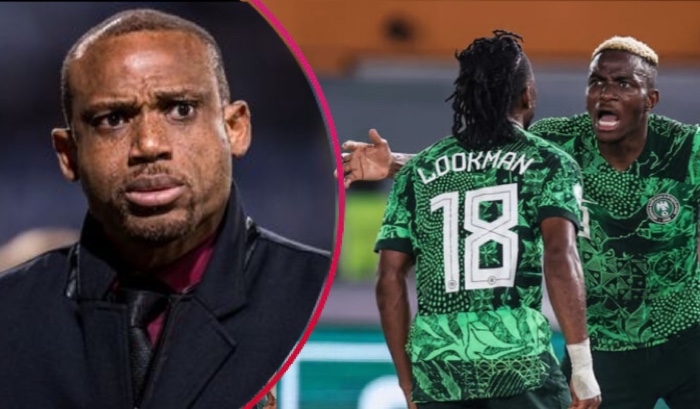
Former Super Eagles captain and coach Sunday Oliseh has blamed internal indiscipline, public confrontation and a growing culture of entitlement for Nigeria’s failure at the Africa Cup of Nations, warning that star power without character is damaging the national team.
Speaking in a lengthy intervention on his YouTube channel, Oliseh said a public outburst which saw Victor Osimhen confronting teammate Ademola Lookman shattered team chemistry at a crucial stage of the tournament, with lasting psychological consequences.
“We are confusing talent with license,” Oliseh said. “Victor Osimhen is world-class, but talent is not a license to destroy team chemistry.”
Oliseh said the impact of the confrontation was evident in Lookman’s performances, despite his strong statistical contribution earlier in the competition.
“Since that public outburst against Ademola Lookman, one of our brightest lights, Lookman became a shadow of himself, and we lost the fight,” he said. “When you publicly diminish your teammates, you break their spirit.”
According to Oliseh, Lookman had been Nigeria’s most dangerous attacking player before the incident.
“Statistically, Ademola Lookman was the most dangerous player in the tournament,” he said. “Until that public verbal abuse broke his focus.”
He added that such internal conflict was costly, particularly against elite opposition.
“You cannot expect a playmaker to perform miracles on the pitch when he has been demoralized by his own teammates,” Oliseh said. “The conflict did its damage. We didn’t just lose a game. We lost the psychological edge we needed to win.”
Oliseh also criticised what he described as excessive tolerance from fans and administrators, warning that accountability has been replaced by hero worship.
“We have reached a point where anybody who dares to point out the truth is immediately attacked or threatened online by a mob of followers,” he said. “We are breathing a culture of entitlement where the player is treated as a god and the nation is treated as an afterthought.”
He insisted that goals alone do not justify indiscipline or disrespect.
“Scoring goals for Nigeria doesn’t give you a license to disrespect certified legends like Finidi George or Victor Ekweba,” Oliseh said. “It doesn’t give you the right to disrespect coaches or teammates.”
Drawing comparisons with previous generations, Oliseh said past stars combined success with humility.
“If goals alone justified arrogance, what should the legends who actually put Nigeria at the pinnacle of world football like Amokachi, Amunike, Okocha, Babangida, and myself do? Walk on people’s heads? No. We respected the jersey,” he said.
Oliseh also criticised the team’s mentality, pointing to celebrations after a third place finish as evidence of declining standards.
“Celebrating third place builds a culture of mediocrity,” he said. “There was a time when the Super Eagles shed tears at second place because to us, anything but the trophy was a failure.”
He warned that Nigeria’s decline began when ambition gave way to complacency.
“We must remember the decline of our dominance began exactly when we started being content with bronze,” Oliseh said.
Beyond on field issues, Oliseh questioned the decision to protest Nigeria’s World Cup qualification failure rather than confront internal shortcomings.
“We failed to qualify for the World Cup on the pitch, where it actually matters,” he said. “This protest is solely aimed at creating a false narrative that we were robbed. We are trying to qualify through an office, instead of through goals, tactics, and hard work.”
Oliseh also addressed criticism directed at him personally, revealing that complaints had been made to CAF officials in an attempt to have him removed as a match analyst.
“Some people actually took the time to write and call the Confederation of African Football CAF officials,” he said. “Their goal? To get me removed as an AFCON match consultant.”
He said CAF rejected the complaints and instead expanded his role.
“They didn’t just keep me on, they asked me to analyse and commentate the semi-final and the final,” Oliseh said, adding that he was later invited to handle the 2027 AFCON Preliminary Round draws.
Oliseh said his loyalty has always been to honesty and professionalism.
“My loyalty is to the truth and the game, not to a false narrative,” he said.
He concluded with a warning about the future of Nigerian football if discipline and administration are not addressed.
“If we don’t fix the discipline and the administration, there won’t be a Super Eagles left to support,” Oliseh said. “I didn’t speak during the tournament because I didn’t want to be a distraction. But now that the trophy has been decided, it’s time for the truth.”
Faridah Abdulkadiri
About the Author