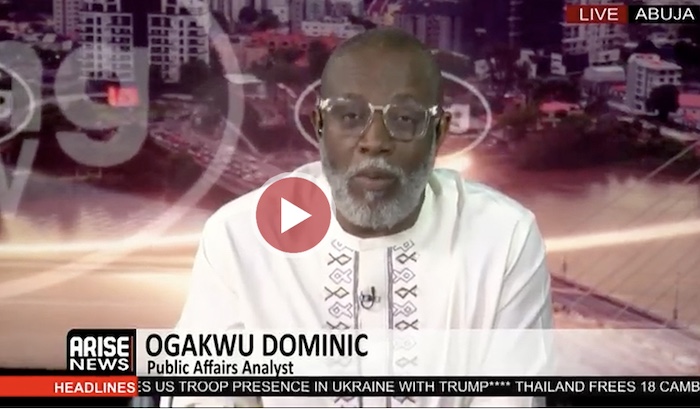
Public affairs analyst Ogakwu Dominic has called for a reconsideration of the proposed sachet alcohol ban, warning that the policy could result in massive job losses and significant economic damage if implemented as planned.
Speaking on ARISE News on Wednesday, Dominic said civil society groups recognise concerns around alcohol abuse but believe the ban, as designed, would have severe consequences for ordinary Nigerians.
“This is an issue of serious concern to us as stakeholders in the Nigerian project,” Dominic said. “As civil society, we understand the position and why we are concerned about the fact that the ban may help in one way or the other to cope one or two challenges, the menace of abuse of alcohol and the rest of it.”
However, he argued that the wider impact of the policy would be harmful to the public, describing it as anti-people.
“If you look at the statistics, it is going to affect us. The impact is actually anti-people. Jobs will be lost,” he said. “It is proposed that over 500,000 jobs will be lost in the first instance. And Nigeria will be losing over 1.5 trillion naira in investment.”
Dominic questioned whether regulators had fully examined the implications of the ban, urging authorities to separate concerns around alcohol consumption from the packaging format being targeted.
“I don’t want to believe that it’s the alcohol or the container or the sachet that is a problem,” he said. “Is it the alcohol that is a problem? Or is it the sachet that is a problem? So, we need to really look at these issues the way they are before any of such ban is carried out.”
Responding to questions about the long-running negotiations and the one-year moratorium already granted to manufacturers, Dominic said available information did not sufficiently justify ending the grace period.
“Truth be told, if you look at it, the available information is not green enough,” he said. “There’s no substantial report as to what are the pros and cons. These are people who have invested so much. From the information we are gathering, it’s going to really affect them seriously, and so they are asking for more time.”
He also rejected arguments that the sachet alcohol ban should be treated as a public health emergency, saying other issues deserved greater urgency.
“The ban on such alcohol is not a public health emergency,” Dominic said. “There are more important issues to be addressed. Issues bordering on GMOs, on fake drugs. Even the issue of compliance should be taken more aggressively. It is not in the sachet.”
When pressed to provide data supporting his claims on job losses and economic impact, Dominic cited figures from a Nairametrics study.
“A study that was done by Nairametrics shows that over 500,000 jobs will be lost,” he said. “Also, over about 1.2 trillion naira in investment with regards to the investment that we made in this sector will also go down the drain.”
On public health concerns, Dominic maintained that banning sachets would not curb alcohol consumption and could worsen the situation.
“That will not stop people from taking alcohol,” he said. “That might even heighten the consumption of alcohol.”
He added that policy decisions must strike a balance between protecting public health and safeguarding livelihoods.
“In as much as we are concerned about the public health dimension of this discussion, we should also be more concerned about people who have made investment rolling into millions and millions of naira,” Dominic said. “If you throw people out of jobs, you are asking them to go into other vices.”
Dominic concluded by calling for renewed engagement between regulators, manufacturers and other stakeholders, insisting that further dialogue was in the national interest.
“There must be a balance in our policy shift,” he said. “I think that this is the right time for the stakeholders to come back.”
Faridah Abdulkadiri
About the Author