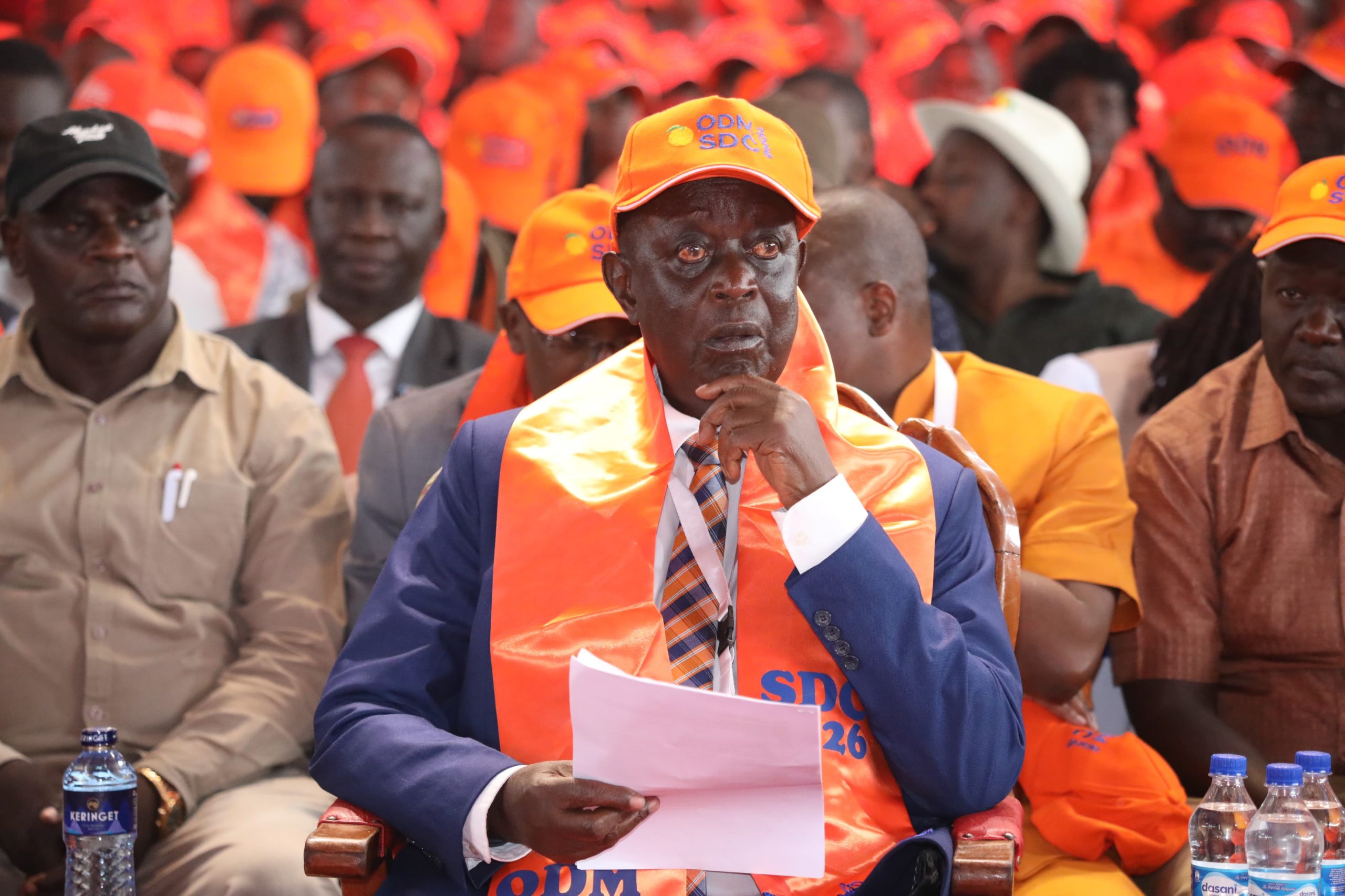
The Orange Democratic Movement (ODM) on Friday formally ushered in a new leadership chapter after delegates at a Special National Delegates Convention (SDC) ratified a new team to steer the party following the passing of former party leader Raila Odinga.
In a convention marked by strong messaging on unity, discipline and coalition realignments, Siaya Senator Dr Oburu Oginga was endorsed as the official ODM Party Leader after delegates endorsed his name, following approval by NEC.
The convention, held at Jamhuri Grounds in Nairobi, also endorsed deputy party leaders, with Mombasa Governor Abdulswamad Shariff Nassir and Kisii Governor Simba Arati securing delegates’ approval as ODM’s new deputy party leaders.
However, in a dramatic political twist, Vihiga Senator Godfrey Osotsi was kicked out as one of the ODM deputy party leaders after delegates rejected his name during the endorsement process, leaving the position vacant.
Mr Osotsi failed to attract any proposer, a humiliating blow seen as a political statement against the growing dissent within ODM.
Mr Osotsi has in recent months been linked to the Linda Mwananchi faction associated with Nairobi Senator Edwin Sifuna, a wing that has increasingly raised concerns over ODM’s internal democracy and the party’s relationship with the ruling Kenya Kwanza administration.
His ouster makes him the first major casualty in ODM’s internal restructuring in the post-Raila era.
Delegates at the SDC also ratified Homa Bay Governor Gladys Wanga as the official ODM National Chairperson, cementing her growing influence within the party and positioning her as one of the key faces of ODM’s future political strategy.
In the same breath, Rarieda MP Otiende Amollo and Turkana South MP John Namoit were endorsed as deputy national chairpersons.
The convention further approved Wajir Governor Ahmed Abdullahi as the National Organising Secretary, a position that places him at the centre of ODM’s grassroots mobilisation machinery.
Kisumu Woman Representative Ruth Adhiambo Odinga was endorsed as the Deputy Organising Secretary, while Kisumu West MP Rozah Buyu was confirmed as the Secretary of Political Affairs.
The ratification of the new leadership structure came as ODM sought to project unity and stability following the departure of Mr Odinga, who has for decades served as the party’s political engine and unifying symbol.
But beneath the applause and celebrations, Friday’s convention also exposed ODM’s shifting internal power dynamics, with the rejection of Mr Osotsi’s name serving as a clear warning to emerging factions seen as challenging the party’s mainstream direction.
Party insiders described the events as a “silent purge” aimed at neutralising dissent and ensuring loyalty as ODM charts its next political path.
A key highlight of the convention was the expedited consideration of a National Executive Council (NEC) resolution pursuant to Article 87 of the ODM Party Constitution, relating to coalition-building arrangements.
Delegates ratified the resolution, effectively giving the party a green light to formally pursue coalition-building talks beginning with the ruling United Democratic Alliance (UDA) led by President William Ruto.
The endorsement of the coalition-building framework is expected to shape ODM’s political posture ahead of the 2027 General Election, with insiders saying the party is keen on remaining relevant in national decision-making while also securing strategic political bargains.
During the convention, Ms Wanga warned against internal wars and personal rivalries.
“This moment calls for maturity. This is not a time for blame, wars or petty ego contests. It’s a time to demonstrate that we learned at the feet of a great teacher,” she said in an address that repeatedly referenced Raila Odinga as the party’s founding pillar.
“It’s a time to demonstrate that we learned at the feet of a great teacher. If we truly honour Baba, then we must show it not only in words but our conduct,” she added.
Ms Wanga also signalled that ODM would move into a new phase of engagement with other political formations, but insisted that internal unity must come first.
“As we look ahead, we know that our party must engage others and prepare for the future with wisdom and clarity. But before we negotiate with others we must find coherence with ourselves,” she said.
The chairperson further clarified that the SDC could not be used to fill vacant positions, noting that its role was limited to deliberating on the set agenda.
“Vacant positions can’t be filled during an SDC. An SDC only deliberates on the agenda,” she said.
Her statement means that despite Mr Osotsi’s removal, the third deputy party leader position will remain vacant until a proper party process is convened to fill it.
About the Author