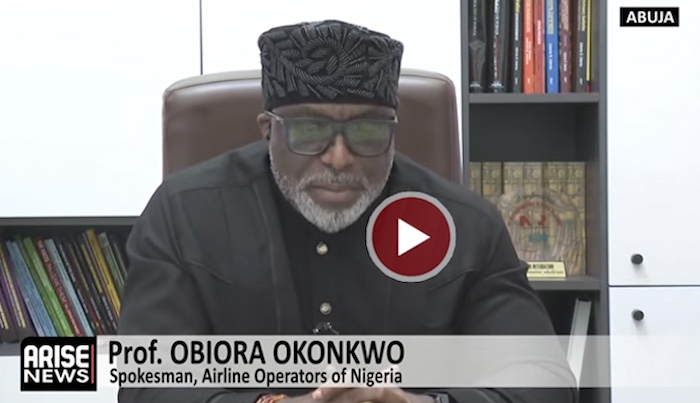

The Spokesperson for the Airline Operators of Nigeria, (AON), Professor Obiora Okonkwo has revealed that Nigerian airlines are absorbing losses due to the recent surge in aviation fuel costs, while continuing to operate flights to ensure passengers can travel.
The AON Spokesperson said this while speaking with ARISE NEWS on Wednesday.
“As regards to us in Nigeria, before the war, we were getting aviation fuel at about 1,000 Naira a liter, just plus or minus. And as we speak right now, the last fuel we had this evening was going for about 1,800 Naira. That’s quite astronomical. We are still battling how to deal with it.
“There are rules. Most of the airlines, from the regulatory requirement, should submit their inventory to NCAA, which is the regulatory body, for any price change, for anything not less than two weeks before implementation. So I guess in this inventory by some of the member airlines of AON, they would have had some rate or fares submitted quite a long time ago.
“Now, the bigger challenge we are even having here is that this is really not the high season for air travelers. Immediately after Christmas, you usually have a great dive to about 40 to 60% pax load, so it’s just coming at a very difficult time. So we are really quite in a very difficult situation right now. You can’t just wake up and say ‘I’m doubling or tripling my fare’ as much as the aviation fuel new price.
“Today, you can still buy tickets to some destinations at 100,000, 100-plus and less. So this is that moment that when I tell Nigerian viewers that there are occasions the airlines fly and lose money—this is that moment we are carrying you at our own expense. So any operator that is carrying 40, 60, 70% pax load there is carrying you at a loss. It happens; it’s not only peculiar to us. There are times you lose money, but because it’s an essential service, you can’t just call it off and say ‘I don’t have passengers, I won’t fly.’
“You must also have the financial chest so when you bleed, it doesn’t take you to your grave. So we are absorbing that extra cost right now; the operators are absorbing it for the interest of Nigerian travelers and hoping there will be a time things will normalize and we try to shuffle with our rates. That’s why when we continue to say the pricing of air tickets is a very complicated and sophisticated process… we know how to do it and then start accusing airlines of price-fixing”, he explained.
Prof. Okonkwo also said that enormous taxes, high loan interest, and currency conversion challenges push up Nigerian airline ticket prices.
“There used to be multiple factors that determine the final cost of air tickets. Obviously, taxes and other charges you have said are very, very enormous—more than any part of the world. But one thing beyond all those charges we are talking about is interest rate. The average interest rate you get from any bank in Nigeria, average, any operator is about 30%. Let me give you the mathematics. Investing in aircraft and aviation is very expensive, so you’re not going to the bank for 1 billion or 5 billion; you’re talking about 100 billion, for instance.
“So this is what we’re talking about, but we are competing with other operators outside Nigeria that are getting interest rates for like 2%, 3%, 5%. And in this interest rate, you have to get it in Naira, we have our charges in Naira and have to convert in Dollar. So I believe that all these things, including the other charges, affect the ticket price”, he shared.
Prof. Okonkwo further called on the government to provide both short-term fuel relief through discounted Jet A1 and long-term low-interest funding to ease financial pressures on airlines.
“We would want a situation where government will have to make a deal with Dangote and then offer him some crude at a special rate and then at a dedicated price for the aviation airline operators. That will help a lot in the interim.
“But down the line, we continue to ask for a special window intervention fund, not free money, not grants, a single-digit loan for us to have access to for our acquisitions and other operations. That will go a long way in reducing the financial pressure that we are feeling”, he appealed.
Favour Odima
About the Author