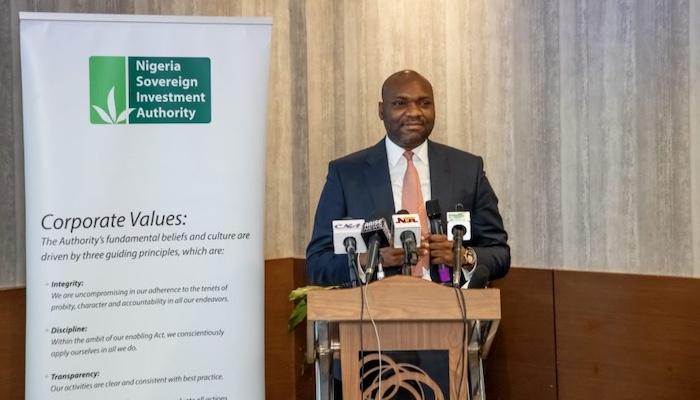
Managing Director/Chief Executive, Nigeria Sovereign Investment Authority (NSIA), Mr. Aminu Umar-Sadiq, on Thursday disclosed that its net asset value increased to $3.40 billion, indicating a 10.7 per cent Compound Annual Growth Rate (CAGR) while total income also increased to N478.8 billion in 2025.
He said the performance reflected 13 consecutive years of earnings and asset growth, starting with $1 billion in seed capital and an additional $1.06 billion in contributions.
In Naira terms, total assets rose 10.9 per cent year-on-year to N4.91 trillion, he said.
Umar-Sadiq, stated that the authority reported core total comprehensive income of N478.8 billion, delivering strong performance despite domestic and global macroeconomic volatility and heightened geopolitical tensions. Core operating income stood at N525.3 billion.
Core total comprehensive Income (Core TCI) rose 17.4 per cent, year on year to N478.8 billion ($320.2 million) from N408.0 billion ($190.2 million)
This remained the highest Core TCI since inception, in both Naira and US dollar terms, reflecting strong core performance among others, he noted.
In Naira terms, total assets rose 10.9 per cent year-on-year to N4.91 trillion in 2025, supported by N360.8 billion in capital contributions and N478.8 billion in core earnings.
Growth was driven by strategic asset allocation, efficient liquidity use, a 35.8 per cent increase in investment securities, and improved returns across multiple asset classes, strengthening the balance sheet.
However, in dollar terms, the Group’s net asset value increased by 19.8 per cent, from $2.8 billion in 2024 to $3.4 billion in 2025, aided by a cumulative $241.2 million in capital injections during the year, combined with $320.2 million in net earnings from performance across core revenue streams.
The increase underscores NSIA’s capacity to preserve and grow long-term shareholder value, the authority stated.
NSIA’s profitability improved, with Return on Equity (ROE) rising to 10.3 per cent compared to 7.2 per cent in 2024.
Umar-Sadiq said the financial results reaffirmed NSIA’s strong track record in delivering financial returns, strategic national impact, and intergenerational wealth creation.
He said, “Looking ahead, NSIA is well-positioned to continue growing core revenue streams while maintaining balance sheet resilience and deploying capital efficiently. Its strategic emphasis on portfolio diversification, risk-adjusted returns, and catalytic investments will continue to drive transformative, economy-wide impact across the stabilisation, infrastructure, and future generations mandates.
He said, “In reflecting on how the institution has consistently outperformed and generated resilient earnings, five key factors stand out.
“First is the quality of earnings. When you look at core income and total comprehensive income, both in naira and dollar terms, the institution continues to outperform annually.
“Second is execution capacity across infrastructure delivery. Whether in renewable energy through platforms like Ripple, healthcare initiatives, agriculture projects, or financial market infrastructure, NSIA combines creativity with execution to solve critical national challenges.
“Third is risk management. Despite pursuing strong returns, there is a consistent focus on downside protection to preserve value.
“Fourth is enhanced operations, driven by data, artificial intelligence, and ESG integration, ensuring operational efficiency and sustainability.
“Fifth, and most importantly, is the quality and dedication of our people. The institution’s success is driven not only by leadership but by the commitment of staff who work daily to demonstrate what is possible within public sector institutions in Nigeria.”
Return on Assets (ROA) increased to 9.9 per cent from 7.1 per cent, reflecting the resilience and effectiveness of its diversified global investment portfolio in generating stable, long-term value.
In the review period, core operating income grew to N525.3 billion ($349.1 million) from N498.0 billion ($328.5 million) in 2024.
It stated that the growth was primarily driven by a 138 per cent increase in the performance of externally managed investment portfolios, supported by improved performance across both developed and emerging markets.
Other drivers include infrastructure revenues from agriculture and healthcare businesses.
It further noted that as part of its planned exit from the Presidential Fertilizer Initiative (PFI) under the market-driven Phase II model, NSIA completed the phased transfer of operatorship to the Ministry of Finance Incorporated (MoFI) in 2025.
The transition impacted agriculture infrastructure revenues but aligned with the government’s strategy to promote long-term sustainability and private sector participation across the fertiliser value chain.
Core operating income rose to N525.3 billion ($349.1 million) in 2025 compared to N498 billion ($328.5 million) in the prior year, reflecting the authority’s deliberate efforts to actively deploy capital across diverse asset classes.
The growth was primarily driven by a 138 per cent increase in the performance of externally managed investment portfolios, supported by improved performance across both developed and emerging markets.
In addition, interest income from financial assets increased by 10 per cent, reflecting higher yields and increased volumes, despite market rate cuts. Other components of core operating income included infrastructure revenues from agriculture and healthcare businesses.
Also, as part of its planned exit from the Presidential Fertilizer Initiative (PFI) and in line with the market-driven Phase II model of PFI, NSIA successfully completed the phased transfer of operatorship to the Ministry of Finance Incorporated (MoFI) between 2024 and 2025.
The transition impacted agriculture infrastructure revenues but aligns with NSIA’s strategic goal of promoting long-term sustainability and deepening private sector participation across the fertilizer value chain.
However, commenting on non-core operating income, including Foreign Exchange (FX) gains or losses and fair value gains on FX-linked collateralised securities, NSIA stated that following a 6.5 per cent Naira appreciation against the US dollar in 2025 (versus a 71 per cent devaluation in 2024), the Group recorded a net unrealised FX loss of N322.4 billion, compared with an unrealised gain of N859.4 billion in the prior year.
In addition, 2024 non-core income included N618.3 billion in fair value gains from FX-linked collateralised securities, which did not recur in 2025.
NSIA’s Cost-to-Income Ratio (CIR) remained below 5 per cent, rising modestly from 3.6 per cent in 2024 to 4.2 per cent in 2025.
The increase reflected both customary inflationary pressures and strategic investments in two portfolio entities’ growth.
Also, Medserve, NSIA’s oncology platform consolidated three existing diagnostics and cancer centres, with an additional eight centres currently under construction.
The NSIA boss said the full network of 11 centres is expected to be operational by Q3 2026, significantly enhancing frontline healthcare delivery through improved early detection, advanced diagnostics, and specialised care services.
Cost growth also included non-recurring items, such as hosting the 2025 Africa Sovereign Investors’ Forum (ASIF), which reinforced the authority’s continental leadership and advanced cross-border investment collaboration, in addition, targeted investments in systems, governance, and institutional capacity to strengthen long-term operational effectiveness.
He stated that in 2025, NSIA continued to advance its dual mandate of delivering sustainable financial returns while driving tangible economic impact through investments in critical sectors of the Nigerian economy.
He said the authority played catalytic roles in mobilising capital, strengthening infrastructure, and supporting innovation across healthcare, energy, technology, agriculture, and capital markets.
Among other things, he said NSIA, working with the Japan International Cooperation Agency (JICA), launched a $50 million innovation fund to support high-impact Nigerian startups.
Backed by $20 million from NSIA and a $14 million grant from the Government of Japan, with an additional $16 million expected from development finance institutions, the fund will provide flexible financing to startups in sectors such as agriculture, healthcare, education, energy, and water management.
Umar-Sadiq said, “Irrespective of the macro-financial situations, the institution continues to deliver financial performance on the positive side year in, year out.
“The promise from NSIA is that we will continue to strengthen the institution. We do not take our responsibility lightly. We are enhancing real-time risk monitoring to ensure continuous resilience. The global risk landscape continues to evolve, with ongoing geopolitical conflicts impacting variables such as oil prices.
“As a result, we must remain proactive and resilient, and we have developed strong frameworks around this. Over the last few years, we have reorganized our infrastructure and are now close to achieving our target state. It is important to note that we are on a four-year digital transformation journey.
“This demonstrates that we are not deploying data capabilities for the sake of it, but doing so responsibly. In 2025, we continued to build a centralized data analytics capability, which enables improved real-time reporting.
“We do not compare ourselves only within Nigeria; we benchmark against global peers. This requires strengthening insights derived from data and ensuring effective testing and validation…
“Overall, NSIA is a resilient and forward-thinking institution. AI is not just a buzzword, it represents the future, and we are well positioned on that journey.”
James Emejo