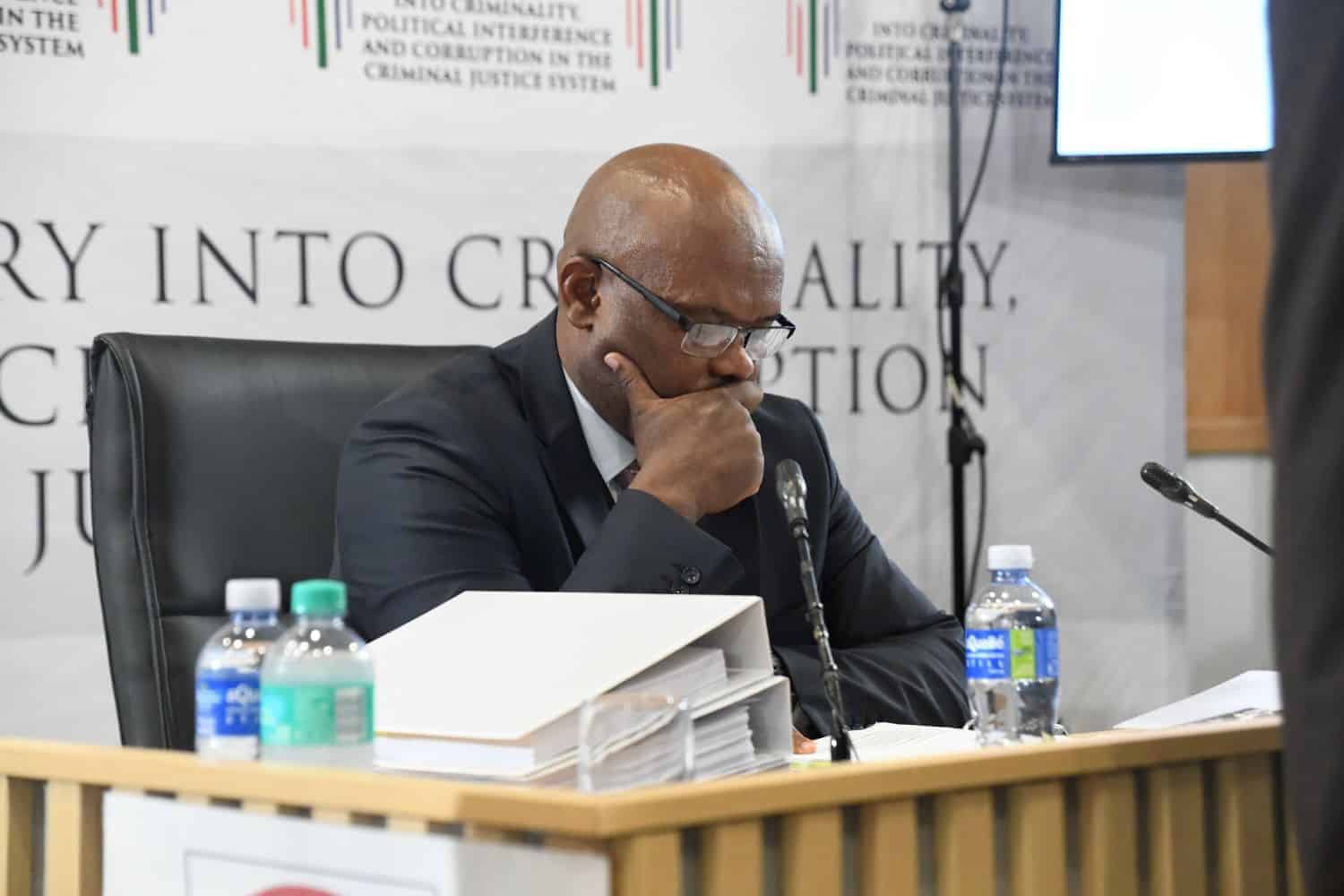
Suspended deputy national police commissioner Shadrack Sibiya says it is unfair that he is being blamed for the delays in the investigations of the dockets of the political killings task team (PKTT).
During his testimony in September last year, KwaZulu-Natal (KZN) police commissioner Nhlanhla Mkhwanazi told the Madlanga commission that on 26 March 2025, 118 ‘under investigation’ dockets investigated by the PKTT were handed over to Deputy National Commissioner for Crime Detection Lieutenant General Hilda Senthumule on Sibiya’s instruction.
On 10 April 2025, three additional dockets, still under investigation by the team, were handed over to the South African Police Service head office in Pretoria, also on Sibiya’s instruction, bringing the total to 121 dockets.
Mkhwanazi said no further investigation was conducted on the dockets while they were in Pretoria. No action was taken, even on those who were ready for arrest.
In November last year, Major-General Mary Motsepe, component head for serious and violent crime investigations, told the commission that she did not understand why the dockets could not be inspected in KZN if the plan was to eventually return them there.
Mkhwanazi’s response
While arrangements were being made to return the dockets to KZN, Mkhwanazi informed the head office he wanted nothing to do with them. This was because he was not informed when they were initially removed from the PKTT.
READ MORE: No arrests made on task team dockets despite instructions to do so – Mkhwanazi
Senthumule escalated Mkhwanazi’s answer to national police commissioner Fannie Masemola, who told her Sibiya should decide what to do with them.
“On 19 May, I was called by General Sinthumule to meet at General Sibiya’s office. General Sibiya said General Mkhwanazi refused the dockets and the national commissioner advised that he must use his discretion,” she said.
Sibiya informed Motsepe that the ball was now in her court, as political killings fall under her unit.
“I think what changed the process from just auditing to investigating was that General Mkhwanazi refused the dockets. I did put myself in General Mkhwanazi’s shoes. You can’t just take dockets and say it’s for auditing processes and then return them.”
Sibiya on dockets
On Friday, Sibiya told the commission that he viewed Masemola’s response that he should use his discretion in handling the dockets after Mkhwanazi rejected them in a “positive light”.
He blamed Mkhwanazi for rejecting the dockets, saying this was what caused all the confusion around them. He further denied being the one who issued the instruction to remove the dockets from KZN.
“There is no wrongdoing whatsoever that happened in the process. But the way I am being pushed into a certain corner, that says, is there an instruction that says the dockets must go to head office or not? I’ve never given such an instruction; it’s never happened that I said, ‘Take the dockets from head office to …’ They decided to take the dockets themselves to head office. Now it’s on my shoulder, and I’m the one who has to bear responsibility for why they left KZN to head office, when in fact I did not give such an instruction,” said Sibiya.
ALSO READ: Mkhwanazi: ‘Brown Mogotsi knew about task team disbandment and 121 dockets before me’
“Let us accept the fact that someone refused to accept or rejected the dockets. That part on its own was not a smart move either from the provincial commissioner, to reject.”
Masemola suspended Sibiya on 12 September 2025 on five charges of serious misconduct, all related to suspended Senzo Mchunu’s 31 December 2024 directive to disband the PKTT.
Among other things, he is accused of failing to comply with Masemola’s instruction to leave matters of the PKTT disbandment to the commissioner. Instead, Sibiya allegedly sent an instruction to Crime Intelligence head Dumisani Khumalo concerning the deactivation and disbandment of the PKTT.
‘Part of the process’
In his action plan on the PKTT disbandment, Sibiya instructed that the dockets be stored in a repository to be established by General Senthumule.
“The plan allowed General Senthumule to establish the repository anywhere in the country. It is only logical, then, that for as long as the dockets were stored in the repository, detectives could not access them as and when they wanted to. It must mean that during the period of storage, however short or long, investigations would be halted,” commented chair Mbuyiseli Madlanga.
Sibiya agreed with Madlanga’s assertions, despite his disbandment plan outlining measures to ensure that investigations would not be disrupted.
“Do you accept that this was meaningless because storage of the dockets automatically meant that investigations had to come to a halt, put differently, disruption of investigations was inevitable?: asked Madlanga.
“I don’t accept that,” said Sibiya.
“Considering the fact that these dockets were not meant to be withdrawn and stored, and nothing should happen further. It was meant for the handing over, and when the handing over is happening, those dockets that are in the process of being handed over are kept in a safe space where no one can say I don’t know what happened to that docket.
“As General Senthumule said, they were meant to be in transit back to KZN without any waste of time. They were meant to go back. The idea here was just that nothing falls between the cracks, and it doesn’t happen that we don’t know where the other dockets are.”
“If detectives did not have access to the dockets during this time, this would result in disruption, however long or short of the investigative process,” said Madlanga.
“It is correct, chair. Unfortunately, it is part of the process,” responded Sibiya.
‘There are explanations’
Further, Sibiya said, although he agreed with Madlanga that no investigation was conducted during their time in Pretoria, there was an explanation for this.
“I just want to say that the previous questions that the chair asked, I answered correctly, but there are explanations, chair,” he said.
“In the police, we lose members every day, every month, in terms of attrition. It is standard practice and a well-known fact that members get transferred, and some of them leave their dockets because they were assigned to the task teams.
“There is an A1 document that gives you the whole background of the case. Then you see the directive of the commander in red pen and other statements attached, so it’s a normal practice… It’s unfortunate how the system is built and how it works.”
NOW READ: Sibiya says directive to disband PKTT ‘not surprising’, Masemola knew it was coming
About the Author