Kim Jong Un has been reappointed as president of the State Affairs Commission, reaffirming his grip on power in North Korea following a vote by the country’s Supreme People’s Assembly, the nation’s parliament largely viewed as a ceremonial legislative body.
State media, Korean Central News Agency, reported on Monday that Kim was re-elected during the first session of the 15th Supreme People’s Assembly held on March 22, describing the decision as an expression of the “unanimous will” of the North Korean people.
According to the report, Kim’s reappointment places him once again at the helm of the country’s highest policymaking institution — the State Affairs Commission — which oversees major national decisions in politics, defence, and governance.
Political analysts, however, say the process follows a long-established pattern in which elections in North Korea are tightly controlled, with outcomes effectively determined before voting begins. Critics argue that such exercises are designed primarily to project institutional legitimacy for the ruling leadership rather than provide genuine electoral competition.
Kim, the third-generation leader of the isolated nuclear-armed state, inherited power in 2011 after the death of his father, Kim Jong Il. He is the grandson of Kim Il Sung, who founded the country in 1948.
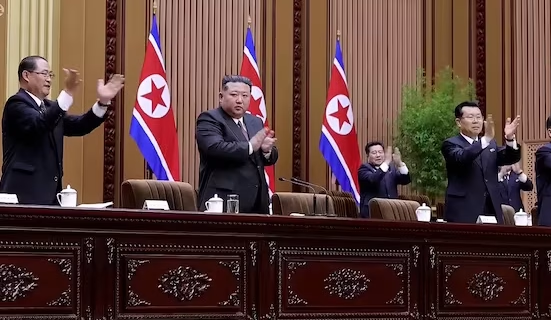
Photographs released by KCNA showed Kim dressed in a dark formal suit, seated prominently at the centre of the assembly hall, flanked by senior officials beneath large portraits of his father and grandfather — imagery widely interpreted as reinforcing dynastic continuity.
Before the session, 687 deputies were formally elected to the assembly, with voters reportedly offered a single candidate approved by the ruling party in each constituency. State media said turnout reached 99.99 percent, with 99.93 percent voting in favour of the approved candidates.
Analysts are also closely watching the current legislative session for possible constitutional changes, particularly around Pyongyang’s evolving position toward South Korea.
Observers suggest the assembly could formalise language framing inter-Korean relations as those between “two hostile states,” a move that would further harden diplomatic tensions on the Korean Peninsula.
Experts say the wording Kim uses in his policy address may offer key signals about North Korea’s future posture on territorial claims, military strategy, and relations with Seoul.
About the Author