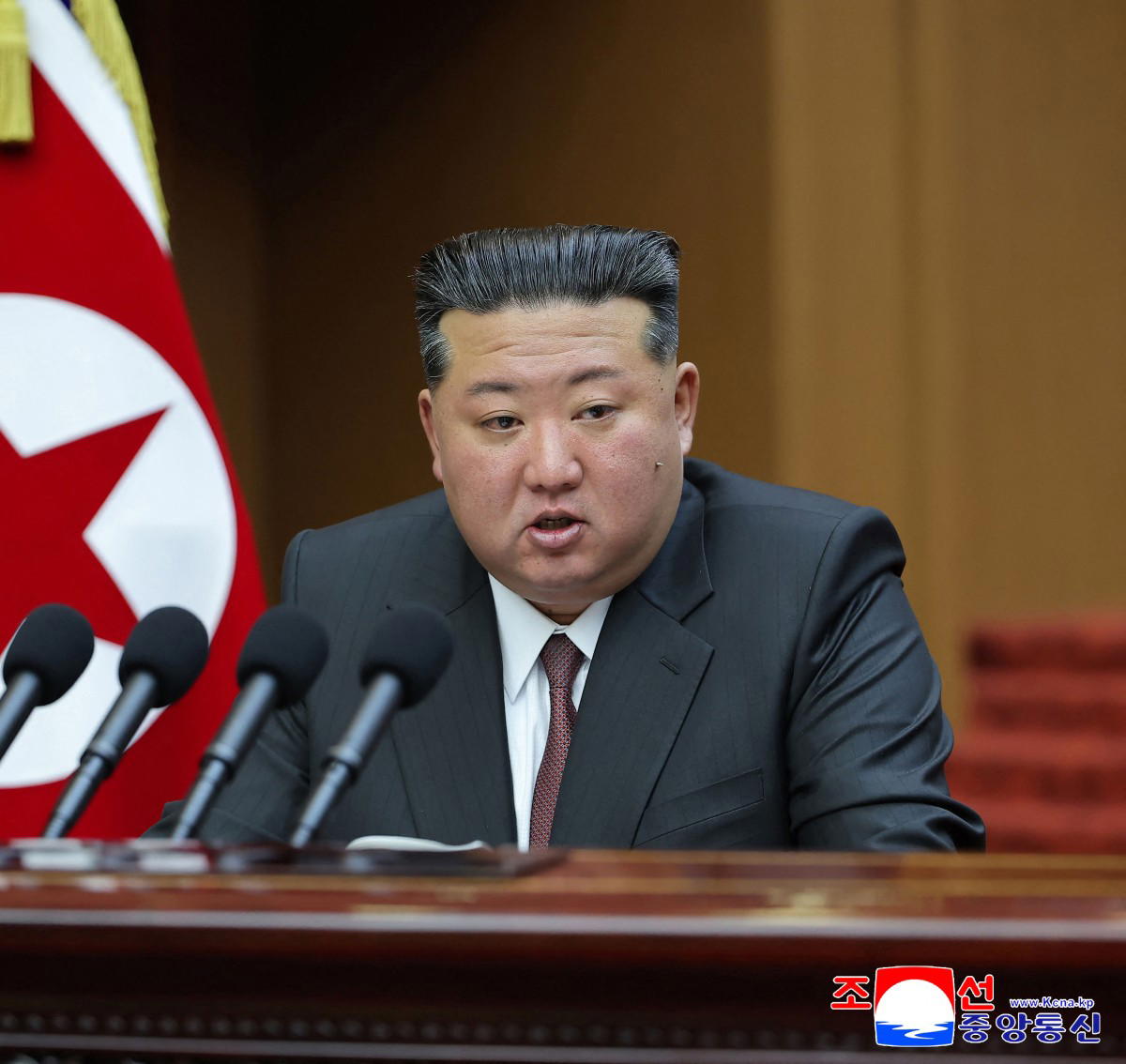
This picture taken on March 23, 2026 and released by North Korea's official Korean Central News Agency (KCNA) on March 24, 2026 shows North Korean leader Kim Jong Un delivering a policy speech at the First Session of the 15th Supreme People's Assembly at the Assembly Hall in Pyongyang. (Photo by KCNA VIA KNS / AFP) / South Korea OUT / ---EDITORS NOTE--- RESTRICTED TO EDITORIAL USE - MANDATORY CREDIT "AFP PHOTO/KCNA VIA KNS" - NO MARKETING NO ADVERTISING CAMPAIGNS - DISTRIBUTED AS A SERVICE TO CLIENTS THIS PICTURE WAS MADE AVAILABLE BY A THIRD PARTY. AFP CAN NOT INDEPENDENTLY VERIFY THE AUTHENTICITY, LOCATION, DATE AND CONTENT OF THIS IMAGE. /
North Korea tested weapon systems over three days this week, including the firing of ballistic missiles and cluster bombs, its state media said on Thursday.
A mobile short-range anti-aircraft missile system was also included in the tests, the Korean Central News Agency (KCNA) reported.
The trials took place Monday, Tuesday and Wednesday, as part of regular efforts to develop and upgrade weapons systems, KCNA said.
South Korea’s military reported earlier that North Korea had fired multiple short-range ballistic missiles in two rounds on Wednesday, and an “unidentified projectile” the previous day.
According to KCNA, the exercises “confirmed that the surface-to-surface tactical ballistic missile Hwasongpho-11 Ka tipped with the cluster bomb warhead can reduce to ashes any target covering an area of 6.5-7 hectares”.
Cluster munitions disperse dozens or even hundreds of smaller submunitions over a wide area, making them controversial because of the long-term risks they pose to civilians.
Also tested were an “electromagnetic weapon system” and “carbon fiber sham bombs scattering” that KCNA described as “special assets of strategic nature”.
The launches also involved the use of “low-cost materials” to examine the “maximum workload of the engine”, it added.
South Korea’s military said Wednesday a short-range missile fired in the second round of launches in the day flew more than 700 kilometres (434 miles).
It followed an earlier launch of multiple short-range ballistic missiles towards the East Sea — also known as the Sea of Japan — which flew around 240 kilometres.
North Korean leader Kim Jong Un was not reported to have attended the trials.
No photos of the launches have yet been released by official media.
– Deep frustrations –
Analysts said the launches, North Korea’s fourth and fifth known ballistic missile tests this year, signalled its latest rebuff of Seoul’s attempts to repair ties with the North.
Those included an expression of regret from Seoul on Monday over civilian drone incursions into the North in January.
The comments were initially described as “very fortunate and wise behaviour” by Kim Yo Jong, the powerful sister of North Korea’s leader.
But on Tuesday, a senior North Korean official described the South as “the enemy state most hostile” to Pyongyang, reviving a label previously used by leader Kim Jong Un.
The launches showed Pyongyang’s “deep-seated frustration” with Seoul despite the latter’s repeated overtures, Hong Tae-hwa, a fellow at the Foreign Policy Research Institute, told AFP.
“From the North’s perspective, Seoul’s reconciliatory overtures over the years — when they happened — delivered neither sanctions relief nor security guarantees,” he said.
“North Korea has little interest in direct dialogue with Seoul, at least for now.”