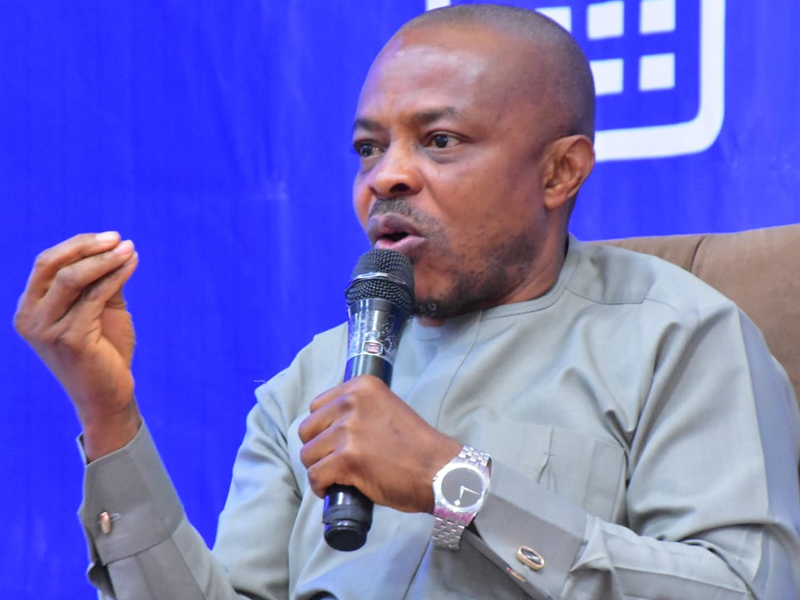
The President of the Nigeria Labour Congress (NLC) Joe Ajaero, at the weekend said Nigeria’s persistent electricity crisis stems from the absence of a coherent national roadmap for the power sector, arguing that no minister regardless of competence can significantly improve supply under the current system.
Speaking during a television interview on TVC, Ajaero maintained that the country’s electricity challenges are structural rather than individual, stressing that the system itself is “designed not to work.”
According to him, with generation capacity hovering around 4,000 megawatts, any minister can at best sustain output at that level but lacks the framework to expand it meaningfully.
Ajaero criticised the 2013 privatisation of the power sector, describing it as a process that transferred public assets to private investors without delivering corresponding improvements in infrastructure or service delivery. Instead, he alleged, it created opportunities for wealth accumulation by asset buyers while performance benchmarks remained weak.
“Well, I have been among the people who have criticised the minister once or twice. But it is not in a strict sense the problem of the minister. It’s a system that is designed not to work. So no matter what the minister does, the minister can at most, if the capacity being generated is 4,000 megawatts, he can take all measures to sustain it.
“But he can’t do anything beyond that. So when you have a sector that doesn’t have a conscious master plan on how it will work, then no matter the minister you bring, he will not do more than what is available,” he maintained.
Ajaero also identified over-reliance on gas-fired generation as a major vulnerability in Nigeria’s power mix. While acknowledging the country’s abundant gas resources, he said poor coordination and pricing challenges have limited its effective use for electricity generation.
He highlighted institutional conflicts between the ministries responsible for petroleum and power, arguing that both sectors are fundamentally linked and should be managed under a single authority.
According to him, such integration would eliminate policy conflicts and ensure that sufficient gas is allocated to electricity production, rather than being diverted primarily for export or other uses.
“In the gas-to-power projects, you have a problem now between the Minister of Petroleum and the Minister of Power. So ordinarily, anybody that understands energy economies or energy law will tell you that the two ministries are ministries of energy. So the two should be in one ministry.
“Yes, the Ministry of Energy, so that the minister there knows that we need a certain amount of gas for power. So it’s not a question between the Minister of Petroleum and the Minister of Power. But that one is not streamlined as we talk now,” he pointed out.
He pointed to rising electricity tariffs and mounting financial demands by operators as evidence of a flawed system, citing recent claims by generation companies for about N6 trillion in subsidy support.
The labour leader argued that the current structure allows operators to push for higher tariffs without commensurate improvements in output, leaving the government to shoulder increasing financial burdens to keep the system afloat.
Ajaero noted that power infrastructure requires years of planning and execution, warning that failure to begin projects today guarantees shortages in the future.
In contrast, he said Nigeria has failed to establish a pipeline of projects, even as new estates, industries, and households continue to increase pressure on an already constrained grid.
Beyond gas, Ajaero lamented the slow pace of development in alternative energy sources, including hydro and solar. He singled out the long-delayed Mambilla hydropower project, which has the potential to generate between 3,600 and 4,000 megawatts, roughly equivalent to Nigeria’s current output.
He also referenced the Zungeru hydropower plant, with a capacity of about 1,000 megawatts, noting that fully harnessing such projects could significantly boost national supply.
Even within the existing system, Ajaero pointed to serious infrastructure weaknesses, particularly in transmission and distribution. He said ageing and inadequate transformers, weak transmission lines, and poor maintenance practices often result in system collapses, even when power is generated.
He further criticised the lack of proper energy management, especially the failure to balance gas and hydro generation across seasons. Ideally, he explained, gas plants should be prioritised during dry seasons while hydro facilities are maximised during periods of high water levels.
Instead, he said, authorities often run both systems simultaneously to boost short-term generation figures, neglecting necessary maintenance and undermining long-term efficiency.
Ajaero warned that such practices not only strain existing infrastructure but also reduce the lifespan of power plants, further compounding the sector’s challenges.
“Even the ministers don’t understand what we call water management. During the dry season, you know, you can do a lot with the gas power stations. You fire them to the maximum. During the rainy season, you service some of the gas power stations and make use of the hydro stations while the water level is high.
“And you can maintain some level of equilibrium in this process. But this time around, you know, politically for them to say they are generating 5,000 megawatts, they fire both gas and hydro.
“And at the time they are supposed to service and do turnaround maintenance on gas plants, they will be firing it, so that they want to prove everybody wrong that they have 6,000 megawatts. So there is no plan on ground on how to sustain the power sector,” he emphasised.
According to the NLC, while the ruling class and their crony capitalist allies in the electricity Distribution Companies (Discos) and Generation Companies (Gencos) continue to feast on the commonwealth through phantom subsidy claims and outrageous tariff hikes, the Nigerian people are left to pay for darkness.
The NLC said there was the need for a holistic view of Nigeria’s energy assets, ensuring that gas, a national heritage, is rather than being flared or exported while Nigerians suffer in darkness.
“We demand that the government treat our energy as a unified whole, managed for the benefit of the many, not the greed of the few,” it said.
Emmanuel Addeh And Onyebuchi Ezigbo
About the Author