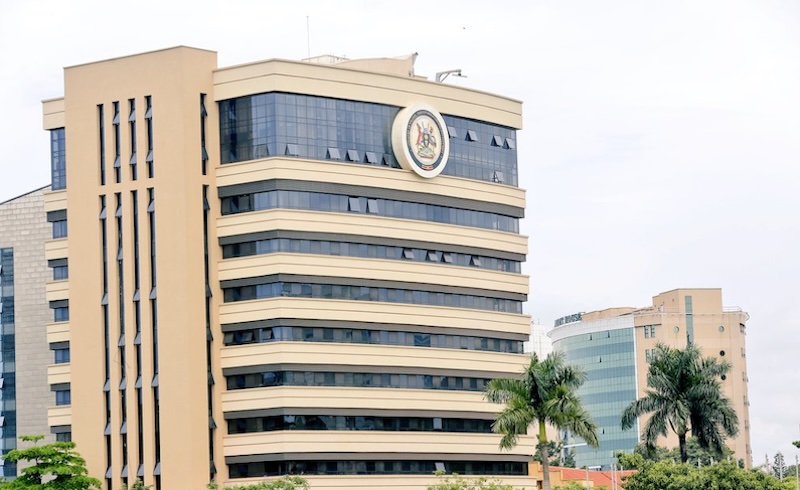
The Anti-Corruption court in Kampala has committed former Accountant General Lawrence Ssemakula and eight other officials to the High court for trial following fresh corruption charges sanctioned by the director of public prosecutions (DPP).
The DPP yesterday, Tuesday, brought additional charges against Ssemakula and the commissioner of treasury services, Jennifer Muhuruzi, alongside seven other officials from the ministry of Finance, Planning and Economic Development, for their alleged roles in manipulating the Finance ministry and Bank of Uganda payment systems, leading to a reported loss of about Shs 60 billion.
The prosecution, led by chief state attorney Richard Birivumbuka, informed the court, presided over by chief magistrate Peter Fred Lochomin, that police investigations are complete and requested that the accused be committed to the High court for trial.
Those committed are Lawrence Ssemakula, acting director of treasury services and asset management; Jennifer Muhuruzi, Paul Nkalubo Lumala, a systems IT officer; Deborah Dorothy Kusiima, a senior accountant in the treasury services department; Judith Ashaba, an accountant; Bettina Nayebare, a research assistant; Mark Kasiiku, an IT systems officer; Tonny Yawe, an IT senior officer; and Pedison Twesigomwe, assistant commissioner for accounts in the ministry of Finance.
The group was first charged in 2024 with 11 counts relating to corruption, abuse of office, and causing financial loss. On Tuesday, eight additional counts, including money laundering and electronic fraud, were read to them, bringing the total number of charges to 19.
According to the indictment filed before the Anti-Corruption Division, the charges stem from the alleged failure by the officials to institute effective safeguards for public funds, resulting in the loss of billions of shillings in government money.
The prosecution contends that the accused negligently failed to implement robust financial controls within the Accountant General’s office and the treasury services department, which manages government loan repayments under Vote 130.
The DPP intends to rely on evidence showing that Uganda’s loan repayments to the International Development Association (IDA) of the World Bank and the African Development Fund of the African Development Bank were fraudulently diverted.
Court documents indicate that on September 12 and 30, 2024, payments totalling more than $14 million intended for international lenders were instead diverted to foreign companies, including Roadway Company Limited in Tokyo, Japan, and MJS International in London, United Kingdom.
The prosecution alleges that electronic payment files generated through the Integrated Financial Management System (IFMS) were unlawfully altered before encryption and transmission to the Bank of Uganda.
It is alleged that Linux executable scripts were inserted into the system to change payee details from the intended beneficiaries to foreign entities. The DPP is expected to adduce forensic and IT audit reports, including findings that administrator-level access was used to manipulate payment files and that email communications from the Bank of Uganda meant for reconciliation were intercepted and altered to conceal the fraud.
Investigators further allege that email server logs were deliberately deleted to erase evidence of altered payment instructions and that false reconciliation reports were prepared to reflect the intended international lenders as beneficiaries instead of the actual recipients.
In one instance, the prosecution states that a previous attempt to divert more than $6.6 million to an entity in Poland was intercepted and blocked by the SWIFT messaging system after a complaint from the World Bank over non-payment of a due loan installment.
The DPP contends that despite receiving an internal inquiry report from the Bank of Uganda highlighting irregularities, Ssemakula and Muhuruzi failed to institute corrective measures or disciplinary action, allegedly allowing subsequent fraudulent transactions to occur.
According to the prosecution, Bank of Uganda managed to recover more than $8.2 million from one of the fraudulent transfers to MJS International. However, more than $6.1 million were allegedly paid to Roadway Company Limited, and an additional $391,720 remain unrecovered, forming part of the financial loss to the government.
Police preliminary investigations had earlier indicated that money mysteriously disappeared from the Bank of Uganda in September 2024 and ended up in foreign accounts in the United Kingdom and Asian countries such as Japan following manipulation of the Finance ministry and Central Bank systems.
Since then, the Criminal Investigations Directorate (CID), in collaboration with Defence Intelligence and Security (DIS), formerly the Chieftaincy of Military Intelligence (CMI), has interrogated several individuals from the Bank of Uganda, the ministry of Finance, and the Accountant General’s Office.
The Bank of Uganda money heist was initially described as a hacker’s attack, but this was later disproved by the CID’s Information and Communication Technology (ICT) team. After establishing that it was not an external hack but a well-orchestrated fraudulent payment scheme, President Yoweri Museveni directed DIS to join the probe.
By the end of 2024, at least 21 staff members from the Bank of Uganda, ministry of Finance, and the Accountant General’s Office had been interrogated. Their electronic devices, including mobile phones and laptops, were confiscated and subjected to forensic examination.
Through interactions with various sources, URN established that out of the Shs 60 billion, the Bank of Uganda managed to recover more than half through engagements with banks in the United Kingdom.
However, efforts to recover funds that were transferred to Asian countries were unsuccessful. Investigators are also pursuing a line of inquiry suggesting that some of the funds believed to have ended up in Asian countries may have been withdrawn and clandestinely returned to beneficiaries in Uganda in the form of cash or goods procured on their behalf.
About the Author