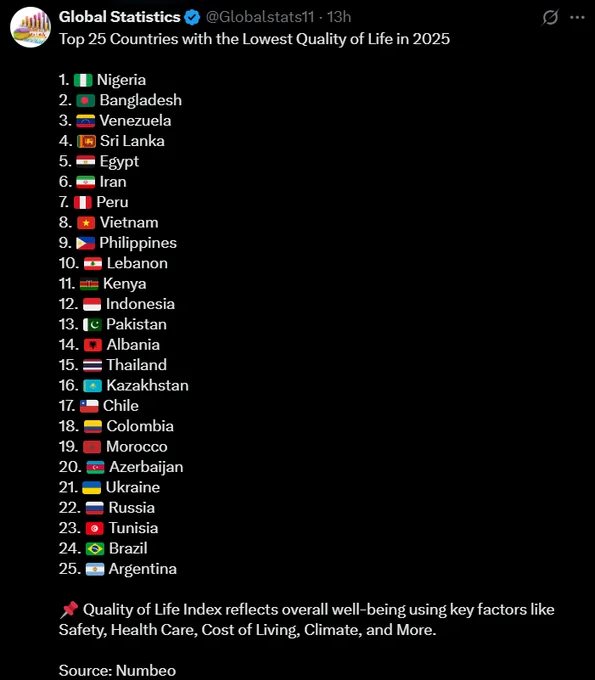
Nigeria has emerged at the very bottom of the 2025 Quality of Life Index, according to a new global ranking published by data platform Numbeo. The mid-year report evaluates living standards across multiple countries using indicators that reflect well-being, including public safety, healthcare access, living costs, environmental conditions and overall security.
Nigeria recorded an index rating of 15.6, placing it 89th out of 89 countries surveyed, the lowest score worldwide. Venezuela, ranked second-lowest at 88th, scored 58.1 points more, despite grappling with long-standing economic sanctions from the United States and persistent internal instability.
Several countries facing serious internal difficulties still ranked ahead of Nigeria. Bangladesh, which recently underwent a violent political transition that forced former Prime Minister Sheikh Hasina from power, registered 77 points. Sri Lanka followed with 82.8, while Egypt, at 83.2, completed the five lowest-performing nations.
The index arrives at a time when Nigerians are experiencing the effects of wide-ranging policy decisions introduced under President Bola Tinubu. These economic reforms were initially presented as measures to revitalise the country, but critics argue the policies have instead intensified hardship, pushing inflation higher and straining household living conditions. Security concerns have further compounded public anxiety, with a spike in violent incidents, including a heavily publicised attack on a church in Kwara State and the abduction of schoolgirls in Kebbi and Niger States just nine days apart.
In stark contrast, Luxembourg topped the global ranking with a score of 218.2, followed closely by the Netherlands (216.5) and Denmark, which trailed by just 1.4 points. Oman, Switzerland, Finland, Norway, Iceland, Austria and Germany rounded out the list of the ten countries offering the world’s highest quality of life.
About the Author